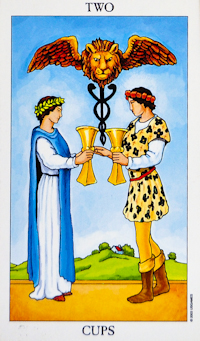
The Two of Cups at a Glance
- Core Meaning
-
Upright
Both people want the connection and respond to each other willingly.
ReversedThe connection is out of balance because the two people are no longer meeting each other halfway.
- Keywords
-
Upright
Mutual affection, partnership, attraction, reconciliation, agreement, reciprocity, shared commitment
ReversedUnequal attachment, disconnection, mistrust, incompatible expectations, unresolved conflict, one-sided effort, separation
- Love & Relationships
-
Upright
The attraction is mutual, and both people want to develop the relationship.
ReversedThe relationship is strained by unequal effort or different expectations of closeness.
- Career & Money
-
Upright
A cooperative partnership helps both people accomplish something they value.
ReversedThe partnership is weakened by unequal contributions or conflicting expectations.
- Health
-
Upright
A trusting relationship makes it easier to speak honestly and accept help.
ReversedYou feel misunderstood by someone whose support matters to you.
The Two of Cups Upright Meaning
The upright Two of Cups often appears when a connection is starting to form, or when an existing one is becoming more real. It might be a new romance, a friendship that suddenly feels easy and close, or a working relationship where both people clearly respect each other. What sets this connection apart isn't intensity. It's a sense of balance. Neither person is chasing the other, and neither is holding back to stay in control. You feel met.
That kind of reciprocity is worth noticing, because it's less common than it seems. In many relationships, one person does most of the reaching out, planning, or emotional work. The Two of Cups describes something more even. You text, and they reply with the same warmth. You share something personal, and they share something back. If this card shows up, it's worth recognizing when you've found this balance, and not taking it for granted just because it feels easy.
The card also encourages you to take the next honest step. Early connections often stall because both people are waiting for the other to say something first. Saying "I've really enjoyed getting to know you" or "I'd like to keep working with you on this" can turn a promising start into something steady. You don't need a grand declaration. Just let the other person know the feeling is mutual.
Reconciliation is another strong theme. If a friendship, family relationship, or partnership was damaged by misunderstanding or distance, this card suggests there may be a real chance to repair it now. The first step might be one simple message. Healing tends to happen when both people are willing, and this card suggests that willingness may be present on both sides.
In work and practical matters, the Two of Cups can point to a partnership, contract, or agreement that benefits everyone involved. It favors deals made in good faith, where each side understands what the other needs. If you're choosing a collaborator, pay attention to shared values, not just shared goals. People who want the same outcome for different reasons often clash later.
A connection like this is a beginning, not a guarantee. The card shows two people choosing each other today. What happens next depends on whether that give-and-take continues after the easy early stage is over.
Upright Love & Relationships
The attraction is mutual, and both people want to develop the relationship.
You do not have to interpret every small gesture to establish interest. They make contact, accept invitations, suggest plans, and show curiosity about your life. Your affection has somewhere to go because the other person responds.
In an established relationship, the card represents treating each other as partners. You discuss decisions, notice each other's needs, and make time for contact that is not limited to household duties.
After a disagreement, the Two of Cups signifies reconciliation through mutual willingness. Both people want to reconnect and take part in the repair.
Learn more about the Two of Cups in Love Upright
Upright Career & Money
A cooperative partnership helps both people accomplish something they value.
You find a colleague, client, or business partner who understands the proposal and wants to participate. Conversations produce agreements because both sides listen and can explain what they need.
The card favors work between people with complementary abilities. One handles something the other cannot, and each contribution receives proper acknowledgment.
With money, the Two of Cups represents a mutually accepted arrangement: agreed payment, shared costs, or an exchange both parties consider worthwhile. Put the terms into words so the goodwill has a practical basis.
Upright Health
A trusting relationship makes it easier to speak honestly and accept help.
The Two of Cups represents support from someone who listens to your experience and works with you rather than talking over you. You can explain what is difficult, ask a question without embarrassment, and say when a suggestion does not fit. A partner, friend, or care professional becomes a person you can communicate with openly, so asking for help no longer means surrendering your say.
Upright Advice
Approach the situation as something two people must agree to together.
Say what you want, ask what the other person wants, and listen to the answer. Look for a next step that both of you choose willingly.
Where someone has already shown genuine interest, respond. Accept the invitation, return the call, or acknowledge their effort. Reciprocity needs your participation as well as theirs.
Upright Yes or No
Yes. Interest is returned, and the card favors partnership, agreement, and reconciliation.
The Two of Cups Reversed Meaning
Reversed, the Two of Cups often shows a connection that has lost its balance. The exchange that once felt equal has tilted. One person now does most of the reaching out, apologizing, or adjusting, while the other seems less present. It may not be dramatic. It might look like shorter replies, cancelled plans, or conversations where you notice that you're asking all the questions. Over time, the person giving more usually starts to feel tired, unsure, or quietly resentful.
The card asks you to look honestly at the balance. It helps to set feelings aside for a moment and look at what's actually happening. Who starts contact? Who makes plans? Who changes their schedule to fit the other's? The answers are often clearer than the feelings. If the imbalance is real, it's worth saying so directly and calmly before resentment grows too strong to talk about.
Miscommunication is a common theme. Two people can care about each other and still misunderstand what the other needs. One wants reassurance while the other wants space. One sees a comment as honest while the other hears it as criticism. Small misunderstandings that never get cleared up can build into distance neither person meant to create. A simple question like "What do you need from me right now?" can prevent a lot of hurt.
Sometimes the reversal points to broken trust. That might mean a broken promise, a secret coming out, or a moment when one person didn't show up when it counted. Repair may be possible, but it takes more than an apology. It takes consistent behavior over time. If trust is shaken, the card suggests watching what happens over the following weeks rather than deciding everything based on one conversation.
In work and business, this reversal can point to a partnership that's struggling, a contract dispute, or a collaboration where the two sides want different things. It's better to address these issues early and put agreements in writing when you can.
Sometimes the card also points inward. If you've been giving so much to others that you've lost touch with what you need, the imbalance may be with yourself. A healthy connection with another person usually starts with treating your own needs as worth meeting.
Finally, this card can describe a relationship that's simply ending. When that happens, it doesn't mean either person failed. Sometimes two people grow in different directions, and the most honest choice is to recognize that the exchange is over.
Effort That Is Not Returned
One person initiates, listens, apologizes, and arranges everything. The connection continues because they keep supplying what the other no longer contributes.
Agreement on the Surface
You avoid expressing a difference because you fear losing the connection. Outward agreement conceals expectations that have never been discussed honestly.
Making Closeness Conditional
Affection becomes a reward for compliance. Someone withdraws warmth to obtain an apology, concession, or proof of loyalty instead of addressing the disagreement directly.
Reversed Love & Relationships
The relationship is strained by unequal effort or different expectations of closeness.
You want time together while your partner keeps creating distance, or one person seeks commitment while the other wants a less involved arrangement. The difficulty is not solved by acting as though both want the same thing.
For an established couple, affection is interrupted by unresolved arguments. You talk about the practical details of life but avoid the subject that keeps separating you.
Repair begins with an honest answer from each person about what they want and what they are willing to contribute. Repeated reassurance without changed behavior leaves the imbalance intact.
Learn more about the Two of Cups Reversed in Love
Reversed Career & Money
The partnership is weakened by unequal contributions or conflicting expectations.
One person delivers while the other delays, or each assumes the other is responsible for an unfinished task. Friendly conversation no longer compensates for a working arrangement that is failing.
A client and provider disagree about what the price includes. Partners want different outcomes but continue discussing the project as though their goals are shared.
With money, review contributions, payment, and obligations directly. A fair agreement needs both parties to understand and accept the same terms.
Reversed Health
You feel misunderstood by someone whose support matters to you.
You explain what you need and receive a different kind of help, or your concerns are brushed aside before you finish speaking. Frustration makes you less willing to ask again, and the distance grows. The reversed Two of Cups calls for a direct conversation about what useful support looks like, including what you want the other person to stop assuming or deciding for you.
Reversed Advice
Stop compensating for an imbalance that needs to be addressed openly.
Identify what is unequal: contact, effort, money, responsibility, or commitment. Discuss that specific issue instead of trying to solve it by giving more.
Ask for a clear response and observe what follows. If the other person does not want to participate, stop treating the connection as a shared undertaking.
Reversed Yes or No
No to the current arrangement. Unequal effort or conflicting expectations prevent a mutual agreement.
Contextual Readings for the Two of Cups
Two of Cups as Feelings - Upright
This person feels affection and wants the closeness between you to be mutual.
They enjoy being with you, care about how you feel, and want to know that their interest is welcome. Your response matters to them because they are seeking a connection, not simply an audience.
Their feelings include a wish to share: time, conversation, affection, and experiences. They see you as someone they want beside them.
Two of Cups as Feelings - Reversed
This person feels disconnected from you or uneasy about the balance between you.
They feel that something important is not being returned or understood. Affection is complicated by disappointment, resentment, or uncertainty about whether you want the same relationship.
The card also describes interest that has become unequal. The decisive question is whether they still want to restore closeness and are willing to take part in doing so.
Two of Cups as Intentions - Upright
This person intends to develop the connection through mutual contact and agreement.
They want to meet, express affection, discuss the relationship, or make a plan you both accept. They are interested in your response and prepared to contribute their own time and effort.
After a disagreement, their intention is reconciliation. They want a conversation that brings you back into a workable relationship rather than merely ending the argument.
Two of Cups as Intentions - Reversed
This person is not ready to make the mutual agreement the relationship needs.
They avoid defining what they want, resist a proposed commitment, or continue contact without addressing the difference between your expectations. Their participation does not match the arrangement you are seeking.
In an existing dispute, they remain focused on their own position rather than restoring cooperation. An intention to keep talking does not resolve an unwillingness to agree.
Two of Cups as an Outcome - Upright
Both people choose the connection, and a mutual relationship or agreement takes shape.
An invitation is accepted, affection is returned, or a disagreement ends in sincere reconciliation. You reach an understanding that both people want to honor. The result is shared participation: each of you knows the other is choosing to be there.
Two of Cups as an Outcome - Reversed
The two people do not reach the mutual understanding needed to continue as hoped.
One person wants a relationship or agreement the other does not accept, or unresolved conflict keeps them apart. The effort remains unequal, and further discussion repeats the same difference. The result exposes what cannot be sustained by one person's willingness alone.
Two of Cups in the Future - Upright
A meeting or conversation brings a willing partner into the picture.
You encounter someone who returns your interest, find a collaborator who wants the same undertaking, or reconnect with a person ready to resolve an old disagreement.
The opportunity develops through an exchange. Speak clearly, respond to their effort, and establish what you are choosing together.
Two of Cups in the Future - Reversed
A difference in expectations brings tension to a relationship or partnership.
You discover that the other person wants a different level of involvement, or an existing imbalance becomes too noticeable to ignore. Plans stall because agreement has been assumed rather than established.
Address the difference directly. Continuing without discussing it leaves each person expecting something the other has not promised.
The Two of Cups Symbolism
Two of Cups. The man and woman are exchanging cups to demonstrate the law of give and take. This is also the symbol of the duality of creation. The winged lion above the caduceus is a composite symbol meaning, 'The adept who has power to interpret to others knowledge of the higher worlds." The woman is dressed in white with a blue outer robe to show the purity underlying the soul or subconscious. The man's costume has a yellow background which stands for consciousness and is decorated with trefoils symbolizing the trinity. The house in the background represents the creativity of humanity or the united effort of male and female.
The Two of Cups as a Birth Tarot Card
The Two of Cups corresponds to the numerology number 42/6. If your Life Path Number is 42, the Two of Cups is your Birth Tarot Card, reflecting your life's lessons, strengths, and challenges.
The Two of Cups as an Attitude Card
If your Attitude Number is 42/6, the Two of Cups is its corresponding tarot card. In this position, it describes how you approach new situations, respond to everyday life, and come across to others.