What Does the Suit of Swords Represent?
Swords represent the mind's power to distinguish one thing from another. They describe thought, analysis, communication, belief, strategy and decision. When Swords appear in a Tarot reading, the central issue often concerns how a situation is being understood, what has been said and which judgment is directing the action.
A sword can cut through confusion and reveal the truth, but it can also divide, threaten and injure. The same intellectual power that creates clarity can produce conflict when it becomes rigid, hostile or disconnected from feeling and physical reality.
This is why the Suit of Swords contains many difficult images. Thought does not remain abstract. Beliefs influence choices, words alter relationships and repeated fears can become conditions through which a person experiences the world.
The 14 Swords Tarot Cards
The Suit of Swords contains ten numbered cards and four court cards:
 King of Swords
 Queen of Swords
 Knight of Swords
 Page of Swords
 Ace of Swords
 Two of Swords
 Three of Swords
 Four of Swords
 Five of Swords
 Six of Swords
 Seven of Swords
 Eight of Swords
 Nine of Swords
 Ten of Swords
Select any Swords card to study its individual imagery, structure and meaning.
Swords as the Element of Air
Air is invisible, mobile and necessary for communication. It carries sound, connects separate spaces and allows ideas to move between people. Within the Minor Arcana, this makes Swords the suit of intellect, language and mental activity.
The mind organizes experience by naming, comparing and separating. This ability makes reason and conscious choice possible, but it can also create division. Once a person identifies one position as correct, every opposing position may be treated as a threat.
When air moves freely, thought remains flexible and communication allows understanding. When air becomes turbulent, the result may be argument, anxiety or rapidly escalating conflict. When movement stops, a person may become mentally trapped, unable to decide or unwilling to consider another interpretation.
The condition of the air is therefore central to interpreting a Swords card. The card may show insight, indecision, painful truth, strategy, transition, fear or the final collapse of an established mental position.
The Numbered Swords Sequence
The numbered Swords cards trace the development of thought from its first clear formulation to the exhaustion of a mental pattern.
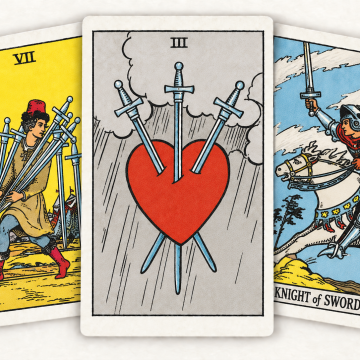
The Ace of Swords contains the concentrated potential of air: clarity, truth and the power to form a definite judgment. The Two of Swords introduces opposing positions and the inability or refusal to choose between them. The Three of Swords shows division becoming emotionally painful through separation, rejection or a truth that cannot be avoided.
The Four of Swords withdraws from conflict and creates a necessary period of rest, recovery or mental stillness. The Five of Swords returns to conflict and questions the value of a victory gained through humiliation, hostility or unequal force.
The Six of Swords moves away from turbulence and begins a difficult transition toward a different mental or physical condition. The Seven of Swords uses strategy, concealment or indirect action to avoid open confrontation.
The Eight of Swords shows thought becoming a structure of confinement. Restrictions may be real, but fear and limited perception make the available movement difficult to recognize. The Nine of Swords brings conflict inward as anxiety, guilt and repetitive thought that continues when no external action is taking place.
The Ten of Swords brings the mental sequence to a definitive ending. A position, belief or conflict has reached the point at which it can no longer continue in its existing form. The ending may be painful, but it also prevents the exhausted pattern from being endlessly prolonged.
The Swords Court Cards
The Swords court cards personify different ways in which air can be observed, pursued, embodied and governed.
The Page of Swords discovers air. The Page represents curiosity, observation, questioning and the collection of information before a complete judgment has been formed.
The Knight of Swords pursues air. The Knight acts directly upon an idea or conclusion and moves with speed and determination. This energy can be courageous and decisive, but it may become aggressive when action outruns understanding.
The Queen of Swords embodies air as clear perception and independent judgment. She separates fact from sentiment without denying the experience that produced her understanding. Her authority comes from discernment and the willingness to recognize what is true.
The King of Swords governs air. He represents intellectual order, law, strategy and the authority to make decisions according to established principles. His power depends upon impartial judgment, but it can become cold or oppressive when reason is separated from humanity.
A Swords court card may describe a person, but it can also identify a role, mental attitude or level at which the air element is operating.
Swords in a Tarot Reading
A strong presence of Swords indicates that thought, communication or conflict is directing the situation. The outcome may depend upon a conversation, decision, legal matter, strategy or interpretation of events.
Swords answer questions such as:
- What conclusion is controlling the situation?
- Which facts are known, and which are being assumed?
- What has been communicated or deliberately withheld?
- Is the conflict necessary, avoidable or already exhausted?
- Is the mind revealing a problem or continually recreating it?
- What decision can no longer be postponed?
Few Swords may indicate that facts, communication or careful judgment are being neglected. Many Swords can show intelligence and strategic focus, but they may also reveal hostility, fear, excessive analysis or an environment in which every difference becomes a conflict.
Swords with the Other Tarot Suits
Swords describe thought and judgment, while the other suits show what motivates, receives or gives substance to those conclusions.
With Wands, air interacts with fire and will. Thought may give action a clear strategy, or words and intentions may intensify conflict.
With Cups, air encounters feeling and relationship. Communication may clarify emotion, but intellectual judgment can also wound, suppress or misinterpret what another person feels.
With Pentacles, air enters material conditions. A plan must be tested against available resources, physical limitations and practical consequences.
When a Sword appears with a Major Arcana card, the Major Arcana identifies the broader principle while the Sword shows how that principle is being understood, communicated or contested.
Upright and Reversed Swords Meanings
An upright Swords card generally shows air expressing itself directly. The card may indicate truth, decision, communication, strategy or conflict. An upright position does not make every Sword favorable; anxiety, division and painful endings are also direct expressions of the mental element.
A reversed Swords card may indicate confused thinking, misinformation, withheld communication or a judgment that cannot be acted upon. It can show conflict occurring indirectly, thoughts turned inward or an attempt to avoid a truth that remains active beneath the surface.
Reversal may also indicate that mental pressure is beginning to release. A conflict may be losing its force, a limiting belief may be questioned or a period of anxiety may be approaching resolution. The card's number and surrounding cards determine whether the air needs to be clarified, expressed, redirected or allowed to become still.