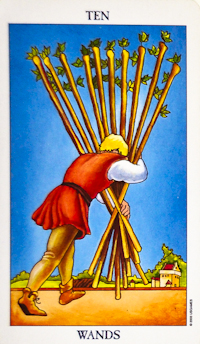
The Ten of Wands at a Glance
- Core Meaning
-
Upright
You are carrying more responsibility than you can comfortably sustain.
ReversedThe load needs to be reduced, shared, or reconsidered before more responsibilities are dropped.
- Keywords
-
Upright
Overload, responsibility, obligation, hard work, unequal workload, completion, the cost of success
ReversedDelegation, release, reduced commitments, refusal of help, dropped responsibilities, unsustainable workload, resentment
- Love & Relationships
-
Upright
Responsibilities are taking up more space than companionship, or one partner is carrying too much.
ReversedThe relationship needs a fairer division of responsibility or a decision about what can no longer continue.
- Career & Money
-
Upright
Your workload or financial commitments have grown beyond what is manageable.
ReversedWork or financial pressure can ease when commitments are reduced and responsibility is reassigned.
- Health
-
Upright
Daily obligations may be crowding out time for rest and care.
ReversedReducing your workload may require giving up duties you have continued out of habit or guilt.
The Ten of Wands Upright Meaning
The upright Ten of Wands often describes the point where being dependable starts to hurt. You're still getting things done, and on the surface you may even seem successful, but every day feels heavier than it should. You wake up already behind, and small requests feel like the last straw. You may also notice you can't remember the last time you did something just because you wanted to.
The load often builds without you noticing. You agreed to one extra task because it made sense, then another because nobody else stepped in, then a third because you were already involved. Over time, people began assuming you would handle it. Now the pile belongs to you, even though you never chose all of it at once.
Part of what makes this card hard is that putting things down can feel worse than carrying them. You might feel guilty for letting people down, worry that nobody else will do it right, or feel uneasy about who you are if you aren't the one holding everything together. "It's faster if I just do it myself" is a common thought here. That may be true for any single task, but it usually isn't true for all of them together.
A practical step is to go through what you're carrying and sort it honestly. Some things truly belong to you and need to be done. Some belong to other people and ended up with you by accident. Some could wait a month and nothing bad would happen. Some you could stop doing altogether. Even handing off one or two items can make a real difference.
The card also carries some hope. In the traditional image, the town is visible ahead, so the load isn't meant to last forever. This may be the heavy final stretch of something that will end: a busy season, a big move, or a project close to finishing. If so, focus on getting there without breaking down on the way. And if the load doesn't have an end in sight, that's worth noticing too, because it suggests your life may need a larger change.
Upright Love & Relationships
Responsibilities are taking up more space than companionship, or one partner is carrying too much.
You may be managing bills, appointments, household work, and difficult conversations while your partner waits to be asked. The burden includes remembering what needs doing, not just completing individual tasks.
For some couples, the workload is shared but unusually heavy. A move, a new household, or demanding jobs can leave both people tired and with little time together.
The relationship needs an honest discussion about responsibilities. Affection can remain present while the daily arrangement becomes exhausting.
Learn more about the Ten of Wands in Love Upright
Upright Career & Money
Your workload or financial commitments have grown beyond what is manageable.
A promotion may add responsibilities without removing your previous duties. A business may gain customers while every sale still depends on your personal attention. You are producing results, but the arrangement requires too much of you.
Define what each new commitment replaces. If nothing can be removed, the deadline, staffing, or scope needs adjustment.
With money, several obligations may consume your income before you can use it elsewhere. List the full set of payments and costs rather than evaluating each one as though it were your only expense.
Upright Health
Daily obligations may be crowding out time for rest and care.
In a symbolic health reading, the Ten of Wands concerns the practical difficulty of caring for yourself when work, household duties, and other people's needs fill the day. You may keep postponing an appointment or return to tasks whenever you try to rest. Identify what must be covered so that care can actually happen. The card does not diagnose a condition or establish that workload is the cause of a symptom.
Upright Advice
Review the whole workload and decide what must be finished, shared, delayed, or removed.
Start with your actual commitments, including the small recurring tasks that are easy to overlook. Identify what belongs to you and what you have absorbed because someone else did not handle it.
If this is a temporary final effort, define the endpoint. If the demands are ongoing, negotiate a sustainable arrangement before agreeing to more.
Upright Yes or No
Yes, but at a considerable cost in effort. Check whether the result is worth the responsibility it brings.
The Ten of Wands Reversed Meaning
Reversed, the Ten of Wands is often about what happens when the load finally comes off. There are two very different ways that can happen, and the card asks you to notice which one is happening to you.
The first is choosing to put things down. You hand the project to a colleague, tell your family you won't host this year, or quit the committee you joined out of guilt. It can feel uncomfortable, and some people may be disappointed, but there's also a strong sense of relief. You can think clearly again. You might sleep better, laugh more, and remember what you actually enjoy. When the reversal shows this, it supports your choice. Setting down responsibilities that weren't yours to carry isn't selfish. It's a correction.
The second way is dropping everything because you can't keep going. That might mean missing deadlines, cancelling plans at the last minute, or having a sudden health problem or emotional breakdown that forces you to stop. This is still a kind of release, but it's messier, and other people may be caught off guard. If this is where you are, focus first on recovering, then go back and sort out what needs to be picked up again and what can stay down for good.
The reversal can also point to the opposite of overload: avoiding responsibility. Someone may be dodging tasks that really are theirs and leaving others to handle them, or they may be afraid to commit to anything because the last time was too much. After burnout, it's understandable to be cautious. Still, refusing all responsibility can slowly make life feel smaller.
Sometimes the reversed Ten of Wands points to a hidden burden, something heavy that nobody else can see. It might be worry about money, a secret, or caring for someone in private. If that sounds familiar, the card suggests telling at least one person. You don't have to hand over the whole load, but letting someone know it's there can make it easier to carry.
More Work Than Time
Essential tasks compete for the same limited hours. Even careful planning cannot make the workload fit without removing, delaying, or sharing something.
Carrying It Without Telling Anyone
You keep saying that you will manage while privately feeling overwhelmed. Others see completed tasks and do not realize what completing them is costing you.
Making Yourself Indispensable
You insist on handling everything, then resent others for depending on you. Refusing handoffs or accepting only your own method keeps the workload concentrated in your hands.
Reversed Love & Relationships
The relationship needs a fairer division of responsibility or a decision about what can no longer continue.
One partner may finally ask for help, stop covering every gap, or refuse a role they never agreed to carry indefinitely. Relief becomes possible when the other person takes responsibility without needing constant reminders.
Alternatively, resentment may lead someone to withdraw and leave tasks unfinished without explaining why. The imbalance then becomes another argument instead of a problem being addressed.
Sometimes the card describes ending a relationship that has become an obligation. It does not establish infidelity or abuse; it asks you to assess the actual workload, conduct, and willingness to change.
Learn more about the Ten of Wands Reversed in Love
Reversed Career & Money
Work or financial pressure can ease when commitments are reduced and responsibility is reassigned.
You may hand over a recurring task, narrow a project, leave an unmanageable role, or stop providing work outside an agreement. A useful handoff includes the authority and information the other person needs to complete it.
The less constructive version is work being dropped without warning or transferred to someone who is already overloaded. Moving the burden does not resolve it unless the new arrangement is workable.
With money, review which obligations can be renegotiated or ended. Avoid accepting another commitment on the assumption that you will somehow find room for it later.
Reversed Health
Reducing your workload may require giving up duties you have continued out of habit or guilt.
You may have been told to rest while still being expected to cook, answer work messages, or organize everything at home. Rest remains difficult until those responsibilities are assigned elsewhere or allowed to wait. Ask for a specific task to be taken over rather than a general offer of help, and discuss persistent symptoms or limitations with your clinician. You do not need to demonstrate complete exhaustion before explaining what you cannot manage.
Reversed Advice
Let go of a specific responsibility and make the handoff clear.
Choose something that does not require your continued involvement. Explain what needs doing, provide the necessary information, and allow the other person to carry it through without taking it back at the first difference in approach.
If no one can take it over, decide whether it can be simplified, postponed, or stopped. A task cannot remain essential forever while no one has the capacity to do it.
Reversed Yes or No
Not as currently arranged. Reduce or share the burden before committing to more.
Contextual Readings for the Ten of Wands
Ten of Wands as Feelings - Upright
This person may feel that the connection comes with responsibilities they are struggling to manage.
They could care about you while feeling overwhelmed by what they believe is expected of them. Contact may become another task to fit into an already crowded day, especially if other obligations are demanding.
The card can also describe someone who feels solely responsible for keeping the relationship going. It does not measure affection; it shows how effort and obligation are affecting their experience.
Ten of Wands as Feelings - Reversed
This person may feel relieved by reduced pressure or resentful about carrying too much.
They could want a simpler way of being together, with fewer demands and more shared responsibility. An honest change in expectations may allow them to feel more comfortable.
If nothing changes, they may feel increasingly unwilling to keep making the same effort. Notice whether they explain what needs to be different or simply stop participating.
Ten of Wands as Intentions - Upright
This person intends to fulfill an obligation, even though the effort may be difficult to sustain.
They may keep an agreement, manage practical matters, or continue supporting the relationship because they take their responsibility seriously. Their plans may leave little room for additional commitments.
Reliable effort can matter, but accepting every duty does not establish enthusiasm or long-term capacity. Look at what they have actually agreed to and whether the arrangement is shared.
Ten of Wands as Intentions - Reversed
This person intends to reduce their involvement, ask for help, or step away from a responsibility.
They may propose a fairer arrangement, decline something extra, or end an obligation they can no longer carry. A clear conversation allows both people to understand what changes.
Alternatively, they may avoid the handoff and leave you to discover that they are no longer doing their part. The distinction is whether they communicate the change and address its consequences.
Ten of Wands as an Outcome - Upright
The goal may be completed, but the result leaves a demanding workload to manage.
You may deliver the project, obtain the role, or carry an arrangement through because you accept much of the responsibility. Completion is possible, though it may bring less relief than expected.
The outcome asks you to consider maintenance as well as achievement. What you obtain must fit into your life after the initial effort ends.
Ten of Wands as an Outcome - Reversed
The burden may be reduced, or parts of the commitment may remain unfinished.
A revised agreement, a successful handoff, or a deliberate ending can create relief. The result improves when everyone knows which duties continue and who will handle them.
If the workload is left unchanged, tasks may be abandoned because there is no capacity to complete them. That outcome requires addressing the excess commitments rather than merely assigning blame.
Ten of Wands in the Future - Upright
An upcoming commitment may add more work than its initial description suggests.
A role, project, or shared arrangement could bring recurring duties that have not yet been discussed. Before agreeing, ask about the full workload and what support is available.
You may also face a demanding period of completion. Identify its endpoint and avoid adding unrelated commitments while the essential work is still underway.
Ten of Wands in the Future - Reversed
You may have an opportunity - or a practical need - to reduce what you are carrying.
A responsibility could end, someone may become available to help, or an agreement may be renegotiated. Prepare a clear handoff so the change produces lasting relief.
If you keep accepting more without removing anything, missed tasks may force the issue later. Discuss capacity while there is still time to choose what changes.
The Ten of Wands Symbolism
Ten of Wands. This key represents the binding of one's forces to preserve and protect them. Spiritual forces, if used as a spiritual fence between the individual and the affairs of earth, serve to blind one and lead to an attempt to escape from the discipline of matter before its lessons are learned. Thus, it is not advancement but rather represents arrested development. The lesson of this key is to guard against the repression of energy and force and use it instead for invention and upliftment.
The Ten of Wands as a Birth Tarot Card
The Ten of Wands corresponds to the numerology number 36/9. If your Life Path Number is 36, the Ten of Wands is your Birth Tarot Card, reflecting your life's lessons, strengths, and challenges.
The Ten of Wands as an Attitude Card
If your Attitude Number is 36/9, the Ten of Wands is its corresponding tarot card. In this position, it describes how you approach new situations, respond to everyday life, and come across to others.