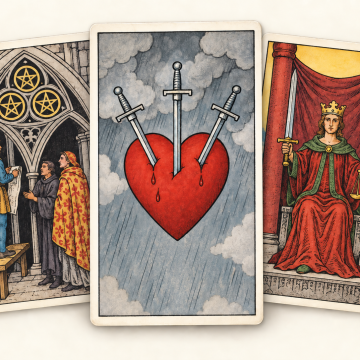
Explore All 78 Tarot Card Meanings
A traditional Tarot deck contains 78 cards divided into the Major Arcana and Minor Arcana. Begin with either part of the deck to explore its cards, symbolism and meanings.
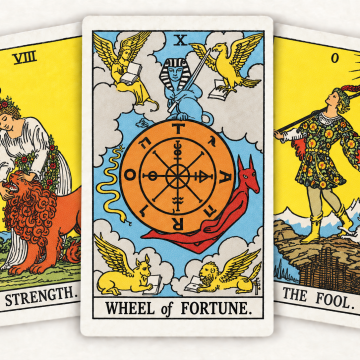
The Major Arcana are the 22 unsuited cards that form the symbolic foundation of the Tarot deck, beginning with The Fool and ending with The World. Each card represents a distinct principle, stage of consciousness or transformative force that can shape the meaning of an entire reading.
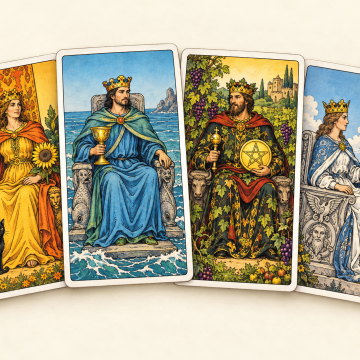
The Minor Arcana comprise 56 Tarot cards divided into four suits: Wands, Cups, Swords and Pentacles. Their suits, numbers and court ranks describe how the greater forces of the Tarot take form through thought, emotion, desire, action, relationships and material circumstances.
What Is Tarot?
Tarot is a structured symbolic system expressed through a deck of 78 illustrated cards. Each card combines imagery, number, color and elemental symbolism. During a reading, these symbols are interpreted in relation to the question, the card's position and the other cards surrounding it.
The deck is divided into the 22 Major Arcana and the 56 Minor Arcana. The Major Arcana establishes the central archetypal sequence of the Tarot, while the Minor Arcana brings those principles into ordinary experiences involving action, emotion, thought, relationships, work and material circumstances.
A Tarot card may describe an active influence, a developing condition, an internal attitude, a person or a possible direction. Its meaning becomes more precise when considered as part of the complete reading.
The Four Suits of the Minor Arcana
The Minor Arcana is divided into four elemental suits. Each suit contains ten numbered cards and four court cards: Page, Knight, Queen and King. The suit identifies the area of experience, while the card's number or rank shows how that energy is developing or being expressed.
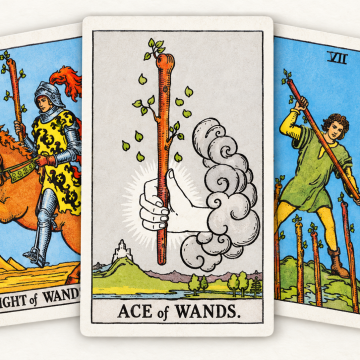
The Suit of Wands contains 14 Minor Arcana cards associated with fire, will, desire and directed action. From the first impulse of the Ace to the authority of the King, Wands show how inner motivation becomes movement, enterprise, creation and visible change.
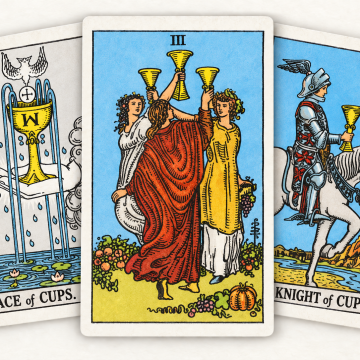
The Suit of Cups contains 14 Minor Arcana cards associated with water, imagination, emotion and relationship. From the first opening of the Ace to the emotional command of the King, Cups show how inner images and feelings are received, shared, pursued, tested and brought into conscious form.
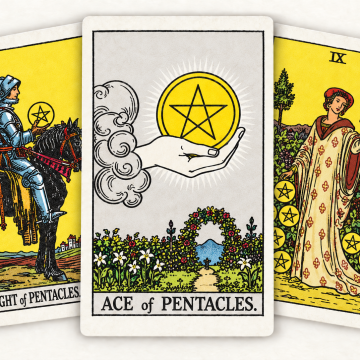
The Suit of Pentacles contains 14 Minor Arcana cards associated with earth, the body, labor, resources and material form. From the tangible potential of the Ace to the established authority of the King, Pentacles show how an intention acquires substance and becomes something that must be built, maintained, exchanged or protected.
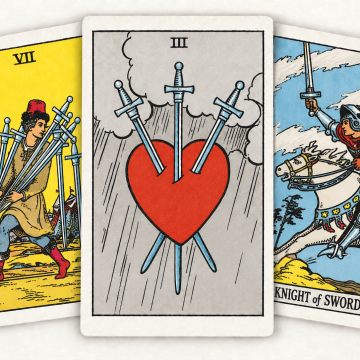
The Suit of Swords contains 14 Minor Arcana cards associated with air, thought, language and judgment. From the first clarity of the Ace to the intellectual authority of the King, Swords show how the mind perceives, separates, decides and confronts the consequences of its own conclusions.
Browse Every Tarot Card
Select a category to browse all 78 Tarot cards and open the complete meaning of any card.
Tarot Card of the Day
The Tarot Card of the Day reflects the universal pattern associated with the current calendar date. It describes a collective theme rather than a private prediction for every individual. Your own experience of the card will depend on your circumstances, choices and personal cycles.
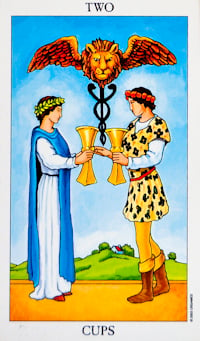
What Are Your Tarot Cards?
Your date of birth contains several compound numbers, each corresponding to a card within the 78-card Tarot deck. The compound number identifies the specific Tarot card, while its root number reveals the underlying numerical principle expressed through that card.
Enter your date of birth to calculate your personal Tarot cards and explore how their numbers, symbols and meanings combine to describe your individual pattern.
How to Read Tarot Cards
Begin a Tarot reading with a clear question or subject. Shuffle the deck while holding that subject in mind, then draw the number of cards required by the chosen spread. Each position in the spread has a function, such as the present situation, an obstacle, an unseen influence or a possible outcome.
Interpret each card first according to its central meaning. Then consider its suit, number, imagery, orientation and relationship with the surrounding cards. Repeated suits, numbers or Major Arcana cards often reveal the dominant pattern within the reading.
A Tarot reading is strongest when the cards are interpreted as a connected sequence. One card may identify a condition, the next may reveal what produced it, and another may show how the pattern can develop.
Upright and Reversed Tarot Card Meanings
An upright card generally expresses its energy directly or outwardly. A reversed card does not automatically mean the opposite or a negative outcome. Reversal may indicate that the energy is blocked, delayed, internalized, excessive, weakened or expressed through its more difficult qualities.
The correct interpretation depends on the question and the complete reading. For this reason, upright and reversed keywords should be treated as starting points rather than rigid definitions.
Simple Tarot Spreads for Beginners
One-Card Reading
Draw one card to identify the central energy, lesson or consideration surrounding a question.
Three-Card Reading
Draw three cards to examine a sequence such as past, present and future; situation, challenge and guidance; or mind, emotion and action.
Five-Card Reading
A five-card spread can show the present condition, supporting influence, obstacle, recommended action and likely direction.