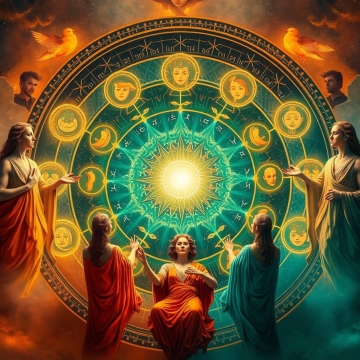

Aries - The Law of Initiation
Aries is ignition: the first surge of directed energy that turns potential into action. Ruled by Mars and aligned with Fire, it represents the moment consciousness asserts I am, chooses momentum, and begins creation through initiative, courage, and decisive movement.

Taurus - The Law of Continuity
Taurus embodies continuity: the force that stabilizes movement and allows what has begun to endure. Governed by Venus and rooted in Earth, Taurus preserves coherence, value, and direction over time, transforming initial action into something lasting and real. It is the intelligence of sustaining growth - maintaining rhythm, cultivating substance, and holding form steady long enough for life to take root, mature, and prosper.

Gemini - The Law of Perception
Gemini embodies perception: the intelligence that observes, distinguishes, and interprets reality in motion. Governed by Mercury and aligned with Air, Gemini transforms stability into awareness by noticing differences, patterns, and connections. Where continuity holds form, perception gives it responsiveness - allowing life to adapt, communicate, and remain conscious of itself as it changes.

Cancer - The Law of Emotion
Cancer embodies emotional intelligence: the capacity to sense, retain, and give continuity to experience through feeling. Governed by the Moon and aligned with Water, Cancer transforms perception into meaning by storing memory, tone, and resonance within the inner world. It is through Cancer that experience becomes personal, connected, and enduring - not as thought or action, but as lived emotional reality that shapes care, belonging, and inner coherence.

Leo - The Law of Radiance
Leo embodies radiance: the force that brings inner meaning into visible expression. Governed by the Sun and aligned with Fire, Leo turns what has been felt and formed within into presence, confidence, and creative display. It is the intelligence of illumination - giving life warmth, direction, and vitality by allowing identity, purpose, and joy to be seen, affirmed, and shared.

Virgo - The Law of Precision
Virgo embodies precision: the intelligence that refines expression into function. Where radiance makes something visible, Virgo makes it work. Governed by Mercury and grounded in Earth, Virgo translates awareness into accuracy, care, and practical coherence. It is the law through which meaning is adjusted, corrected, and aligned with reality - not to diminish what shines, but to ensure that what exists is useful, reliable, and true.

Libra - The Law of Harmony
Libra embodies harmony: the intelligence that balances forces in relation to one another. Where precision perfects function, Libra aligns parts into fairness, proportion, and mutual coherence. Governed by Air, Libra transforms accuracy into equilibrium - ensuring that what works also fits, that expression considers others, and that systems remain stable through balance rather than control.

Scorpio - The Law of Transformation
Scorpio represents transformation at the point where change becomes unavoidable. It governs the intelligence that penetrates beneath appearances, confronts hidden forces, and compels renewal from the inside out. Where balance can no longer be maintained and surface adjustment fails, Scorpio initiates deep restructuring - dissolving what is false, exposing what is real, and allowing life to regenerate through truth rather than preservation.

Sagittarius - The Law of Expansion
Sagittarius embodies expansion: the intelligence that seeks meaning beyond limits and direction beyond the familiar. Governed by Jupiter and aligned with Fire, Sagittarius drives growth through vision, exploration, and understanding - extending awareness outward to discover purpose, opportunity, and broader perspective.

Capricorn - The Law of Structure
Capricorn embodies structure: the intelligence that gives form, responsibility, and durability to purpose. Where expansion opens possibility, Capricorn builds what can endure. Governed by Saturn and grounded in Earth, Capricorn transforms vision into order - establishing boundaries, systems, and commitments that allow progress to become stable, measurable, and real over time.

Aquarius - The Law of Innovation
Aquarius embodies innovation: the intelligence that reimagines structure when it no longer serves life. Where form becomes rigid, Aquarius introduces change - not through destruction, but through insight, originality, and future-oriented vision. Aligned with Air and guided by higher-order intelligence, Aquarius breaks inherited patterns to allow new systems, ideas, and ways of living to emerge.

Pisces - The Law of Unity
Pisces embodies unity: the intelligence that dissolves separation and returns experience to wholeness. Where innovation reshapes form, Pisces integrates all that has been divided - feeling, meaning, memory, and possibility - into a shared field of awareness. Aligned with Water and guided by transcendent perception, Pisces completes the cycle by reconnecting individual experience to the greater whole, allowing understanding, compassion, and coherence to emerge beyond boundaries.
How Astrologers Interpret Zodiac Signs
While the zodiac follows a shared structure, interpretation is not mechanical. Astrologers may differ in emphasis, language, or technique, yet their readings are guided by consistent patterns. What changes from one astrologer to another is not the foundation, but the way these patterns are observed, combined, and prioritized. Interpretation emerges from understanding how multiple principles interact rather than from reading signs in isolation.
Elements describe the nature of expression.
The zodiac signs are grouped into four elements - fire, earth, air, and water - each reflecting a basic mode of experience. Fire signs emphasize action and inspiration, earth signs focus on stability and material reality, air signs engage with thought and communication, and water signs respond through emotion and sensitivity. Elements reveal how energy moves and responds within a sign.
Modalities describe how energy is applied.
Each sign also belongs to a modality - cardinal, fixed, or mutable - which reflects how it approaches change. Cardinal signs initiate, fixed signs sustain, and mutable signs adapt. This principle explains why signs sharing an element may behave very differently in practice. Modality adds movement and timing to elemental expression.
Polarity reflects orientation and balance.
Zodiac signs alternate between active and receptive polarity. This does not describe gender or value, but orientation - whether a sign tends to project outward or process inward. Polarity helps explain dynamics such as initiative versus responsiveness, expression versus containment, and how signs seek equilibrium through relationship.
Planetary rulers provide focus and direction.
Each sign is associated with a ruling planet that shapes its primary motivations and concerns. The ruler does not dominate the sign, but gives it coherence - highlighting what the sign seeks, values, and responds to most strongly. Understanding rulership connects zodiac signs to planetary cycles and timing.
Dignity and challenge refine interpretation.
Astrology also considers conditions such as exaltation, detriment, and fall - symbolic descriptions of how comfortably a planet expresses itself within a sign. These concepts do not imply good or bad outcomes, but describe ease, tension, or adjustment. They help astrologers assess where energy flows naturally and where it requires awareness or effort.
Together, these principles form a structured language for astrology interpretation. While styles may vary, astrologers are reading the same symbolic framework - one that balances consistency with nuance, and structure with lived experience.