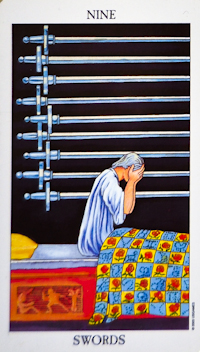
The Nine of Swords at a Glance
- Core Meaning
-
Upright
Worry, guilt, or regret is keeping you distressed long after the immediate event.
ReversedDistress can become more intense, but admitting it creates an opening for support and relief.
- Keywords
-
Upright
Anxiety, sleeplessness, guilt, shame, regret, fear of the worst.
ReversedIntense distress, isolation, nightmares, disclosure, comfort, gradual relief.
- Love & Relationships
-
Upright
The relationship is causing fear, guilt, or distress that you cannot put aside.
ReversedThe distress begins to ease when the truth is spoken and harmful behavior changes.
- Career & Money
-
Upright
You feel overwhelmed and expect a mistake or setback to have serious consequences.
ReversedWork-related distress is reaching a point where you need support or a change in approach.
- Health
-
Upright
Anxiety and disrupted sleep are interfering with daily life.
ReversedDistress may feel more severe, or support is beginning to make it manageable.
The Nine of Swords Upright Meaning
You cannot stop reviewing what happened or anticipating what might happen next. At night, without other demands occupying your attention, the same thoughts become harder to interrupt.
Your concerns can have a real basis. Illness, conflict, loss, an error at work, or another person's behavior has unsettled you. The difficulty is that every uncertainty begins to look like another threat.
Some of what troubles you is already over. You cannot change the conversation, prevent the ending, or undo the mistake by examining it again. Where action remains possible, identify it. Where it does not, repeated self-punishment adds suffering without repairing anything.
Guilt needs a specific response. If you harmed someone, acknowledge it and make amends where possible. If you are taking responsibility for something outside your control, examine why you believe it was yours to prevent.
Upright Love & Relationships
The relationship is causing fear, guilt, or distress that you cannot put aside.
You worry about losing your partner, question what a message meant, or replay an argument long after it ended. Sleep and concentration suffer because you cannot establish where you stand.
Sometimes the distress follows genuinely cruel behavior. A partner shocks you, threatens the relationship, or repeatedly uses a past mistake against you. The problem then includes their conduct, not only your response.
Resentment can also turn into a desire to punish. You want the other person to feel what you felt. Acting on that impulse adds another injury and makes repair harder.
If you are single, regret about an earlier relationship can dominate your view of the future. The card does not say you will remain alone. It describes how difficult it currently feels to imagine anything else.
Learn more about Upright Nine of Swords in Love.
Upright Career & Money
You feel overwhelmed and expect a mistake or setback to have serious consequences.
You worry about an unfinished task, a critical manager, or whether you are capable of the role. A small difficulty can trigger panic because it seems to confirm every doubt you have about yourself.
This card does not establish that the work is hopeless. Anxiety can make you hide your abilities, avoid questions, or delay a task until it becomes genuinely urgent.
Check the actual position. What has gone wrong? What is the deadline? Who needs to know? What can still be corrected? Specific answers are more useful than repeatedly imagining dismissal or financial ruin.
Money worries can follow the same pattern. Review the figures and obligations rather than estimating the danger while lying awake.
Upright Health
Anxiety and disrupted sleep are interfering with daily life.
The card describes lying awake, waking frightened, or struggling to concentrate because worry continues throughout the day. Existing illness or stress can contribute to that experience.
Persistent sleep disruption or distress deserves professional attention. The card itself does not diagnose depression, panic disorder, or another condition.
Upright Advice
Separate the problem you can address from the catastrophe you keep imagining.
Write down what you know, what remains uncertain, and what action is available. Do not treat a frightening possibility as an established fact.
If guilt is involved, take responsibility for the specific action. If the event cannot be changed, stop requiring yourself to solve it through further worry.
Tell someone what has been keeping you awake.
Upright Yes or No
Not a reliable yes. Fear or guilt is obscuring your assessment; establish the facts first.
The Nine of Swords Reversed Meaning
You might conceal how badly you are sleeping or how frightened you feel. Other people assume you are coping because you continue working, answering messages, or handling ordinary responsibilities.
Isolation makes the experience harder. You are left with your own worst interpretation and nobody to question it or help with the practical problem.
The reversal can mark a shift toward relief. You explain what is happening, receive useful support, or discover that the situation is less final than you feared. Problems still need attention, but you begin seeing more than the worst possible outcome.
Be patient with that change. One difficult night does not erase improvement, and feeling better does not require you to deny what hurt you.
Distress kept private
You are embarrassed by the intensity of your reaction, so you conceal it. Someone cannot offer the support you need if they do not know what is happening.
Guilt without an end
You have acknowledged the mistake but continue treating yourself as though it is happening again. Decide what responsibility still requires action and what has become repeated punishment.
Relief through disclosure
You say the thing you have been afraid to admit. An honest conversation gives you another perspective and makes it possible to address the actual problem.
Reversed Love & Relationships
The distress begins to ease when the truth is spoken and harmful behavior changes.
An honest conversation can clarify a misunderstanding, expose an unfounded fear, or allow someone to acknowledge the hurt they caused. Compassion matters, but so does a concrete response.
If you are responsible for harm, admit it without turning the conversation into a request for reassurance. If your partner harmed you, you do not have to accept continued mistreatment to demonstrate forgiveness.
Relief can come through repairing the relationship or leaving it. The important change is that fear, guilt, and retaliation stop directing every interaction.
Learn more about Reversed Nine of Swords in Love.
Reversed Career & Money
Work-related distress is reaching a point where you need support or a change in approach.
You might become angry with colleagues because you feel unsupported, threatened, or unable to keep up. Before reacting, identify whether the problem is workload, unclear expectations, a specific person's behavior, or fear about your own performance.
Seek advice from someone experienced enough to assess the situation. You do not have to wait until you have exhausted every possibility alone.
The reversal can also describe relief after a correction, clarification, or practical intervention. Your position becomes easier to judge once you have reliable information.
Reversed Health
Distress may feel more severe, or support is beginning to make it manageable.
You might be functioning outwardly while feeling increasingly overwhelmed in private. Explain the extent of the difficulty rather than minimizing it.
In recovery, improvement can be uneven. Notice changes in sleep, concentration, and daily functioning without demanding immediate relief from every symptom.
Reversed Advice
Stop concealing how difficult this has become.
Ask for support and explain what you need: help assessing the situation, practical assistance, company, or professional care.
Be less punitive toward yourself. Recognizing a mistake or fear clearly is useful; repeatedly attacking yourself makes it harder to respond.
Reversed Yes or No
Possibly, after clarification. Relief and a more accurate understanding can change the answer.
Contextual Readings for the Nine of Swords
Nine of Swords as Feelings - Upright
They feel anxious, guilty, ashamed, or afraid of what happens next.
They might regret their behavior, fear losing you, or worry about a conversation they have avoided. Their attention is occupied by consequences.
Their distress does not establish love, innocence, or an intention to repair the connection. Those require evidence beyond how badly they feel.
Nine of Swords as Feelings - Reversed
They feel overwhelmed, but they may be becoming more willing to admit it.
They can be seeking comfort, regretting what happened, or beginning to see that their worst fear is not inevitable.
Another expression is deeper withdrawal: they conceal their distress and become difficult to reach. The card alone does not distinguish relief from continued isolation.
Nine of Swords as Intentions - Upright
They intend to avoid a feared conversation or keep reconsidering what to do.
They rehearse explanations, anticipate rejection, or delay because they cannot tolerate the possible response. Concern has not yet become a decision.
If they intend to make amends, look for an apology and action rather than repeated statements about their guilt.
Nine of Swords as Intentions - Reversed
They intend to disclose what is troubling them or seek relief from it.
They might confess, ask for help, or finally address an issue they have kept private.
Someone who remains afraid of the consequences can still withdraw instead. Follow-through determines whether the situation changes.
Nine of Swords as an Outcome - Upright
The situation leaves you distressed or uncertain rather than reassured.
An unresolved question, regret, or fear continues occupying your attention. The emotional impact can exceed what the available facts establish.
Further worrying does not produce the missing answer. Clarification or support is needed.
Nine of Swords as an Outcome - Reversed
The distress begins to lessen, or its severity becomes impossible to keep hidden.
An honest account and useful help can make the problem more manageable. Practical consequences might remain, but you are no longer facing them entirely alone.
If concealment continues, the strain can deepen before anything changes.
Nine of Swords in the Future - Upright
A worry or regret becomes difficult to put aside.
You might spend more time anticipating consequences than responding to the situation itself. Obtain clear information early and address what remains within your control.
Nine of Swords in the Future - Reversed
An opportunity arises to speak openly and receive support.
The situation can begin feeling less hopeless once you have another perspective and a practical response. Allow time for your emotional reaction to catch up with that improvement.
The Nine of Swords Symbolism
The woman has an attitude of despair, regret, and contemplation. The coverlet which is marked with the signs of the zodiac and the seven planets symbolizes the experiences that life has brought her. These bring sorrow only if we allow them to impel us. If we understand that difficulties are lessons for growth and development, sorrow is lessened, and courage replaces frustration. The nine swords are pointing east, toward the light; this indicates new beginnings in the dawning new day.
The Nine of Swords as a Birth Tarot Card
The Nine of Swords corresponds to the numerology number 63/9. If your Life Path Number is 63, the Nine of Swords is your Birth Tarot Card, reflecting your life's lessons, strengths, and challenges.
The Nine of Swords as an Attitude Card
If your Attitude Number is 63/9, the Nine of Swords is its corresponding tarot card. In this position, it describes how you approach new situations, respond to everyday life, and come across to others.