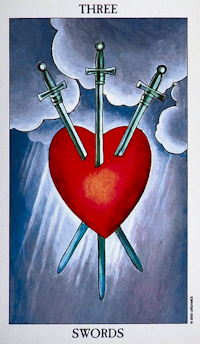
The Three of Swords at a Glance
- Core Meaning
-
Upright
A loss or painful truth has broken your sense of security.
ReversedThe hurt remains, but you are either beginning to recover or withdrawing further into it.
- Keywords
-
Upright
Heartbreak, rejection, conflict, separation, grief, painful truth.
ReversedAlienation, regret, concealed betrayal, unresolved grief, recovery.
- Love & Relationships
-
Upright
Rejection, harsh conflict, or separation is causing real emotional pain.
ReversedUnresolved hurt or a concealed betrayal makes the relationship difficult to continue.
- Career & Money
-
Upright
A professional setback brings disappointment, conflict, or financial loss.
ReversedDamaged trust and unresolved conflict continue to undermine your position.
- Health
-
Upright
Grief and distress are interfering with your everyday functioning.
ReversedDistress has persisted, or recovery is beginning after a difficult period.
- Advice
-
Upright
Accept what happened before deciding what to do next.
ReversedStop repeating the behavior that keeps the hurt active.
- Yes or No
-
Upright
No.
ReversedNot yet.
The Three of Swords Upright Meaning
The Three of Swords describes the immediate impact of being hurt. You might be dealing with a breakup, bereavement, rejection, or news that changes how you see someone. Concentration suffers. Ordinary tasks become difficult. You have less patience for people who expect you to carry on as usual.
Repeated disappointments can make you defensive. You snap at people, expect another setback, or argue over things that would normally pass without comment. The hurt explains your reactions, but those reactions can create additional problems.
Sometimes this card marks the end of something that was already failing. A relationship had become cold, an agreement was no longer credible, or a conflict had made cooperation impossible. Ending it removes the uncertainty. It does not remove the emotional cost.
Upright Love & Relationships
Rejection, harsh conflict, or separation is causing real emotional pain.
In an established relationship, arguments have consequences beyond the moment. Insults, repeated accusations, and contempt make it harder to feel close afterward. A separation can become contentious when hurt turns into disputes over money, property, or blame.
In a new relationship, the connection can end before it becomes secure. One person withdraws, intentions prove incompatible, or an early revelation changes the other person's interest.
If you are single, an earlier loss can still shape how you approach dating. New attention does not necessarily make you feel better. You might compare everyone with the person you lost or experience ordinary uncertainty as rejection.
An ending can also release you from a relationship that had already stopped working. Relief and grief can exist together.
Learn more about the Three of Swords in Love Upright
Upright Career & Money
A professional setback brings disappointment, conflict, or financial loss.
This card can describe dismissal, redundancy, a failed deal, or the loss of a position you worked hard to obtain. For someone in authority, losing influence can be as painful as losing income.
Conflict with colleagues or management makes the situation harder. Criticism becomes personal, working relationships deteriorate, and you spend more energy defending yourself than doing the work.
Separate the practical consequences from the emotional impact. Establish what has ended, what you are owed, and which commitments you can still meet. Avoid making an expensive decision simply to escape the humiliation or prove someone wrong.
Upright Health
Grief and distress are interfering with your everyday functioning.
The card's useful health theme is the effect of emotional pain on sleep, concentration, appetite, and daily care. Notice what has become difficult since the loss or conflict.
The pierced heart is symbolic. It does not establish heart disease or predict a medical emergency. Physical symptoms need assessment on their own terms.
Upright Advice
Accept what happened before deciding what to do next.
Name the loss accurately. Someone rejected you. An agreement failed. A relationship ended. Replacing those facts with explanations you cannot verify keeps you arguing with the situation.
Give yourself time to grieve, while addressing anything that cannot wait. You do not need to feel composed before arranging practical support or handling essential responsibilities.
Do not send a message, make an accusation, or commit to a major change solely to make someone feel your pain.
Upright Yes or No
No. The situation involves a painful conflict, rejection, or ending.
The Three of Swords Reversed Meaning
The reversed Three of Swords can describe regret over your own decision. You rejected someone, ended a relationship, or said something you cannot take back. Now you are living with the consequences and questioning whether you understood what you were giving up.
It also describes pain that has become difficult to express. Other people see irritability, distance, or harshness without knowing what happened. You reject contact because explaining feels exhausting, then feel even more alone.
Recovery begins when you can acknowledge the loss without repeatedly reopening it. That might mean accepting an ending, speaking honestly about a betrayal, or seeking support you have been refusing. Reversal does not automatically mean reconciliation.
Regret after rejecting someone
You wanted distance and now miss the person you pushed away. Before trying to reconnect, identify what has changed. Loneliness alone does not resolve the reason you ended the relationship.
Withdrawal and bitterness
You stop expecting anything good from people. Every invitation feels intrusive; every disagreement feels like another rejection. Withdrawal gives you temporary protection but can also cut you off from the people willing to help.
Recovery after the damage
The event still matters, but it no longer dominates every conversation or decision. You begin sleeping, working, socializing, or making plans with less effort. Progress can be uneven without being false.
Reversed Love & Relationships
Unresolved hurt or a concealed betrayal makes the relationship difficult to continue.
The relationship might survive through habit while neither person feels satisfied. You remain together but avoid the conversations that would expose how much has changed.
A revealed secret can destroy the remaining trust. Infidelity, involvement with someone else, or an important deception makes earlier assurances difficult to believe. Even friendship afterward can feel impossible.
The card can also describe regret after ending a relationship yourself. Wanting the person back is different from being ready to address what went wrong. Reconciliation requires an honest account of the damage and changes both people can observe.
Learn more about the Three of Swords Reversed in Love
Reversed Career & Money
Damaged trust and unresolved conflict continue to undermine your position.
A business partner's conduct can leave you exposed to losses. At work, gossip, exclusion, or a breakdown in support can make it difficult to do your job or retain your role.
Check what you can establish directly. Missing information, inconsistent explanations, and broken agreements deserve attention. The card alone does not establish that colleagues are plotting against you.
In its recovery expression, this card describes dealing with the consequences of a setback: resolving outstanding payments, leaving a hostile workplace, or finding work after a dismissal. The immediate shock has passed, but rebuilding still takes effort.
Reversed Health
Distress has persisted, or recovery is beginning after a difficult period.
You might be withdrawing, neglecting ordinary care, or struggling to resume your routine. If distress is preventing you from functioning, seek professional support rather than waiting for it to disappear.
This card cannot identify kidney stones, a psychiatric condition, or the need for surgery. Those claims in the supplied source should not become medical predictions.
Reversed Advice
Stop repeating the behavior that keeps the hurt active.
Checking someone's activity, rereading arguments, or seeking another explanation can leave you in the same state each time. Identify what these actions actually give you.
If you caused harm, acknowledge it without demanding forgiveness. If someone harmed you, decide what contact you are willing to have now. Recovery does not require restoring the relationship.
Reversed Yes or No
Not yet. Recovery or repair is possible, but unresolved damage still needs attention.
Contextual Readings for the Three of Swords
Three of Swords as Feelings - Upright
They feel hurt, rejected, disappointed, or grief-stricken.
Their attention is on what happened and what it cost them. Affection can remain, but it is mixed with anger, sadness, or a sense of betrayal.
This card does not make pain evidence of love. Someone can be deeply hurt by rejection, dishonesty, or loss of security without wanting the relationship back.
Three of Swords as Feelings - Reversed
They are struggling with unresolved pain, regret, or emotional withdrawal.
They might miss you while avoiding contact, or resent what happened while refusing to discuss it. If they ended the relationship, they can be questioning their decision.
In recovery, their feelings are becoming less consuming. That can mean renewed openness, but it can also mean accepting the ending.
Three of Swords as Intentions - Upright
They intend to confront the problem, create distance, or end the connection.
A difficult conversation is more likely than reassurance. They want to address what hurt them or make a decision they have postponed.
The card does not establish whether they will handle that conversation fairly. Pain can produce honesty or harshness.
Three of Swords as Intentions - Reversed
They intend to avoid further hurt, though they may still be undecided about contact.
Withdrawal, silence, or limited interaction can follow. Someone who regrets their own actions might want to apologize but hesitate to face the response.
An intention to repair the damage becomes meaningful when they address what happened and take responsibility for their part.
Three of Swords as an Outcome - Upright
The situation ends in a painful confrontation, disappointment, or separation.
Something you hoped to preserve becomes difficult to sustain. The result can settle the uncertainty while leaving grief and practical consequences to manage.
Where a relationship or arrangement was already failing, this ending can make it possible to move on.
Three of Swords as an Outcome - Reversed
The immediate crisis eases, but unresolved hurt can continue.
Recovery is possible when the problem is acknowledged and the damaging behavior stops. Avoiding it produces a quieter situation without necessarily restoring trust.
The outcome can be a repaired connection or a final separation that you begin to accept.
Three of Swords in the Future - Upright
A difficult development brings a loss or conflict into focus.
A conversation, decision, or revelation changes what you can reasonably expect. Prepare to respond to the facts rather than trying to preserve an earlier version of the situation.
Three of Swords in the Future - Reversed
The next stage concerns the consequences of the hurt and how you handle them.
Regret or previously concealed information can demand attention. Alternatively, you begin regaining interest in work, relationships, and plans beyond the loss.
The Three of Swords Symbolism
Three swords pierce a heart. They look like crosses, suggesting that those who bear their crosses bravely become more sympathetic and tolerant of others. The heart is also a symbol of charity. The clouds indicate that the brighter side is hidden and that all your natural attributes are not immediately apparent. There is a need to develop spiritual discernment. If negative, self-pity is your weakness.
The Three of Swords as a Birth Tarot Card
The Three of Swords corresponds to the numerology number 57/12/3. If your Life Path Number is 57, the Three of Swords is your Birth Tarot Card, reflecting your life's lessons, strengths, and challenges.
The Three of Swords as an Attitude Card
If your Attitude Number is 57/12/3, the Three of Swords is its corresponding tarot card. In this position, it describes how you approach new situations, respond to everyday life, and come across to others.