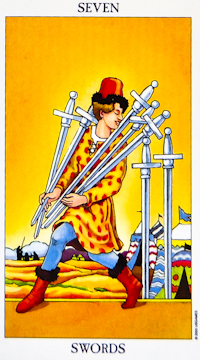
The Seven of Swords at a Glance
- Core Meaning
-
Upright
Someone is acting behind the scenes, and you need accurate information before responding.
ReversedYou are giving up too early, avoiding responsibility, or facing the exposure of something concealed.
- Keywords
-
Upright
Deception, theft, concealment, betrayal, strategy, incomplete success.
ReversedGiving up, indecision, unfinished work, exposure, criticism, resistance to responsibility.
- Love & Relationships
-
Upright
Someone is concealing their behavior or maintaining a relationship that looks closer than it is.
ReversedCriticism, outside influence, or exposed dishonesty is undermining your judgment of the relationship.
- Career & Money
-
Upright
Protect your work, resources, and position from dishonest or concealed dealings.
ReversedFear or incomplete preparation is making you abandon work or concede an advantage.
- Health
-
Upright
Important information or behavior is being left out of the account of your health.
ReversedAvoidance or fear of criticism is interfering with follow-through.
The Seven of Swords Upright Meaning
An explanation leaves out something important. A colleague claims credit for work they did not do. A partner maintains a separate life they do not discuss. Someone uses your belongings, money, or information without permission.
The card can describe your own conduct too. You avoid a conversation, conceal a decision, or try to obtain an advantage without acknowledging its cost to someone else. Getting away with the immediate action does not settle what you have left behind.
The figure carrying five swords while looking back at the remaining two captures that uncertainty. The plan has achieved something, but it is incomplete. There are loose ends, doubts, and consequences still to consider.
Use observation and judgment. Ask precise questions, compare explanations, and protect what is yours. Where another person has more influence, knowledgeable support can help you challenge them effectively.
Upright Love & Relationships
Someone is concealing their behavior or maintaining a relationship that looks closer than it is.
A couple presents an affectionate image while living separate emotional lives. Neither person wants the conversation that would expose how little remains between them.
The card can also describe concealed involvement with another person. Someone wants the security of the existing relationship while pursuing experiences elsewhere. Their partner is denied the information needed to make an informed choice.
Another expression is emotional exploitation. One person receives attention, reassurance, and support while avoiding honesty about their intentions or availability.
The card raises a question about concealment; it does not prove infidelity. Look for specific inconsistencies and ask questions that require clear answers.
Learn more about Upright Seven of Swords in Love.
Upright Career & Money
Protect your work, resources, and position from dishonest or concealed dealings.
A colleague might take credit, withhold information, or make commitments in your name. A business arrangement can contain terms that benefit the other party at your expense.
Keep records of your work and agreements. Read documents closely, clarify responsibilities, and limit access to sensitive information where appropriate.
If someone is challenging your position, understand their approach before reacting. A carefully prepared response, supported by evidence and the right people, can be more effective than an accusation they are ready to dismiss.
Examine your own conduct as well. Gossip, concealed mistakes, and taking credit for others' work undermine the reputation you are trying to preserve.
Upright Health
Important information or behavior is being left out of the account of your health.
You might minimize symptoms, omit relevant details, or quietly disregard an agreed care plan. That makes it harder to assess what is happening.
Give an accurate account when seeking care and ask about anything you do not understand. This card does not identify an illness or establish that someone treating you is dishonest.
Upright Advice
Find out what is happening before revealing how you intend to respond.
Check the facts, secure your belongings and information, and read agreements carefully. Keep your plans private where premature disclosure would weaken your position.
Think strategically without using someone else's dishonesty to justify your own. Your objective is to protect yourself and resolve the problem.
Upright Yes or No
No on the information currently available. Concealment or incomplete disclosure makes the situation unreliable.
The Seven of Swords Reversed Meaning
The first obstacle makes you retreat. You abandon the task, accept someone's explanation without checking it, or decide that a stronger opponent cannot be challenged. Lack of confidence becomes a reason to surrender resources you still have.
A more deliberate approach can defend your position. Consider what the other person wants, what they expect you to do, and which facts they would prefer you not to examine. You do not need to imitate their dishonesty to understand their strategy.
The reversal can also describe an unsuccessful deception. An inconsistency is noticed, concealed actions become known, or someone receives a reprimand. A plan fails because important details were neglected.
If the card describes your own unfinished work, identify the point at which you keep withdrawing. Fear of criticism, reluctance to accept responsibility, and poor preparation require different solutions.
Retreating at the first difficulty
You interpret resistance as proof that the effort is hopeless. Check what you can still do before abandoning the task or conceding your position.
Letting criticism direct your choices
A partner's reproach or another person's opinion carries more weight than your own judgment. You become easier to influence because avoiding disapproval matters more than assessing the facts.
Concealment becoming visible
An unfinished explanation, conflicting account, or overlooked detail reveals what someone tried to hide. The next step is to establish what happened and address its consequences.
Reversed Love & Relationships
Criticism, outside influence, or exposed dishonesty is undermining your judgment of the relationship.
You might be so concerned with your partner's approval that you stop defending reasonable needs. Reproaches make you withdraw, apologize, or accept an account you do not actually believe.
Gossip can also interfere. Other people's claims create suspicion and arguments before either partner establishes what is true.
Where concealed behavior becomes known, the relationship needs a direct response. Explaining why someone hid it is not the same as taking responsibility. Decide what the facts mean for your willingness to continue.
Learn more about Reversed Seven of Swords in Love.
Reversed Career & Money
Fear or incomplete preparation is making you abandon work or concede an advantage.
You stop when the task becomes difficult, avoid responsibility for the result, or assume that a more powerful colleague will prevail. This can leave work unfinished and opportunities unused.
Establish what you need to complete the task: skills, information, guidance, or a firmer response to interference. Obtain that support rather than treating every difficulty as a reason to withdraw.
The reversal can also indicate scrutiny. An error, misleading claim, or concealed transaction comes to light. If you are responsible, correct the record and address the damage. If someone else is responsible, preserve the relevant evidence.
Reversed Health
Avoidance or fear of criticism is interfering with follow-through.
You postpone an appointment, abandon a routine at the first difficulty, or avoid admitting that a plan has not been workable.
Be specific about the obstacle. An honest discussion about what you have and have not managed is more useful than agreeing to a plan you will not follow.
Reversed Advice
Do not surrender before you have examined your options.
A stronger opponent can still make mistakes, contradict themselves, or rely on you giving up. Understand their approach and identify where you have leverage.
If your own avoidance created the problem, finish the task or accept responsibility for what remains. Another excuse will leave the same issue unresolved.
Reversed Yes or No
Not yet. Establish the truth and address the unfinished matter before deciding.
Contextual Readings for the Seven of Swords
Seven of Swords as Feelings - Upright
They are guarded and withholding something about what they want or feel.
They might want the benefits of the connection without revealing their intentions. Alternatively, they fear an honest conversation and keep their feelings private.
This card describes concealment more clearly than affection. You cannot assume that their outward behavior reflects their full emotional position.
Seven of Swords as Feelings - Reversed
They feel uncertain, exposed, or overly affected by criticism.
They might worry that something they concealed will become known. They can also feel too inadequate or discouraged to defend their needs.
The discomfort can lead to honesty, withdrawal, or another attempt to avoid the subject. Their response matters more than their embarrassment.
Seven of Swords as Intentions - Upright
They intend to act privately, avoid confrontation, or secure an advantage without full disclosure.
They might conceal plans, provide a partial explanation, or leave before answering difficult questions. Their objective can be self-protection or self-interest; the surrounding situation distinguishes them.
If their actions affect your money, work, or relationship, require clear information before agreeing.
Seven of Swords as Intentions - Reversed
They intend to retreat, abandon the plan, or respond to something that has been exposed.
They might give up because they expect criticism or failure. Someone caught in a deception can intend to explain, correct it, or simply limit the consequences for themselves.
An admission becomes useful when it includes responsibility and a concrete response.
Seven of Swords as an Outcome - Upright
The result is partial or obtained through concealment, with important matters left unresolved.
Someone gains an advantage or avoids an immediate confrontation. Loose ends remain, making the arrangement unstable.
A result that depends on another person not knowing the facts is difficult to sustain.
Seven of Swords as an Outcome - Reversed
The plan is abandoned, challenged, or exposed before it is completed.
Lack of persistence can prevent a legitimate goal from being achieved. In a dishonest arrangement, the same incompleteness can reveal what was concealed.
What follows depends on whether the facts are addressed or avoided again.
Seven of Swords in the Future - Upright
A situation requires closer scrutiny because the explanation you receive is incomplete.
Protect your position and investigate inconsistencies before committing. Observation and preparation will serve you better than an impulsive confrontation.
Seven of Swords in the Future - Reversed
An overlooked detail or a difficult challenge brings the plan to a turning point.
You might discover concealed information or feel tempted to give up. Establish what has changed before deciding whether to continue, revise your approach, or withdraw.
The Seven of Swords Symbolism
The figure is hurrying away with an armful of swords. He turns around, wondering whether he should have taken the other two swords as well. This depicts uncertainty, hesitation and partial success. The tents also show instability for they are not permanent.
The Seven of Swords as a Birth Tarot Card
The Seven of Swords corresponds to the numerology number 61/7. If your Life Path Number is 61, the Seven of Swords is your Birth Tarot Card, reflecting your life's lessons, strengths, and challenges.
The Seven of Swords as an Attitude Card
If your Attitude Number is 61/7, the Seven of Swords is its corresponding tarot card. In this position, it describes how you approach new situations, respond to everyday life, and come across to others.