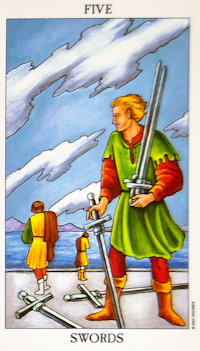
The Five of Swords at a Glance
- Core Meaning
-
Upright
A conflict has become destructive, and winning may no longer produce a useful result.
ReversedYou are caught in a damaging dispute, and stepping out of it can limit the harm.
- Keywords
-
Upright
Conflict, defeat, humiliation, hostility, retaliation, abuse of power.
ReversedUnnecessary conflict, misplaced blame, bullying, false pride, withdrawal from a dispute.
- Love & Relationships
-
Upright
Arguments have become attempts to hurt, control, or defeat each other.
ReversedThe damage from repeated conflict is forcing a separation or a serious change.
- Career & Money
-
Upright
A power struggle or hostile working environment threatens your position and resources.
ReversedSomeone's attempt to shift blame can expose you to professional or financial harm.
- Health
-
Upright
Ongoing conflict is consuming your attention and making ordinary care harder.
ReversedThe conflict has eased, but its effects can continue.
The Five of Swords Upright Meaning
This card describes repeated accusations, cutting remarks, and attempts to force someone into submission. A family dispute becomes personal. A manager treats disagreement as disobedience. An institution makes a decision you cannot easily challenge.
You can feel cornered, angry, and unable to let the matter rest. Each provocation invites another response. Eventually, you are spending more time defending yourself than dealing with the original problem.
The card can describe either side of the conflict. You might be subjected to unfair treatment, or you might be using pressure, ridicule, or authority to get your way. If people comply because they fear your reaction, the disagreement has not been resolved.
All is not lost when you cannot win. Leave without threats, insults, or a final attempt to wound someone. A restrained exit protects what another argument could damage.
Upright Love & Relationships
Arguments have become attempts to hurt, control, or defeat each other.
Partners bring up vulnerabilities, mock each other, or threaten the relationship to force agreement. Resentment grows because neither person feels safe admitting fault or expressing a need.
One partner might feel trapped by the other's demands. Every disagreement becomes a punishment: insults, intimidation, withdrawal of support, or pressure to comply. The person exercising control can also be the person represented by this card.
Retaliation makes the situation worse. Seeking attention elsewhere, exposing private information, or deliberately provoking jealousy adds another injury without resolving the first.
The important question is whether both people are willing to stop the harmful behavior. Affection alone will not make repeated humiliation tolerable.
Learn more about Upright Five of Swords in Love.
Upright Career & Money
A power struggle or hostile working environment threatens your position and resources.
Conflict with a manager, colleagues, an educational board, or a government body can leave you facing a decision you consider unfair. You might lose influence, an opportunity, or the ability to continue under the existing arrangements.
At work, gossip and personal attacks can replace useful discussion. If you manage others, harshness and public criticism can make employees conceal problems or leave. Authority used badly damages the work it is supposed to direct.
Financially, avoid impulsive risks taken to recover a loss or prove your judgment. A dispute is already costly; a speculative decision can add another loss.
Identify the practical objective. Are you trying to correct a record, recover money, retain your role, or leave? Pursue that objective rather than every argument surrounding it.
Upright Health
Ongoing conflict is consuming your attention and making ordinary care harder.
You remain tense after conversations, replay arguments at night, or struggle to concentrate because you expect another confrontation. The practical issue is the sustained strain.
Reduce unnecessary exposure to the dispute where you can. Protect time for sleep, meals, and support rather than allowing the conflict to occupy every available hour.
Upright Advice
Stop fighting once further argument can only increase the damage.
Decide what you still need to protect and what you can no longer obtain from this person or situation. You might never receive an admission, apology, or fair hearing.
Respond deliberately. Avoid threats, reckless decisions, and remarks that can damage your reputation after the immediate anger passes.
Walking away with self-respect depends on how you leave. Do not make your final act another attempt to humiliate someone.
Upright Yes or No
No. Conflict and the cost of pursuing the result outweigh its benefit.
The Five of Swords Reversed Meaning
Someone else's conflict becomes your problem. You are asked to take sides, carry accusations, or accept responsibility for a mistake you did not make. The person initiating the fight might be protecting their position or diverting attention from their own failure.
Workplace bullying often follows this pattern. A manager blames an employee for unclear instructions. A colleague attacks someone's competence before their own mistakes are examined. Public drama gives the aggressor a way to appear powerful.
The reversal can offer a clearer opportunity to leave the dispute or expose what is happening. Establish the facts, keep relevant records, and identify who can address the issue. You do not need to answer every provocation to challenge unfair treatment.
It can also describe the aftermath of your own aggression. The argument is over, but relationships remain damaged. Regret becomes useful when you stop defending the behavior and take responsibility for it.
Fighting someone else's battle
Two people disagree and recruit you as a witness, messenger, or ally. Before participating, establish what actually concerns you. Taking sides can leave you carrying consequences neither person intends to share.
Refusing to accept the ending
You keep drafting replies, revisiting the insult, or planning how to prove the other person wrong. The dispute continues in your decisions even after contact has stopped.
Using conflict to avoid responsibility
Someone makes accusations whenever their own performance is questioned. Bringing the discussion back to specific actions, agreements, and results makes that diversion harder to maintain.
Reversed Love & Relationships
The damage from repeated conflict is forcing a separation or a serious change.
One person stops participating, ends the relationship, or refuses to continue the same arguments. That decision can feel abrupt even when hostility has been building for some time.
A difficult separation can turn into disputes over property, money, or who is to blame. Friends and relatives might be drawn into the conflict. Avoid using them to punish or pressure the other person.
Repair remains possible only when harmful conduct stops and responsibility is taken. An apology followed by the same intimidation does not improve the relationship. Where threats or physical aggression are present, prioritize your safety over obtaining agreement.
Learn more about Reversed Five of Swords in Love.
Reversed Career & Money
Someone's attempt to shift blame can expose you to professional or financial harm.
You might be made responsible for another person's error or drawn into a dispute between managers or business partners. A hostile colleague can use personal information against you, so keep sensitive matters out of the conflict.
Check responsibilities against actual instructions, correspondence, and agreements. Specific evidence is more useful than arguing about someone's motives.
The card can also describe withdrawal from a damaging arrangement. You leave a business relationship, challenge an unfair accusation, or stop spending money on a dispute with little chance of a useful return.
Reversed Health
The conflict has eased, but its effects can continue.
You might still feel defensive, restless, or unable to switch off after leaving a hostile situation. Recovery can require more than ending contact.
Persistent symptoms deserve attention on their own terms. This card does not establish heart disease or predict injury.
Reversed Advice
Separate your responsibility from the conflict someone else is creating.
Do not carry accusations between people or accept blame simply to end an uncomfortable conversation. Establish what you did, what you agreed to do, and what belongs to someone else.
If unfairness needs to be exposed, present the relevant facts to someone able to act. Keep your account clear and specific.
Reversed Yes or No
No to continuing the fight. Withdrawal, a clear boundary, or a factual challenge offers a more useful direction.
Contextual Readings for the Five of Swords
Five of Swords as Feelings - Upright
They feel angry, defeated, resentful, or determined to regain control.
They are focused on what happened and who had the upper hand. Hurt can be expressed through sarcasm, hostility, or a refusal to concede anything.
This card does not describe affection clearly. It describes feelings dominated by the dispute.
Five of Swords as Feelings - Reversed
They feel exhausted by the conflict, ashamed of their conduct, or unwilling to keep fighting.
They might want distance without being ready to forgive. Someone who behaved aggressively can regret the consequences while still resisting responsibility.
Relief at the end of an argument does not automatically restore trust.
Five of Swords as Intentions - Upright
They intend to prevail, defend their position, or force the other person to give way.
They might confront, accuse, withdraw cooperation, or use information to gain an advantage. Agreement is difficult when their main objective is to avoid losing.
In another expression, they intend to leave because continuing has become too costly.
Five of Swords as Intentions - Reversed
They intend to withdraw from the dispute or redirect responsibility.
Someone might stop engaging, seek a settlement, or acknowledge their part in the damage. Another person might attempt to escape consequences by blaming someone else.
Look for a specific action: ending the accusations, correcting a false statement, or accepting responsibility.
Five of Swords as an Outcome - Upright
The dispute ends with a loss, damaged trust, or a victory that carries a substantial cost.
One person gets their way, but cooperation becomes harder. A relationship ends, a position is lost, or the participants leave with more resentment than they brought into the disagreement.
Your conduct can still limit the consequences.
Five of Swords as an Outcome - Reversed
You leave the conflict or expose the behavior that has sustained it.
The situation can settle once people stop feeding it or responsibility becomes clearer. That does not require everyone to agree about what happened.
If blame and retaliation continue, the consequences remain unresolved even after the original argument ends.
Five of Swords in the Future - Upright
A dispute puts pressure on your reputation, position, or relationships.
Someone challenges your authority, assigns blame, or demands that you take sides. Consider the consequences before responding. An impulsive reaction can become more damaging than the initial provocation.
Five of Swords in the Future - Reversed
An opportunity arises to step out of a damaging dispute or challenge unfair treatment.
You become clearer about whose conflict it is and what you are responsible for. Use that distinction to limit your involvement and decide whether formal action is warranted.
The Five of Swords Symbolism
The figure in the foreground represents one who has finished the job. The figure walking away has laid down his sword, but he is still not defeated; he merely shows that he knows when to fight and when to retreat. The other figure really is defeated and is weeping over this fact. This card represents three attitudes of mind. It shows that we must discriminate in all matters and stand on our convictions.
The Five of Swords as a Birth Tarot Card
The Five of Swords corresponds to the numerology number 59/14/5. If your Life Path Number is 59, the Five of Swords is your Birth Tarot Card, reflecting your life's lessons, strengths, and challenges.
The Five of Swords as an Attitude Card
If your Attitude Number is 59/14/5, the Five of Swords is its corresponding tarot card. In this position, it describes how you approach new situations, respond to everyday life, and come across to others.