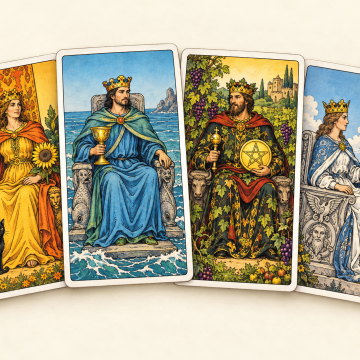
What Is the Minor Arcana?
The Minor Arcana is the suited division of the 78-card Tarot deck. It contains 56 cards, with 14 cards in each of four suits. Every suit includes an Ace, the numbered cards Two through Ten, and four court cards: Page, Knight, Queen and King.
While the Major Arcana identifies primary principles and transformative forces, the Minor Arcana shows how those forces operate through daily experience. These cards describe what people think, feel, choose, create, resist and encounter as a situation develops.
The word minor does not mean insignificant. A Minor Arcana card can describe the specific action, decision or condition upon which an entire outcome depends. Its meaning is narrower and more immediate than that of a Major Arcana card, but not necessarily less consequential.
The 56 Minor Arcana Cards
The Minor Arcana is organized into four groups of 14 cards. Each suit represents a distinct field of experience and follows its principle from the concentrated potential of the Ace through the completion of the Ten and into the personified expressions of the court cards.
Place the four suit sections and their cards here:
- Wands
- Cups
- Swords
- Pentacles
In some traditional decks, Wands may be called Batons, Rods or Staves, while Pentacles may be called Coins or Disks. The names vary, but the underlying four-part structure remains the same.
The Four Suits of the Minor Arcana
Each Tarot suit is associated with one of the four classical elements. The element establishes the fundamental nature of the suit, while the number or court rank determines how that nature is expressed.
Wands: Fire and Will
Wands correspond to fire and represent will, desire, initiative, enterprise and directed energy. They describe what motivates action and gives a person the impulse to begin, pursue, compete, create or transform.
A Wands card may refer to ambition, work, leadership, attraction or creative force. Its central question is not merely what is happening, but what is driving the action and where that energy is being directed.
Cups: Water and Imagination
Cups correspond to water and represent imagination, emotion, receptivity and relationship. They describe the inner images and emotional responses through which experience is felt and interpreted.
A Cups card may concern affection, attachment, intuition, memory, pleasure or disappointment. Cups show what the heart receives, what it desires and how emotional bonds influence perception and choice.
Swords: Air and Intellect
Swords correspond to air and represent thought, analysis, communication, judgment and conflict. They describe the mind's ability to separate, compare, define and decide.
A Swords card may indicate a belief, conversation, strategy, disagreement or difficult truth. Because thought can clarify or divide, the suit includes both intellectual power and the consequences of fear, hostility and mental fixation.
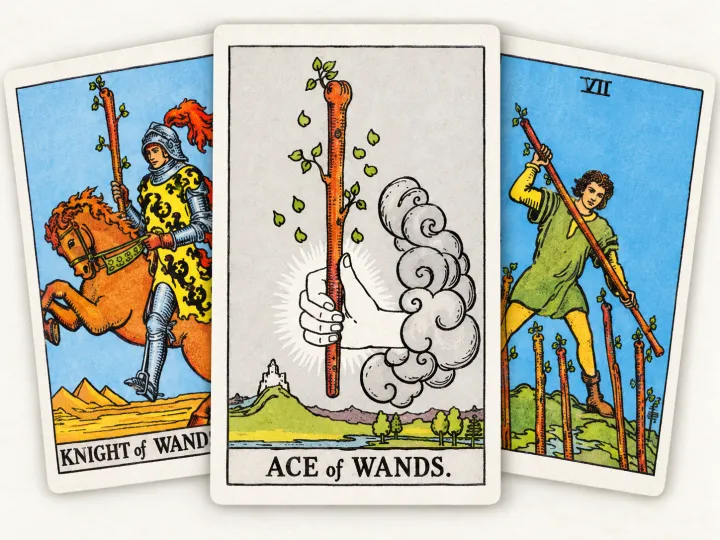
Wands
The Suit of Wands contains 14 Minor Arcana cards associated with fire, will, desire and directed action. From the first impulse of the Ace to the authority of the King, Wands show how inner motivation becomes movement, enterprise, creation and visible change.
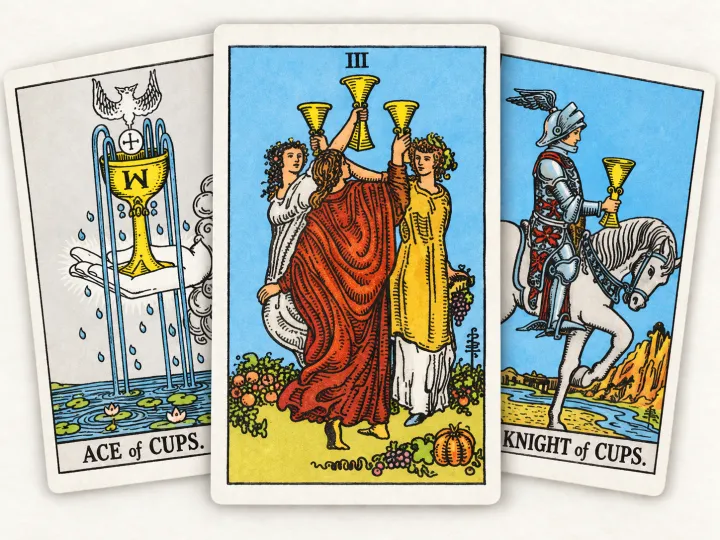
Cups
The Suit of Cups contains 14 Minor Arcana cards associated with water, imagination, emotion and relationship. From the first opening of the Ace to the emotional command of the King, Cups show how inner images and feelings are received, shared, pursued, tested and brought into conscious form.
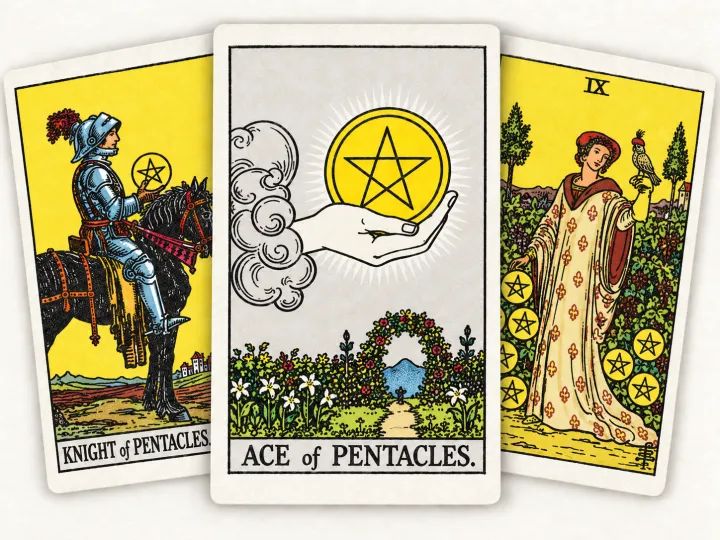
Pentacles
The Suit of Pentacles contains 14 Minor Arcana cards associated with earth, the body, labor, resources and material form. From the tangible potential of the Ace to the established authority of the King, Pentacles show how an intention acquires substance and becomes something that must be built, maintained, exchanged or protected.
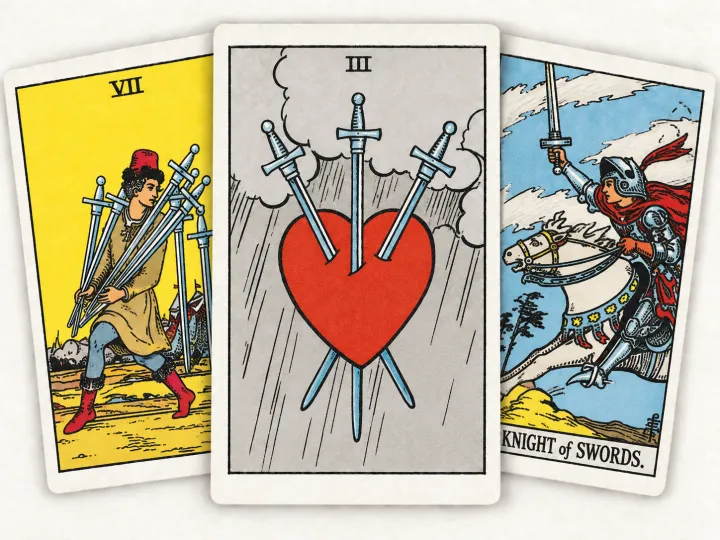
Swords
The Suit of Swords contains 14 Minor Arcana cards associated with air, thought, language and judgment. From the first clarity of the Ace to the intellectual authority of the King, Swords show how the mind perceives, separates, decides and confronts the consequences of its own conclusions.
Pentacles: Earth and Material Form
Pentacles correspond to earth and represent the body, labor, resources, money and material conditions. They describe what has taken physical form and what must be built, maintained, exchanged or protected.
A Pentacles card may concern health, property, employment, practical ability or long-term security. This suit shows whether an intention has acquired substance and whether the resulting form can be sustained.
Numbers and Ranks in the Minor Arcana
The meaning of a Minor Arcana card is created by combining its suit with its rank. The suit identifies the type of energy involved; the rank identifies the stage or form through which that energy is operating.
The Ace contains the principle of its suit in concentrated potential. The numbered cards Two through Ten show that principle entering relationships, structures, conflicts, developments and completed conditions. The same number connects the four suits structurally, but its expression changes according to the element involved.
For example, a number expressed through Cups operates through feeling and imagination, while the same number expressed through Swords operates through thought and judgment. The numerical principle remains related, but its field of action changes.
The Minor Arcana Court Cards
Each suit concludes with four court cards: Page, Knight, Queen and King. Court cards personify the element of their suit and show how that force may be learned, pursued, embodied or directed.
A court card may represent a specific person, but it does not always do so. It can also describe a role, behavior, level of development or manner of responding to the situation. The Queen of Swords, for example, may identify an individual, but she may also represent the need for clear perception and independent judgment.
The surrounding cards and the question being asked determine whether a court card should be read as a person, an influence or a required mode of action.
Minor Arcana and Major Arcana
The Major and Minor Arcana perform different but complementary functions. A Major Arcana card establishes the larger principle operating in a reading. Minor Arcana cards show the conditions through which that principle becomes visible.
If a Major Arcana card indicates transformation, the Minor Arcana may reveal whether that transformation is occurring through a relationship, a decision, a conflict, a job or a material loss. The Major Arcana provides the structural theme; the Minor Arcana supplies its particular expression.
A reading containing mostly Minor Arcana cards often concerns circumstances that can be influenced through ordinary choices and actions. When several Major Arcana cards appear, the immediate events may be connected to a broader transition or developmental process.
Minor Arcana Cards in a Tarot Reading
Minor Arcana cards make a reading specific. Their suits identify the field of experience, their numbers and ranks describe the stage of development, and their positions within the spread show how each condition relates to the question.
The cards should not be interpreted as isolated keywords. A card of conflict beside cards of cooperation will function differently from the same card surrounded by additional signs of division. Repetition of a suit may show that one field of experience dominates the situation, while repeated numbers may reveal a shared structural pattern operating across several areas.
The meaning emerges from the relationship between suit, rank, position and surrounding cards.
Upright and Reversed Minor Arcana Meanings
An upright Minor Arcana card generally expresses its suit and rank directly. The energy is active, visible or available within the situation. This does not make every upright card favorable; some cards directly describe loss, conflict, restriction or instability.
A reversed card may show that the same principle is blocked, delayed, internalized, exaggerated or expressed in a distorted form. Reversal can also indicate that a condition is weakening or that its effects are less visible than they first appear.
A reversed meaning should therefore be derived from the card's underlying structure rather than treated as an unrelated opposite. The suit and rank remain the same; what changes is the direction, availability or condition of their expression.
Select Wands, Cups, Swords or Pentacles to study all 56 Minor Arcana cards and their individual symbolism.