Elizabeth was the elder daughter of Prince Albert, Duke of York, and Elizabeth Bowes-Lyon. Her father was the second son of King George V, and the family's royal duties were modest until her uncle, Edward VIII, abdicated in 1936. Her father became King George VI, and Elizabeth, then ten, became heiress presumptive. She was educated privately at home, with lessons in history, languages, and constitutional law; the historian Henry Marten helped supervise her instruction in the constitution.
During World War II, Elizabeth stayed in Britain through the Blitz and made radio broadcasts, including a 1940 message to children evacuated overseas. In 1945 she joined the Auxiliary Territorial Service, trained as a mechanic and truck driver, and served until the end of the war in Europe. Her public role grew as she accompanied her parents on wartime visits and, after the war, undertook her first overseas tours.
In 1947 she married Philip Mountbatten, a Royal Navy officer and former prince of Greece and Denmark, at Westminster Abbey. Their first child, Charles, was born in 1948, followed by Anne in 1950, Andrew in 1960, and Edward in 1964. While on a tour of Kenya in February 1952, Elizabeth learned that her father had died; she returned to Britain as queen. Her coronation at Westminster Abbey in June 1953 was the first British coronation televised, drawing an enormous audience and signaling a more visible monarchy.
Elizabeth's reign coincided with the breakup of the British Empire and the transformation of the Commonwealth. She was queen of dozens of independent realms over the years, though the number changed as countries became republics or adopted new constitutional arrangements. She visited more than 100 countries, hosted state dinners, and held weekly audiences with prime ministers. In 1965 she made a state visit to West Germany, and in 2011 she became the first British monarch to visit the Republic of Ireland. She also signed legislation and opened Parliament while avoiding public comment on partisan politics.
Her Silver Jubilee in 1977 marked 25 years on the throne. The 1990s brought difficulties: a fire damaged Windsor Castle in 1992, three of her children's marriages ended, and criticism of the monarchy's response to the death of Diana, Princess of Wales, in 1997 prompted the queen to return to London and make a televised address. Elizabeth marked her Golden Jubilee in 2002, her Diamond Jubilee in 2012, and her Platinum Jubilee in 2022. In 2020, during the COVID-19 pandemic, she addressed the nation and thanked health workers. Philip died in April 2021 after more than 70 years of marriage.
Elizabeth died at Balmoral Castle on September 8, 2022, after 70 years on the throne. Her son Charles succeeded her as King Charles III. She had been the longest-reigning British monarch and one of the longest-reigning sovereigns in world history. After a state funeral at Westminster Abbey, she was buried at St George's Chapel in Windsor, and her death prompted public mourning across Britain and the Commonwealth.
Queen Elizabeth II was born on April 21, 1926. In Cardology (Destiny Cards), April 21, 1926 corresponds to the King of Clubs, making the King of Clubs her Birth Card.
In numerology, the name adds another layer to the birth-date profile. The letters of a person’s name are used to explore inner motivation, personality, expression, and the qualities they bring into relationships and everyday life. Explore how her original name Elizabeth Alexandra Mary influences her life and personality.
Queen Elizabeth II Personal Life
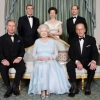
Prince Philip & Queen Elizabeth II
Compatibility: Seven of Diamonds & King of Clubs
Famous Aries People
Discover famous Aries people, from actors and musicians to writers, athletes, and historical figures. Explore their birthdays and biographies, and see who shares the Aries zodiac sign.


View All Famous Aries People →


King of Clubs Famous People
View All Famous King of Clubs People →