What Does the Suit of Wands Represent?
Wands represent the power that initiates action. They describe the impulse to begin, the desire to pursue an objective and the sustained will required to bring an intention forward. When Wands appear in a Tarot reading, the central issue often concerns motivation: what a person wants, what drives the situation and where the available energy is being directed.
This suit is frequently connected with work, ambition and creativity, but its meaning is broader than career. Wands operate anywhere desire produces movement. They may describe attraction, competition, travel, leadership, risk, invention or the determination to overcome resistance.
In older Tarot decks, Wands may also be called Batons, Rods or Staves. The image changes, but the suit retains its connection with fire and active will.
The 14 Wands Tarot Cards
The Suit of Wands contains ten numbered cards and four court cards:
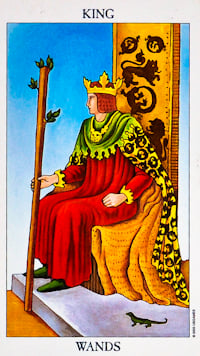 King of Wands
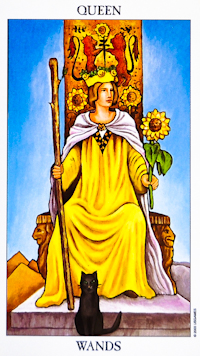 Queen of Wands
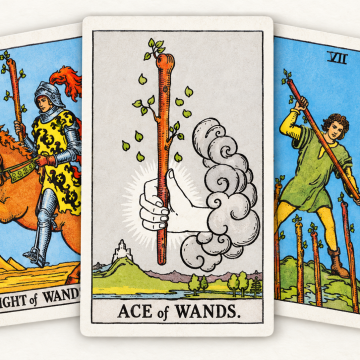
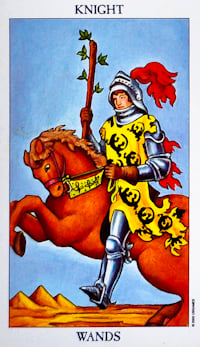 Knight of Wands
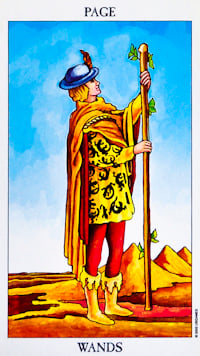 Page of Wands
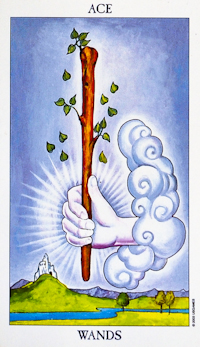 Ace of Wands
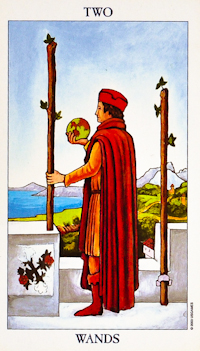 Two of Wands
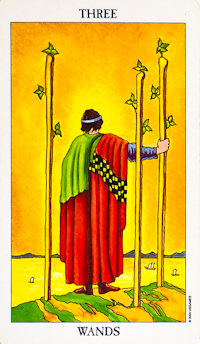 Three of Wands
 Four of Wands
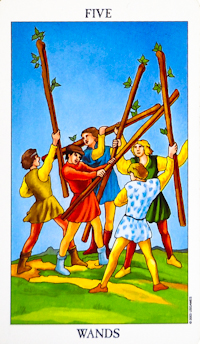 Five of Wands
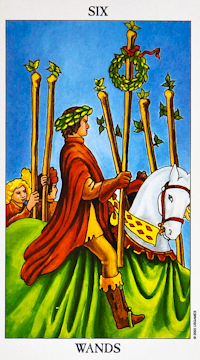 Six of Wands
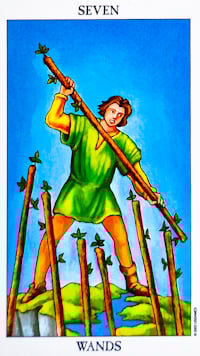 Seven of Wands
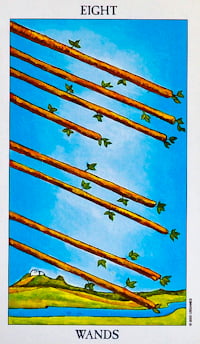 Eight of Wands
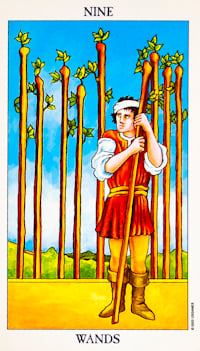 Nine of Wands
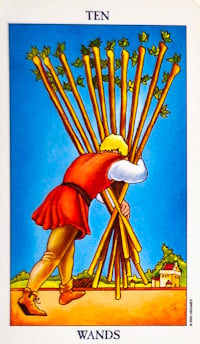 Ten of Wands
Wands as the Element of Fire
Fire is active, expansive and transformative. It produces light and heat, consumes existing material and converts it into another state. Within the Minor Arcana, this makes Wands the suit of initiation, vitality and change through action.
Fire must be directed. When controlled, it becomes courage, enterprise, creativity and sustained purpose. When uncontrolled, it becomes impatience, conflict, exhaustion or destruction. When insufficient, it appears as hesitation, lack of motivation or the inability to move an idea beyond its initial possibility.
The condition of the fire is therefore central to interpreting a Wands card. The card may show energy beginning, expanding, competing, becoming organized, meeting resistance or reaching the limit of what can be carried.
The Numbered Wands Sequence
The numbered Wands cards trace the development of will from its first appearance to its completed burden.
The Ace of Wands contains the concentrated potential of fire: a new impulse, desire or creative force ready to be directed. The Two of Wands establishes polarity and the need to choose a direction. The Three of Wands extends the initial decision outward, allowing intention to develop through movement and expansion.
The Four of Wands gives fire a stable field in which it can become established and shared. The Five of Wands introduces competition, friction and the testing of individual strength. The Six of Wands shows energy gaining recognition and moving successfully toward its objective.
The Seven of Wands requires a position to be defended against opposition. The Eight of Wands releases concentrated energy into rapid movement. The Nine of Wands preserves strength after repeated effort and prepares for one final demand.
The Ten of Wands brings the suit to completion. The original impulse has acquired consequences, duties and accumulated weight. What began as desire must now be carried, delegated, completed or released.
The Wands Court Cards
The Wands court cards personify different ways in which fire can be expressed.
The Page of Wands discovers fire. The Page represents curiosity, a developing enthusiasm, a message or the first recognition of a new possibility.
The Knight of Wands pursues fire. The Knight turns enthusiasm into movement, risk and direct experience. This energy can be courageous and inspiring, but it may also become impulsive or difficult to sustain.
The Queen of Wands embodies fire as a stable inner presence. Her influence comes through confidence, warmth, attraction and the capacity to encourage life and activity around her.
The King of Wands directs fire toward a chosen purpose. He represents vision, leadership and the authority to organize action on a larger scale.
A Wands court card may describe a person, but it may also identify a role, behavior or level at which the fire element is operating.
Wands in a Tarot Reading
A strong presence of Wands indicates that desire and action are driving the situation. Events may be developing quickly, several people may be competing to establish direction, or a person may be attempting to turn an idea into a visible result.
Wands answer questions such as:
- What is motivating this action?
- Where is the energy moving?
- Is the will focused or scattered?
- Is there enough force to continue?
- Has desire become pressure, conflict or excessive responsibility?
Few Wands in a reading can indicate that the situation lacks momentum or that other considerations are stronger than the desire to act. Many Wands can show ambition and creative intensity, but they can also warn that too much activity is occurring without sufficient reflection, emotional awareness or practical structure.
Wands with the Other Tarot Suits
Wands describe the force that initiates movement, while the other suits show what shapes or receives that force.
With Cups, fire interacts with feeling, imagination and relationship. Desire may be emotionally supported or weakened by attachment and changing moods.
With Swords, fire encounters thought, language and judgment. An intention may acquire a clear strategy, or action and reasoning may work against each other.
With Pentacles, fire enters material form. The idea must be supported by labor, resources, physical ability and practical conditions.
When a Wand appears with a Major Arcana card, the Major Arcana identifies the broader principle while the Wand shows how that principle is being pursued through action and will.
Upright and Reversed Wands Meanings
An upright Wands card generally shows fire expressing itself directly. The card may indicate initiative, movement, courage, competition or productive effort. An upright position does not guarantee a favorable meaning; uncontrolled action, conflict and overextension also belong to the fire element.
A reversed Wands card may indicate blocked motivation, delayed action, scattered energy or the misuse of will. It can show that enthusiasm has weakened, that effort is being directed toward the wrong objective or that action is occurring without sufficient control.
Reversal may also intensify the internal experience of the card. Energy that cannot move outward may become frustration, resentment, restlessness or loss of confidence. The card's number and surrounding cards determine whether the fire needs to be strengthened, redirected or contained.
Select any Wands card to study its individual imagery, structure and meaning.