Explore current research and scientific developments curated by Seven Reflections. This section serves as our future home for official press releases - bridging the gap between discovery, structure, and meaning across science and society.
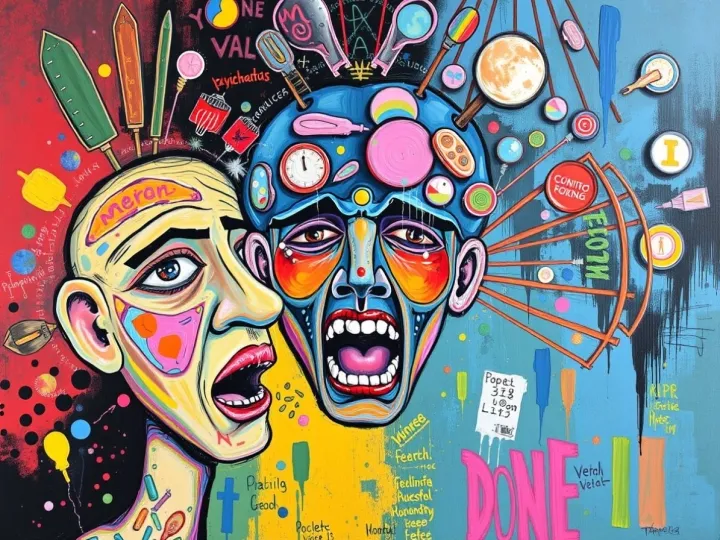
A new study published in Social Cognitive and Affective Neuroscience reveals that faces capture attention differently in adults with ADHD and autism spectrum disorder (ASD). While adults with ADHD display an exaggerated bias toward faces - suggesting hyperactive social salience - autistic adults show no such effect, pointing to a divergence in how social information is processed at the neural level. These findings challenge the idea of a shared attention mechanism across neurodevelopmental disorders and illuminate how dopamine and oxytocin may uniquely shape human social cognition.
Before Daniel Ellsberg became known for leaking the Pentagon Papers, he was a thinker wrestling with a different secret - the nature of uncertainty itself. A recent analysis by economist Carlo Zappia (Cambridge Journal of Economics, 2025) uncovers how Ellsberg's early research at the RAND Corporation went beyond his famous "paradox." Behind the urns and probabilities lay a more radical message: the real world cannot be reduced to a list of known possibilities. True uncertainty, Ellsberg argued, is ontological - it exists in the very structure of reality, where surprise is inevitable and complete prediction impossible.
Can imagination become too real? A new open-access study in Schizophrenia Bulletin Open suggests that our inner world of images and feelings can, under pressure, transform into voices we hear. Researchers Hella Janssen and colleagues have discovered that mental imagery and anxiety interact dynamically to produce and sustain auditory verbal hallucinations (AVHs) - the experience of hearing voices without external sound. Their findings bridge psychology and perception, revealing how the brain's capacity for imagination can cross the threshold into experience.
Every conversation hides a miracle: one mind trying to help another see. According to a new paper in The Philosophical Quarterly, explanation isn't just about giving information - it's about building understanding. Philosophers Grzegorz Gaszczyk and J. P. Grodniewicz propose that explaining is a practice with structure and purpose. Like music, it comes in distinct movements: the minimal, the customized, and the interactive explanation. Each serves a different rhythm of thought - and together, they reveal how humans make meaning visible.
Some people stay sharp, balanced, and graceful under pressure - even when the brain shows signs of aging or disease. What protects them? A new study in Brain Communications offers an answer. Neuroscientists from Tel Aviv and Harvard have developed the first multi-modal stress test to measure the brain's motor-cognitive reserve - the inner capacity that lets us adapt, recover, and perform when life gets demanding. Their findings reveal that resilience can now be measured - not just imagined.
Why do we call one thing "pretty" and another "beautiful"? A new open-access study from The British Journal of Aesthetics offers a surprising answer: beauty is not just about appearances. Philosopher Ryan P. Doran has found that beauty, unlike prettiness, is what scientists call a dual-character concept - something that carries both a descriptive surface (how something looks) and a normative depth (what it represents or embodies). In other words, beauty touches values, ideals, and moral truth - while prettiness remains on the surface.
In the digital age, influence is less about algorithms and more about connection. A groundbreaking study in Human Communication Research reveals that social media influencers can inspire real political participation - not by persuasion alone, but through the emotional closeness their followers feel toward them. When influencers speak about issues like climate change using collective language ("Together, we can make a difference"), they activate a shared sense of purpose that transforms audiences into communities of action.
A name is a doorway - both into being and into confinement. To be named is to be recognized, and yet also to be bound. In Naming and Namelessness (Annual Review of Anthropology, 2025), anthropologist Scott MacLochlainn explores this paradox, tracing how the simple act of naming - whether of people, gods, diseases, or nations - organizes the very logic of recognition. His review turns a mirror toward anthropology itself, revealing that naming is never a neutral gesture: it's an operation of power, an art of containment, and sometimes, a quiet refusal to be captured at all.
When you hear a sudden sound or feel an unexpected touch, your brain responds faster than thought itself. A new Brain study shows these reactions don't come only from the known, high-fidelity sensory pathways. Instead, a second, "extralemniscal" system - diffuse, fast, and supramodal - triggers a global cortical reset that readies the entire brain to act. This discovery challenges decades of neuroscience and redefines how scientists interpret signals of perception and consciousness.