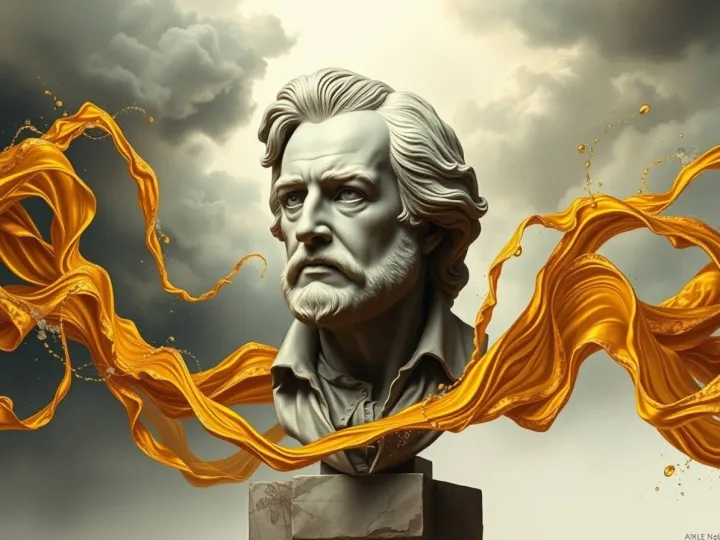
Examining the evolution of human knowledge across time, where philosophy, science, and symbolism converge to reveal how changing worldviews shaped our perception of mind, matter, and meaning.
A new Open Access article in The British Journal of Aesthetics revisits one of the most puzzling features of Kant's third Critique: his wavering assessment of music. Although Kant sharply separates the beautiful from the merely agreeable, his comments on music fluctuate between praise and dismissal. The study argues that this duality is not a biographical quirk but a structural tension within Kant's philosophical system. By analyzing Kant's early writings and the Critique of the Power of Judgment, the author shows how music challenges - and ultimately enriches - Kant's aesthetics.
A new open-access paper in the Journal of Language Evolution proposes a unified framework to test theories about how human language first emerged. Researchers from Cardiff University and collaborating institutions combined causal inference with experimental semiotics to model early communication through shared survival tasks. By recreating ancient cooperative scenarios - such as building shelters and maintaining fires - they found that symbolic language arises only under specific pressures, like information asymmetry and distance between communicators. The work establishes a testable foundation for studying language evolution.
In Ottomans and the Supernatural: Nature and the Limits of Knowledge in the Early Modern Ottoman Empire (Oxford University Press, 2025), historian Marinos Sariyannis traces how Ottoman scholars, mystics, and physicians navigated the porous border between divine intervention and natural law. Before Western rationalism reshaped global thought, Ottoman intellectual life offered a remarkably fluid model of knowing - one where revelation, observation, and imagination coexisted within a single cognitive field. His work exposes how the eventual "disenchantment" of the world transformed both science and consciousness.
The roots of our social world reach deep into the primate tree. A new Annual Review of Anthropology paper by Anthony Di Fiore revisits fifty years of research on primate social systems - from solitary ancestors to complex group societies. Behind every form of cooperation lies a logic of structure, adaptation, and shared history. Using modern comparative phylogenetic methods, scientists are now uncovering how ecology, cognition, and evolution intertwined to build the earliest blueprints of social intelligence - a story that ultimately leads back to us.
In the slave markets of early modern Alexandria, Valencia, and Lisbon, physicians once stood beside traders, examining the bodies of enslaved men and women to determine their price. Their touch was methodical, their gaze clinical. What began as the art of healing became a choreography of commerce - probing eyes, skin, lungs, and voice in search of "defects." Drawing from new historical research, The Physician and the Chain exposes how the language of medical expertise was shaped in slave markets, and how the early science of the body learned to speak the dialect of ownership.