Theories and systems are the scaffolding we use to explain complexity. From the physics of space-time and resonance to the cognitive architectures of mind and intelligence, this section explores the frameworks that attempt to map reality itself. Here we highlight bold models - mathematical, philosophical, and scientific - that seek to unify physics, consciousness, and systems of thought. By examining these structures, we trace the underlying patterns that connect the smallest quantum events to the vast dynamics of human experience.
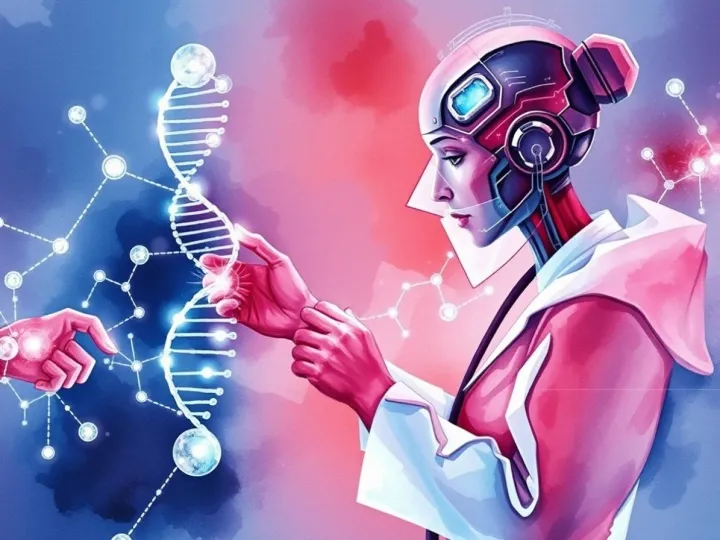
Artificial intelligence is no longer just analyzing data - it's beginning to reason about it. A new open-access paper in Briefings in Bioinformatics explores how Large Language Model (LLM) agents - AI systems capable of planning, reasoning, and taking action - are reshaping bioinformatics and biomedicine. These autonomous "AI scientists" are now being used to design drugs, interpret genetic data, and even collaborate with doctors in clinical decision-making. But as their power grows, so do the challenges: bias, hallucination, privacy, and the ethics of machines that can think.
A new chapter published by Oxford University Press revisits one of philosophy's oldest debates - whether reality is composed of enduring "things" or unfolding "processes." The discussion, led by thinkers like Rowland Stout and Helen Steward, questions how entities persist through time, and what it means for identity to exist in motion. For cognitive science, systems theory, and consciousness research, the implications are profound.
Every conversation hides a miracle: one mind trying to help another see. According to a new paper in The Philosophical Quarterly, explanation isn't just about giving information - it's about building understanding. Philosophers Grzegorz Gaszczyk and J. P. Grodniewicz propose that explaining is a practice with structure and purpose. Like music, it comes in distinct movements: the minimal, the customized, and the interactive explanation. Each serves a different rhythm of thought - and together, they reveal how humans make meaning visible.
What if reality isn't a static stage, but a loop - a cycle of perception and action where consciousness and physics co-create each moment? A new monograph by Emirhan Yildirim introduces The Reality Framework, a daring attempt to unify matter, mind, and meaning under one generative geometry. From the macroscopic world of occupations to the deepest level of subjective experience, the framework suggests that existence itself is not something we have, but something we enact.
What if energy is not just a quantity, but the substance of reality itself? This article rethinks physics from the ground up, showing how particles, fields, and even galaxies may all be stable waveforms of a single energetic continuum. From particles to galaxies, what we see as matter may be nothing more than stable shapes of a single, infinite process.
What if space-time isn't fundamental, but something that emerges from the deep rhythms of quantum information? A new synthesis of two bold frameworks - Unified Space-Time Emergence (USTE) and the Chirality of Dynamic Emergent Systems (CODES) - suggests that reality itself may be built not from particles and forces, but from structured resonance.