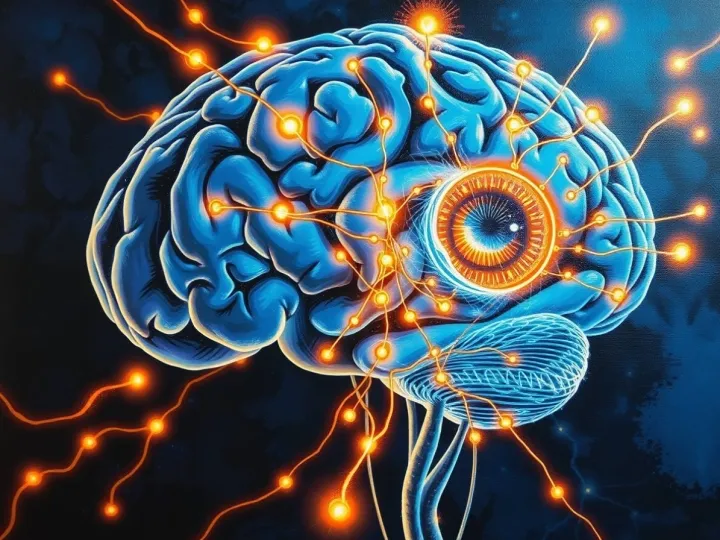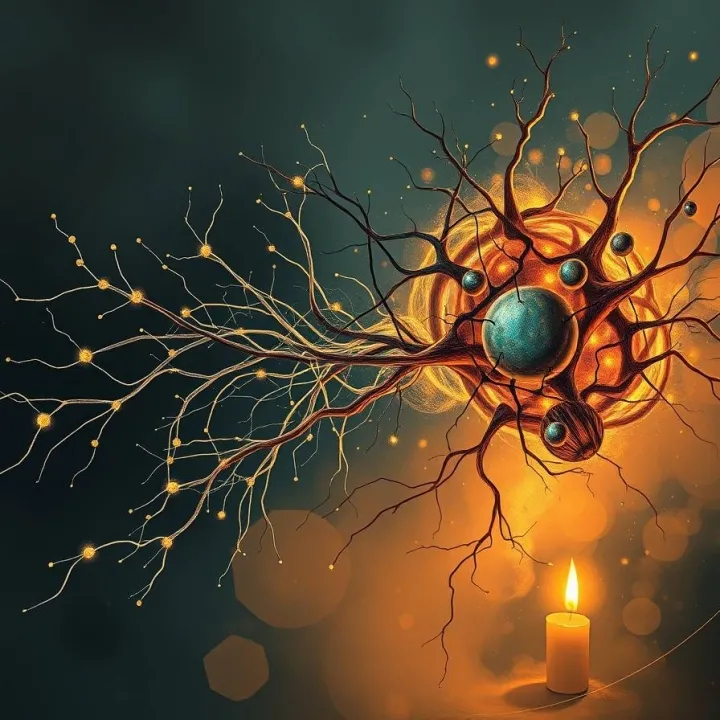
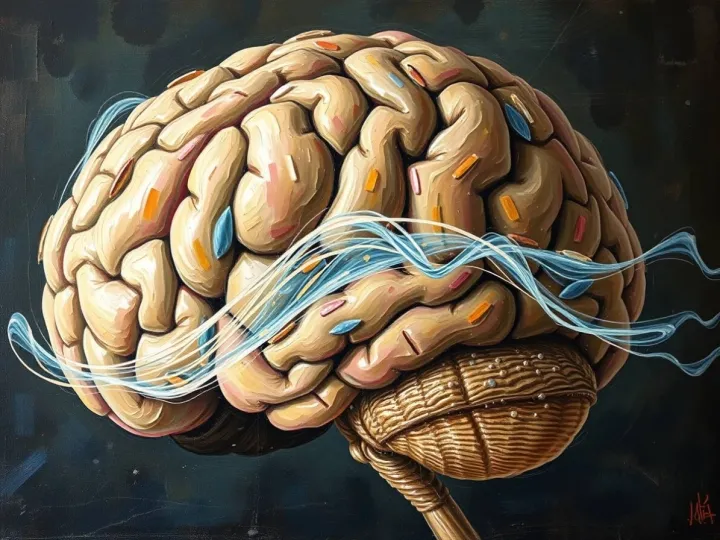
Two interwoven neural networks, one lemniscal and the other extralemniscal, radiating from the thalamus to the cortex.

Before Thought: The Brain's Hidden Alarm System

When you hear a sudden sound or feel an unexpected touch, your brain responds faster than thought itself. A new Brain study shows these reactions don't come only from the known, high-fidelity sensory pathways. Instead, a second, "extralemniscal" system - diffuse, fast, and supramodal - triggers a global cortical reset that readies the entire brain to act. This discovery challenges decades of neuroscience and redefines how scientists interpret signals of perception and consciousness.

October 23, 2025 in Cognitive Science


When you hear a sudden crash, feel a cold touch, or catch a flash of light in your periphery, your brain reacts before you even know what happened. For decades, scientists believed such sensory events traveled through specialized, high-fidelity channels - each dedicated to a single sense like vision, hearing, or touch. But a new study published in Brain by Richard Somervail and colleagues from the Italian Institute of Technology and University College London reveals something far more complex: these reactions are driven not by one, but by two intertwined neural systems.

The familiar one, called the lemniscal system, is precise and orderly. It follows the classic thalamocortical route - information moving from the thalamus to primary sensory cortices, allowing us to perceive sound, sight, or pressure with fine detail. But the newly emphasized extralemniscal system is diffuse, fast, and radically non-specific. It doesn't care what kind of signal arrives - only that something in the environment has suddenly changed.


A Second, Hidden Channel in the Brain

Somervail's team reviewed decades of research and modern brain imaging to show that sudden and isolated sensory stimuli (SISS) - brief, unexpected events - activate this extralemniscal network through the midline and intralaminar nuclei of the thalamus. Instead of targeting a single cortical region, it projects broadly across the brain, producing one of the most powerful and widespread electrical signatures ever recorded in neuroscience: the vertex potential (VP).

First identified in the 1930s and often misinterpreted as a sensory-specific response, the VP is a large, symmetrical electrical wave seen in EEG recordings at the top of the head. It appears in response to sounds, flashes, and touches alike - evidence of its supramodal nature. In other words, it's not about the content of perception, but about change itself.


The Brain's Global "Reset" Mechanism

The authors describe this extralemniscal burst as a kind of cortical reset - a sudden interruption of ongoing brain activity, followed by a surge in excitability that prepares the organism to act. Within milliseconds, neural circuits across the cortex become synchronized, awareness heightens, and the body is ready for immediate response. It's an elegant adaptation: a biological reflex for attention, arousal, and survival.

This process mirrors what happens during the brain's K-complexes and slow waves in sleep - a temporary shutdown and restart that helps maintain equilibrium. During wakefulness, however, the reset is subtle and strategic. It stops nonessential activity so the brain can focus on the most important signal: what just changed, and what does it mean?


Rethinking Consciousness and Perception

Here lies the study's most provocative claim. Many famous neuroscience experiments - especially those searching for the "neural correlates of consciousness" (NCC) - may have mistaken this extralemniscal activity for consciousness itself. The P3 or P300 wave, often considered a hallmark of awareness, shares nearly identical timing and topography with the vertex potential. Yet both vanish under anesthesia and reappear during sudden stimulation, even when participants are unaware of what triggered them.

According to Somervail and colleagues, these signals may not represent conscious perception, but rather the brain's readiness to perceive. Conscious awareness, they argue, likely emerges afterward, in the slower, sustained activations of sensory cortices - not in the instantaneous flash of the VP.

This reinterpretation challenges decades of "pain matrix" studies and other work that linked widespread cortical activity to emotional or perceptual experiences. What researchers have been observing, the authors suggest, might instead be the brain's orienting mechanism - its alarm system - rather than the feeling or awareness itself.


Beyond Theoretical Debates

Beyond theoretical debates, the two-system model carries practical implications for medicine and neuroscience. It could clarify why certain neurological conditions, like Fragile X syndrome, show abnormal sensitivity to sudden stimuli. In these cases, the extralemniscal system may be overactive, causing the brain to overreact to every change in the environment. It may also refine how clinicians interpret EEG and fMRI results in pain, anesthesia, and consciousness research - helping distinguish between awareness, reflex, and readiness.


A Shift in Understanding

The study reopens a forgotten chapter of neurophysiology. Once well-documented but later omitted from modern textbooks, the extralemniscal system may be one of the brain's oldest evolutionary mechanisms - a distributed web designed for vigilance, bridging sensory and motor systems across the entire cortex.

By restoring it to scientific attention, Somervail and his team offer a unifying perspective: our brains are not only information processors but prediction breakers, constantly recalibrating to an unpredictable world. Awareness, in this light, begins not with the details of what we sense - but with the shock that something new has arrived.
References

Richard Somervail, Sofija Perovic, Rory J Bufacchi, Roberto Caminiti, Gian Domenico Iannetti (2025). A two-system theory of sensory-evoked brain responses. [Brain] https://doi.org/10.1093/brain/awaf402...

Leave a Comment


Brain Debate Deepens: Frontal and Sensory Theories of Consciousness Both Hold Weight
Sep 24, 2025 Cognitive Science

Brain Debate Deepens: Frontal and Sensory Theories of Consciousness Both Hold Weight

Is consciousness born in the back of the brain, where sensory signals first converge - or in the front, where thought, memory, and decisions take shape? A new open-access study in Neuroscience of Consciousness finds evidence for both views. Using advanced computational modeling of EEG data, researchers show that awareness depends on feedback loops spanning both sensory and frontal cortices, with only a slight edge for frontal involvement.

Transcranial Direct Current Stimulation Alters Brain Dynamics Across States of Consciousness
Aug 27, 2025 Cognitive Science

Transcranial Direct Current Stimulation Alters Brain Dynamics Across States of Consciousness

Can a mild electrical current change how the brain organizes itself across wakefulness and unconsciousness? A new study in macaques reveals that prefrontal transcranial direct current stimulation (tDCS) profoundly alters dynamic brain connectivity. Cathodal stimulation simplified and stabilized patterns in the awake state, while high-intensity anodal stimulation reshaped unconscious brain dynamics under anesthesia. These polarity-dependent effects suggest that tDCS is not only a tool for modulating vigilance but also a window into the neural architecture of consciousness - with far-reaching clinical implications for awakening patients from disorders of consciousness and refining anesthetic recovery.

The Rhythm Beneath Thought: How Brain Dynamics Shape the Mind
Oct 17, 2025 Cognitive Science

The Rhythm Beneath Thought: How Brain Dynamics Shape the Mind

Every thought we have is born not in silence, but in motion. Beneath the brain's surface-level responses lies a vast field of hidden activity - waves, fluctuations, and timescales that organize consciousness itself. In a groundbreaking paper, Brain Dynamics Shape Cognition (Northoff, Wolman, Zhang, 2025), scientists reveal how these neural rhythms form the Dynamic Layer Model of the Brain (DLB) - showing that cognition is not built on static functions, but on temporal architecture. Spatiotemporal Neuroscience now offers a unified view: the brain's background dynamics continuously sculpt its foreground thoughts, making perception itself a dance between time, structure, and awareness.

When the Brain Chooses Connection Over Fear: Rethinking the Negativity Bias
Oct 15, 2025 Neuroscience & Health

When the Brain Chooses Connection Over Fear: Rethinking the Negativity Bias

We've been told the brain is built to fear - that negative news and bad memories burn deeper than good ones. But new research shows a more human truth: when we see people, the mind chooses connection before threat. A study from the University of Göttingen found that images with social interaction - even happy ones - activate the brain faster than fearful scenes. The discovery challenges the long-standing "negativity bias," suggesting our first instinct isn't avoidance, but recognition. Awareness begins with relationship.

Arousal-Driven Brain Circuit Shows How Internal State Rewrites Vision
Nov 30, 2025 Cognitive Science

Arousal-Driven Brain Circuit Shows How Internal State Rewrites Vision

A new open-access study in Neuron reveals that vision is not a passive recording of the world but a dynamic, state-dependent computation shaped by internal brain signals. Researchers at MIT's Picower Institute mapped a specialized feedback circuit linking the prefrontal cortex with visual and motor areas in mice. They found that arousal and movement send targeted instructions that sharpen certain visual features while suppressing others. The findings show that what we see depends strongly on how alert, active, or behaviorally engaged we are - not only on the stimulus itself.

The Brain Behind the Myth: How Neuroscience Is Rediscovering Jungs Archetypes
Oct 21, 2025 Cognitive Science

The Brain Behind the Myth: How Neuroscience Is Rediscovering Jung's Archetypes

For more than a century, Carl Jung's idea of a "collective unconscious" - a shared layer of the psyche encoded in universal symbols - has fascinated and divided scientists. Now, neuroscience is catching up. A new study by Hugh McGovern, Marco Aqil, Selen Atasoy, and Robin Carhart-Harris argues that Jung's archetypes can be understood as eigenmodes of the deep brain - recurring patterns of neural activity that shape imagination, myth, and meaning itself. Using modern theories like the Free Energy Principle and Predictive Processing, the authors suggest that archetypes are not mystical relics but self-organizing harmonics of consciousness, occasionally revealed in dreams and psychedelic experiences.