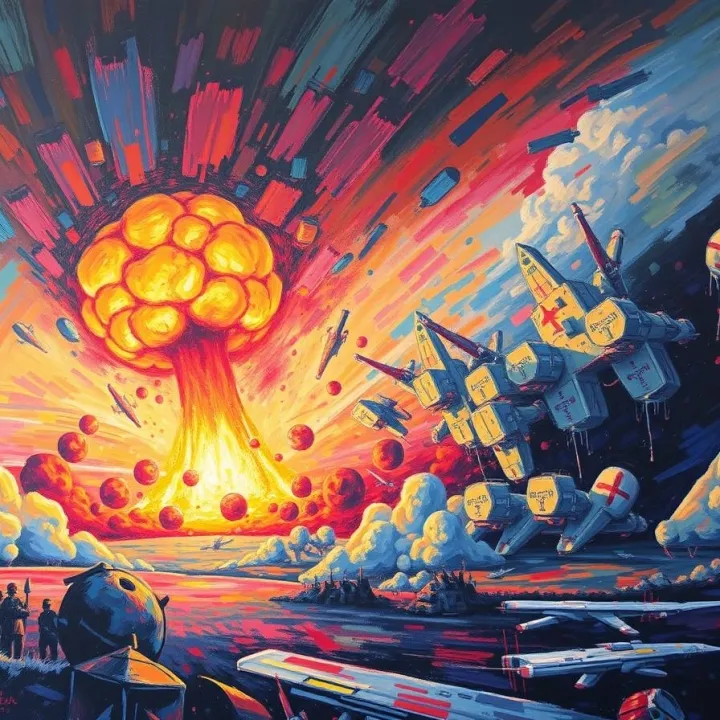
Surprise nuclear attack of the Cold War era, acrylic painting

When the World Refuses to Be Predicted: Ellsberg's Lesson on True Uncertainty

Before Daniel Ellsberg became known for leaking the Pentagon Papers, he was a thinker wrestling with a different secret - the nature of uncertainty itself. A recent analysis by economist Carlo Zappia (Cambridge Journal of Economics, 2025) uncovers how Ellsberg's early research at the RAND Corporation went beyond his famous "paradox." Behind the urns and probabilities lay a more radical message: the real world cannot be reduced to a list of known possibilities. True uncertainty, Ellsberg argued, is ontological - it exists in the very structure of reality, where surprise is inevitable and complete prediction impossible.

October 25, 2025 in Ethics & Governance


The Limits of Knowing

In the early 1960s, Ellsberg's work challenged the mathematical optimism of mainstream economics. The reigning model - known as Bayesian decision theory - assumed that even in uncertainty, rational agents could assign probabilities to every possible event. The world, in this view, might be complex but was ultimately calculable.

Ellsberg disagreed. In his 1961 paper introducing the Ellsberg Paradox, he showed that people systematically reject the idea of betting on unknown probabilities - not out of irrationality, but because they feel the weight of missing information. The human mind, he suggested, distinguishes between risk (known odds) and uncertainty (when the space of possibilities itself is incomplete).

But as Zappia reveals, Ellsberg's private and classified research went much further - into what philosophers call state-space uncertainty, where not only the outcomes but even the set of possible events cannot be known in advance.


From the Urn to the Unthinkable

While still a young analyst at RAND, Ellsberg was tasked with a grim problem: how could the U.S. command structure respond to a surprise nuclear attack during the Cold War? The question was not mathematical - it was existential. He concluded that no probabilistic model could describe such a scenario, because the list of "possible events" itself could never be complete. The conditions of a thermonuclear war, he warned, would bring unimaginable contingencies - outcomes that could not have been formulated beforehand.

Ellsberg described these as "happenings that were considered impossible or undreamt-of." To him, uncertainty was not ignorance - it was a feature of reality. The structure of the world itself generates novelty, surprise, and creation.


The Ontology of Surprise

This insight aligns Ellsberg with the philosopher-economist George Shackle, who argued that decision-making must include what he called the "residual hypothesis" - the fact that something truly unforeseen can always happen. Shackle insisted that a world capable of surprise is a non-deterministic, open system, where imagination, not calculation, becomes the true instrument of reasoning.

Ellsberg, Zappia shows, came to share this view. His later reflections reveal that the assumption of a complete state space - the idea that all possible futures can be enumerated - is not only unrealistic but dangerous. It blinds systems to surprise. In strategic planning, this means overconfidence; in economics, it means mistaking stability for control.

For Ellsberg, rationality required humility - the capacity to act under ontological uncertainty, where new realities can always emerge.


Ambiguity vs. True Uncertainty

Ellsberg's famous paradox inspired decades of research on ambiguity aversion - why people dislike unknown odds. But most of that literature, as Zappia points out, remains limited to what Ellsberg called "mild uncertainty." It assumes that the list of possibilities is still known - only the probabilities are fuzzy.

Ellsberg's deeper view was more radical. He distinguished between:

  • Epistemic uncertainty: when knowledge is incomplete but the world is fixed.
  • Ontological uncertainty: when the world itself is open-ended, and events arise that no model can foresee.

In this sense, Ellsberg anticipated what later thinkers - from post-Keynesians to complexity theorists - would call fundamental uncertainty. This is the uncertainty of real history, of innovation, of evolution, of human creativity.


The Courage to Think in an Open World

In Seven Reflections language, Ellsberg's work describes a shift from the logic of closure to the logic of emergence. A closed system assumes all outcomes are known - it seeks control through prediction. An open system accepts that reality itself is evolving - it seeks resilience through adaptation.

Ellsberg's insight was not pessimistic; it was deeply human. To live in a world of fundamental uncertainty is to live in a world still capable of surprise, novelty, and freedom. His "ontological commitment," as Zappia calls it, was a commitment to truth in unpredictability - an acknowledgment that meaning arises not from the elimination of risk, but from our ongoing encounter with the unknown.


Seven Reflections Insight

The paradox Ellsberg uncovered is not just economic - it's existential. Our need for certainty collides with a universe built on change. The deeper intelligence is not the one that foresees every outcome, but the one that remains flexible, ethical, and aware when facing what cannot be predicted. To think clearly in an open world is to let go of the illusion of mastery - and embrace the art of adaptive understanding.


References

Carlo Zappia (2025). On Ellsberg's commitment to dealing with the uncertainty of the real world. [Cambridge Journal of Economics] https://doi.org/10.1093/cje/beaf040...

Leave a Comment


From Quantum Resonance to Reality: Unifying USTE and CODES
Aug 27, 2025 Theory & Systems

From Quantum Resonance to Reality: Unifying USTE and CODES

What if space-time isn't fundamental, but something that emerges from the deep rhythms of quantum information? A new synthesis of two bold frameworks - Unified Space-Time Emergence (USTE) and the Chirality of Dynamic Emergent Systems (CODES) - suggests that reality itself may be built not from particles and forces, but from structured resonance.

Energy as Reality: Rethinking the Foundations of Physics
Sep 10, 2025 Theory & Systems

Energy as Reality: Rethinking the Foundations of Physics

What if energy is not just a quantity, but the substance of reality itself? This article rethinks physics from the ground up, showing how particles, fields, and even galaxies may all be stable waveforms of a single energetic continuum. From particles to galaxies, what we see as matter may be nothing more than stable shapes of a single, infinite process.

When Mathematics Meets Instinct: The Rise of Analytical Intuition
Oct 21, 2025 Creativity & Performance

When Mathematics Meets Instinct: The Rise of Analytical Intuition

For decades, intuition was seen as the opposite of logic - an unreliable whisper in a world ruled by data. But a growing body of research suggests that intuition is not the enemy of analysis; it's the missing half. A new study by Konstantinos V. Katsikopoulos and Gerd Gigerenzer shows that simple, mathematically defined "fast-and-frugal heuristics" can outperform advanced algorithms when the world is uncertain. The message is clear: intuition, when formalized, can be one of the most powerful analytical tools we have.

How the Brain Learns: The Hidden Architecture of Reward and Connection
Oct 18, 2025 Cognitive Science

How the Brain Learns: The Hidden Architecture of Reward and Connection

From food to friendship, the human brain is constantly learning what to seek and what to avoid. But new research suggests that reward - the driving force behind learning - is not just an external event or a burst of dopamine. It begins deep inside the body, where every meal, heartbeat, and breath shapes the way we learn, connect, and evolve. A trio of recent papers in Trends in Cognitive Sciences is reshaping how neuroscientists understand learning and motivation - revealing that reward signals arise from internal physiological states, extend through social dynamics, and may hold the key to more natural forms of artificial intelligence.

The Brains Secret Trick for Turning Uncertainty into Belief
Sep 18, 2025 Cognitive Science

The Brain's Secret Trick for Turning Uncertainty into Belief

When we face the unknown, the brain does something remarkable: it lets itself wander. Neural activity grows more variable, as if entertaining many possible realities at once. But as evidence accumulates and clarity emerges, that variability compresses. A new study shows this quieting of the brain is not random - it is the hidden signal of belief taking shape.

The Art of Explanation: Three Ways Humans Create Understanding
Oct 25, 2025 Theory & Systems

The Art of Explanation: Three Ways Humans Create Understanding

Every conversation hides a miracle: one mind trying to help another see. According to a new paper in The Philosophical Quarterly, explanation isn't just about giving information - it's about building understanding. Philosophers Grzegorz Gaszczyk and J. P. Grodniewicz propose that explaining is a practice with structure and purpose. Like music, it comes in distinct movements: the minimal, the customized, and the interactive explanation. Each serves a different rhythm of thought - and together, they reveal how humans make meaning visible.