Cognitive Science bridges the gap between the brain and the mind - tracing how networks of neurons shape perception, attention, memory, and imagination. This section explores the science of thinking and awareness, from the role of the default mode network in creativity to the mechanisms of focus, flow, and altered states. By bringing together neuroscience, psychology, and philosophy, we highlight the discoveries that reveal not only how the mind works, but how it can be expanded.
Early trauma doesn't just live in memory - it reshapes the mind itself. A groundbreaking Schizophrenia Bulletin study finds that developmental trauma alters key brain regions responsible for processing fear and emotion, especially the left amygdala. These structural changes create lasting vulnerability to hallucinations and delusions later in life, offering powerful new insight into how the brain transforms fear into perception - and how healing might begin by restoring balance between memory, meaning, and threat.
A new study in the ELT Journal revisits an idea that may soon define what separates human intelligence from artificial systems: agency - the sense of ownership and control over one's actions. As generative AI reshapes education, researchers Jian Tao and Xuesong Gao argue that both learners and teachers must reclaim their role as active decision-makers, not passive processors. Their analysis offers a deeper question for the future of learning itself: what does it mean to act intentionally in a system increasingly designed to act for us?
A new study published in Social Cognitive and Affective Neuroscience reveals that faces capture attention differently in adults with ADHD and autism spectrum disorder (ASD). While adults with ADHD display an exaggerated bias toward faces - suggesting hyperactive social salience - autistic adults show no such effect, pointing to a divergence in how social information is processed at the neural level. These findings challenge the idea of a shared attention mechanism across neurodevelopmental disorders and illuminate how dopamine and oxytocin may uniquely shape human social cognition.
Can imagination become too real? A new open-access study in Schizophrenia Bulletin Open suggests that our inner world of images and feelings can, under pressure, transform into voices we hear. Researchers Hella Janssen and colleagues have discovered that mental imagery and anxiety interact dynamically to produce and sustain auditory verbal hallucinations (AVHs) - the experience of hearing voices without external sound. Their findings bridge psychology and perception, revealing how the brain's capacity for imagination can cross the threshold into experience.
Why do we call one thing "pretty" and another "beautiful"? A new open-access study from The British Journal of Aesthetics offers a surprising answer: beauty is not just about appearances. Philosopher Ryan P. Doran has found that beauty, unlike prettiness, is what scientists call a dual-character concept - something that carries both a descriptive surface (how something looks) and a normative depth (what it represents or embodies). In other words, beauty touches values, ideals, and moral truth - while prettiness remains on the surface.
A name is a doorway - both into being and into confinement. To be named is to be recognized, and yet also to be bound. In Naming and Namelessness (Annual Review of Anthropology, 2025), anthropologist Scott MacLochlainn explores this paradox, tracing how the simple act of naming - whether of people, gods, diseases, or nations - organizes the very logic of recognition. His review turns a mirror toward anthropology itself, revealing that naming is never a neutral gesture: it's an operation of power, an art of containment, and sometimes, a quiet refusal to be captured at all.
When you hear a sudden sound or feel an unexpected touch, your brain responds faster than thought itself. A new Brain study shows these reactions don't come only from the known, high-fidelity sensory pathways. Instead, a second, "extralemniscal" system - diffuse, fast, and supramodal - triggers a global cortical reset that readies the entire brain to act. This discovery challenges decades of neuroscience and redefines how scientists interpret signals of perception and consciousness.
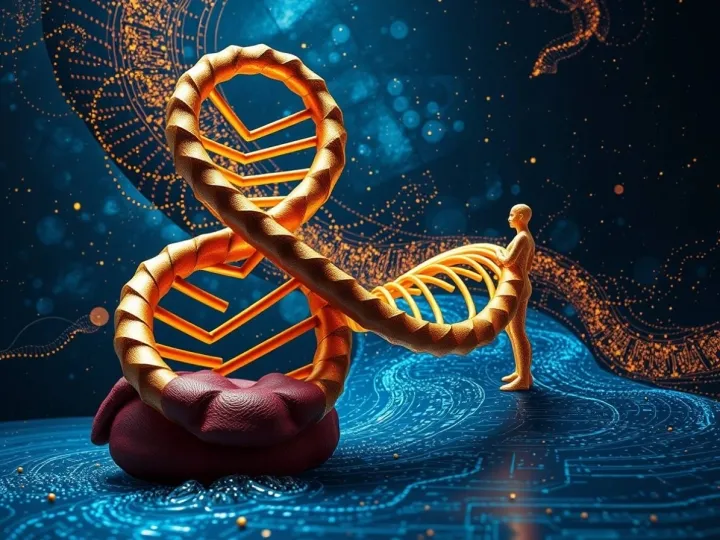
For decades, scientists have dreamed of an intelligent system that could read the human genome as fluidly as we read language. Now that dream is taking form. Genos, a new human-centric genomic foundation model developed in China and published in GigaScience (2025), represents a turning point in biological AI. Designed to understand sequences a million base pairs long, Genos learns the "grammar of life" directly from human DNA - not across species, but within us. With its advanced Mixture-of-Experts architecture and precision at the single-nucleotide level, it opens the door to a new era of precision medicine, where genetic understanding becomes both scalable and personal.
Every act of choice hides a small miracle. At any moment, the human brain can silence habit, imagine alternatives, and redirect behavior toward a distant goal. This ability - known as cognitive control - is the mind's steering wheel. A new synthesis by cognitive neuroscientist David Badre reveals that this steering depends not on a single "executive center" but on an evolving architecture of representations: mental blueprints that determine how we select, monitor, and revise our own thoughts. Cognitive control, he argues, is less a module than a living control system - one that continuously learns how to balance freedom and order.