Explore current research and scientific developments curated by Seven Reflections. This section serves as our future home for official press releases - bridging the gap between discovery, structure, and meaning across science and society.
Can a single number reflect how conscious the brain is? In a new fMRI study, researchers applied Integrated Information Theory (IIT 4.0) to real human data and computed integrated information - known as Phi - across multiple brain-network configurations. Phi dropped during propofol sedation and deep non-REM sleep and rose again in recovery and REM sleep, but via different network routes: anesthesia showed global and frontal "workspace-like" changes, whereas sleep shifts were strongest in posterior systems.
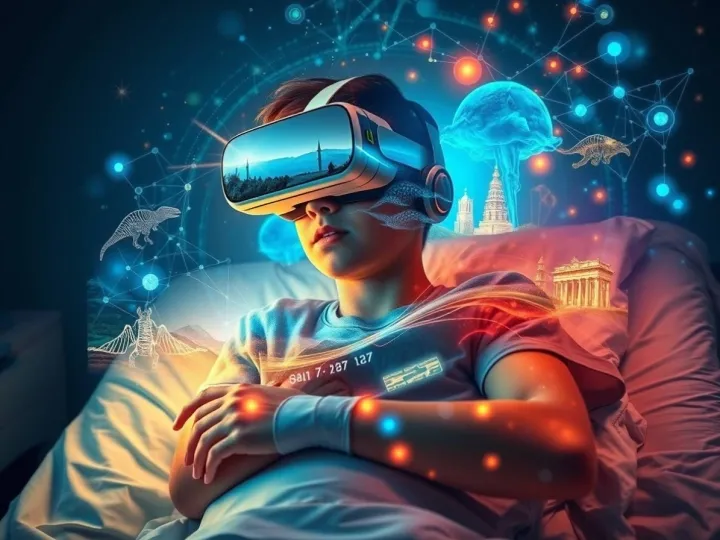
Virtual reality isn't just novel - it's relieving real pain at the bedside. A new systematic review and meta-analysis of 11 randomized trials (n=936) reports a moderate-to-large reduction in procedural pain during burn and wound treatment, with the strongest effects in children and findings robust to sensitivity checks; despite study differences, tests found no significant publication bias. Clinically, the mechanism aligns with "presence-driven" attention capture: immersive environments pull focus away from nociception and have been linked to >50% reductions in activity across pain-processing hubs like the anterior cingulate cortex and insula.
Scientists have unveiled a powerful new brain-mapping method that sheds light on how men and women use their left and right hemispheres differently. The approach, inspired by advances in artificial intelligence, goes beyond traditional brain scans to detect subtle patterns of lateralization. The findings challenge decades of assumptions in neuroscience and point toward more personalized treatments for mental health and neurological conditions.
Loneliness does more than affect mood - it changes how the mind anticipates emotions. New research with over 1,700 participants shows that lonely individuals expect others to be more volatile, misjudge how emotions shift, and assume their own positive feelings will fade quickly. These distorted predictions make it harder to connect, reinforcing isolation. By uncovering the cognitive patterns behind loneliness, this study highlights new possibilities for interventions that could strengthen emotional forecasting and repair social bonds.
Can a mild electrical current change how the brain organizes itself across wakefulness and unconsciousness? A new study in macaques reveals that prefrontal transcranial direct current stimulation (tDCS) profoundly alters dynamic brain connectivity. Cathodal stimulation simplified and stabilized patterns in the awake state, while high-intensity anodal stimulation reshaped unconscious brain dynamics under anesthesia. These polarity-dependent effects suggest that tDCS is not only a tool for modulating vigilance but also a window into the neural architecture of consciousness - with far-reaching clinical implications for awakening patients from disorders of consciousness and refining anesthetic recovery.
What if doing too much could kill your brain cells? A new study shows that chronic overactivation of dopamine neurons in the midbrain is enough to make them degenerate - offering fresh insight into why certain neurons die in Parkinson's disease.
What if space-time isn't fundamental, but something that emerges from the deep rhythms of quantum information? A new synthesis of two bold frameworks - Unified Space-Time Emergence (USTE) and the Chirality of Dynamic Emergent Systems (CODES) - suggests that reality itself may be built not from particles and forces, but from structured resonance.
For years, the default mode network (DMN) has been crowned the brain's creative hub - the place where daydreaming, free association, and sudden insights arise. But a new opinion paper in Current Opinion in Behavioral Sciences argues that this tidy story may be misleading. The evidence, researcher Anna Abraham says, is far too inconsistent and individual creativity far too varied to pin down to a single network.
Balancing opposites may be one of the most powerful skills a leader can bring to the workplace. A new study in the Journal of Business Research finds that "paradoxical leadership" - managing with both firmness and flexibility, control and empowerment - fuels employee creativity by expanding the way people think and adapt.