Paradoxal creativity lucid dreaming brain cognitive network

How Paradoxical Leaders Spark Employee Creativity

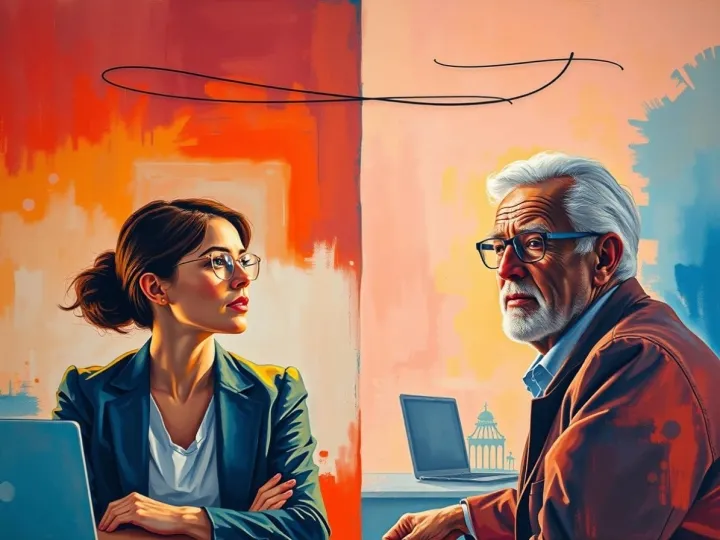
Balancing opposites may be one of the most powerful skills a leader can bring to the workplace. A new study in the Journal of Business Research finds that "paradoxical leadership" - managing with both firmness and flexibility, control and empowerment - fuels employee creativity by expanding the way people think and adapt.

August 27, 2025 in Business & Workplace


Leaders often face conflicting demands: set clear rules, but allow freedom; demand results, but show empathy. Rather than seeing these as contradictions, paradoxical leaders embrace both sides. According to new research from China, this leadership style significantly boosts employee creativity by shaping how employees process information.

The study surveyed over 400 supervisor-employee pairs in high-tech firms, followed by a cross-lagged online study with another 355 employees. Results showed that paradoxical leadership strengthens two critical cognitive processes: cognitive complexity (the ability to integrate multiple perspectives) and cognitive flexibility (the ability to shift perspectives and adapt). Both traits are directly tied to generating creative ideas.

However, not all employees respond the same way. The researchers found that perception matters:

  • When employees appraised challenges as opportunities for growth, paradoxical leadership amplified their creativity even further.
  • But when they saw challenges as hindrances, the same leadership behaviors could lose effectiveness.

In other words, paradoxical leadership is not a "one-size-fits-all" approach. It works best in environments where employees are primed to view complexity as an invitation to grow, rather than as a barrier.

For organizations, the findings underline the importance of leadership development that embraces nuance - teaching managers to navigate contradictions without defaulting to either/or thinking. At the same time, it suggests HR strategies should foster a workplace culture where challenges are framed as growth opportunities, not obstacles.

As the researchers conclude, employee creativity is not only about motivation or resources - it also depends on how leaders influence the way people think. By cultivating both complexity and flexibility, paradoxical leaders help employees generate the fresh, useful ideas organizations need to stay competitive.


References

Zhang, Y., & Zhang, Y (2025). Paradoxical leadership and employee creativity: The role of cognitive complexity and flexibility. [Journal of Business Research, 158, 115542] https://www.sciencedirect.com/science/ar...

How Age Shapes Leadership Effectiveness in Todays Workplace
Nov 26, 2025 Cognitive Science

How Age Shapes Leadership Effectiveness in Today's Workplace

As workforces become older and more age-diverse, leadership no longer functions the same way for everyone. A new systematic review of nearly 40 years of research shows that leadership styles interact with employee age in complex, measurable ways - boosting wellbeing for some groups while influencing retention or performance for others. Younger, midlife, and older workers respond differently not because of stereotypes, but because motivation, goals, and cognitive priorities shift across the lifespan. Understanding these patterns may help organizations build healthier, more adaptive, and more age-inclusive workplaces.

When Work Keeps Changing: APA Survey Finds AI, Remote Shifts, and Mental Health on the Line
Sep 8, 2025 Business & Workplace

When Work Keeps Changing: APA Survey Finds AI, Remote Shifts, and Mental Health on the Line

Change is no longer the exception - it's the daily reality of work. The APA's 2025 Work in America™ Survey reveals how AI adoption, shifting work arrangements, and mental health pressures are reshaping the employee experience. Some workers are thriving on productivity gains, while others struggle with uncertainty, stress, and a widening gap between leadership and the front lines.

Why Creativity Cant Be Reduced to One Brain Network
Aug 27, 2025 Creativity & Performance

Why Creativity Can't Be Reduced to One Brain Network

For years, the default mode network (DMN) has been crowned the brain's creative hub - the place where daydreaming, free association, and sudden insights arise. But a new opinion paper in Current Opinion in Behavioral Sciences argues that this tidy story may be misleading. The evidence, researcher Anna Abraham says, is far too inconsistent and individual creativity far too varied to pin down to a single network.

How Social Control Shapes Organizational Culture and Performance
Nov 9, 2025 Business & Workplace

How Social Control Shapes Organizational Culture and Performance

A new open-access study in The Journal of Law, Economics, and Organization offers a formal model of how organizational culture emerges and evolves through social control. Economist Mark Gradstein examines how management influences employees' values and norms - through rewards, penalties, and shared commitment - to achieve coordination and cohesion. The analysis shows that loyalty and social pressure can substitute for financial incentives in shaping behavior and that tighter alignment of cultural norms correlates with improved firm performance.

When Mathematics Meets Instinct: The Rise of Analytical Intuition
Oct 21, 2025 Creativity & Performance

When Mathematics Meets Instinct: The Rise of Analytical Intuition

For decades, intuition was seen as the opposite of logic - an unreliable whisper in a world ruled by data. But a growing body of research suggests that intuition is not the enemy of analysis; it's the missing half. A new study by Konstantinos V. Katsikopoulos and Gerd Gigerenzer shows that simple, mathematically defined "fast-and-frugal heuristics" can outperform advanced algorithms when the world is uncertain. The message is clear: intuition, when formalized, can be one of the most powerful analytical tools we have.

How Social Media Influencers Mobilize Collective Action: The Hidden Power of Parasocial Bonds
Oct 24, 2025 Ethics & Governance

How Social Media Influencers Mobilize Collective Action: The Hidden Power of Parasocial Bonds

In the digital age, influence is less about algorithms and more about connection. A groundbreaking study in Human Communication Research reveals that social media influencers can inspire real political participation - not by persuasion alone, but through the emotional closeness their followers feel toward them. When influencers speak about issues like climate change using collective language ("Together, we can make a difference"), they activate a shared sense of purpose that transforms audiences into communities of action.