Jefferson grew up in the Virginia piedmont as the son of Peter Jefferson, a surveyor and planter who amassed substantial land, and Jane Randolph, whose family belonged to the colony's established gentry. After his father's death he inherited property and slaves, and he attended the College of William & Mary, where he joined a circle of Enlightenment-minded teachers and students, including the legal scholar George Wythe. He read law, was admitted to the bar, and began practicing while managing his growing estate, which he would eventually build into the mountaintop plantation he called Monticello.
He entered the Virginia House of Burgesses in 1769 and quickly allied with critics of British authority. His 1774 pamphlet A Summary View of the Rights of British America argued that the colonies owed allegiance to the king but not to Parliament, and it made his reputation as a forceful writer. Sent to the Second Continental Congress in 1775, he was chosen in June 1776 to draft the Declaration of Independence. The committee and Congress edited his text, but the document's assertions of natural rights and government by consent became founding statements of the new nation.
Jefferson returned to Virginia and served in its legislature, where he pushed through reforms including a bill that became the Virginia Statute for Religious Freedom, a landmark for separating church and state. He was governor of Virginia from 1779 to 1781, a tenure shaken when British forces under Benedict Arnold and Lord Cornwallis invaded the state. His wife, Martha Wayles Skelton, died in 1782 after a decade of marriage, a loss he felt deeply.
In the 1780s he represented the United States in France, succeeding Benjamin Franklin as minister, and observed the early stirrings of the French Revolution. President George Washington made him the first secretary of state in 1790, where he clashed repeatedly with Treasury Secretary Alexander Hamilton over the balance of federal power. Their rivalry helped shape the first party system, with Jefferson leading the Democratic-Republicans. He served as vice president under John Adams before defeating Adams in the bitterly contested election of 1800, which was decided in the House of Representatives after tying with Aaron Burr.
As the third president, from 1801 to 1809, Jefferson cut federal spending and the national debt, and in 1803 he authorized the Louisiana Purchase, roughly doubling the country's territory. He dispatched the Lewis and Clark expedition to explore the new western lands. His second term was dominated by the Embargo Act of 1807, an attempt to avoid war with Britain and France by halting American trade, which damaged the economy and proved unpopular.
After leaving office he retired to Monticello, where he pursued architecture, science, and an extensive correspondence, notably with his old rival John Adams. His most ambitious late project was the founding of the University of Virginia in Charlottesville, for which he designed the buildings and shaped the curriculum. Persistent debt threatened his estate, and he died on July 4, 1826, the fiftieth anniversary of the Declaration and hours apart from Adams.
Jefferson's legacy is bound up with the contradiction between his words and his life. He enslaved more than six hundred people over his lifetime, and the Declaration's claims of liberty coexisted with his ownership of human beings. Historical and genetic evidence indicates he fathered children with Sally Hemings, an enslaved woman at Monticello. Americans continue to weigh his contributions to democratic thought against these realities.
Thomas Jefferson was born on April 13, 1743. In Cardology (Destiny Cards), April 13, 1743 corresponds to the Eight of Diamonds, making the Eight of Diamonds his Birth Card.
In numerology, the name adds another layer to the birth-date profile. The letters of a person’s name are used to explore inner motivation, personality, expression, and the qualities they bring into relationships and everyday life. Explore how her original name Thomas Jefferson influences her life and personality.
Thomas Jefferson Quotes
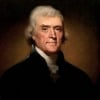
“Honesty is the first chapter in the book of wisdom.” - Thomas Jefferson
Famous Aries People
Discover famous Aries people, from actors and musicians to writers, athletes, and historical figures. Explore their birthdays and biographies, and see who shares the Aries zodiac sign.






View All Famous Aries People →
Famous People born on April 13
View All Famous People Born on April 13 →
Eight of Diamonds Famous People


View All Famous Eight of Diamonds People →