Hemingway grew up in a comfortable, religious household, the second of six children of a physician father and a musically trained mother who taught music. His parents encouraged outdoor pursuits and music, and the family spent summers at a Michigan lake, where he learned to fish and hunt. At his high school he wrote for the school paper and yearbook, showing an early interest in journalism and fiction. After graduating in 1917, he took a job as a reporter for The Kansas City Star, whose style guide urged short sentences and vigorous prose - lessons that stayed with him.
In 1918 he joined the Red Cross as an ambulance driver in Italy. Wounded by mortar fire near the Piave River, he received Italy's Silver Medal of Military Valor and spent months recovering in a Milan hospital, where he fell in love with an American nurse. The experience supplied material for A Farewell to Arms and shaped his recurring subject: courage under pressure and the wounds, physical and emotional, left by war.
After the war he worked as a journalist in Toronto and Chicago, married Hadley Richardson in 1921, and moved with her to Paris. There he covered international news and joined a circle of expatriate artists and writers that included Gertrude Stein, Ezra Pound, and F. Scott Fitzgerald. A small-press collection, Three Stories and Ten Poems (1923), and the stories in In Our Time (1925) established his iceberg theory of omission - the idea that a story's deeper meaning could lie beneath a restrained surface. The Sun Also Rises (1926), about disillusioned expatriates in Paris and Spain, made him a leading voice of the Lost Generation.
A Farewell to Arms (1929), a tragic love story set in wartime Italy, confirmed his commercial and critical success. He followed it with nonfiction on bullfighting (Death in the Afternoon, 1932) and safari hunting (Green Hills of Africa, 1935), as well as the novel To Have and Have Not (1937). Reporting on the Spanish Civil War for American newspapers gave him the material for For Whom the Bell Tolls (1940), his novel about an American explosives expert fighting with Republican forces. During these years his marriages to Pauline Pfeiffer and Martha Gellhorn, his homes in Key West and Cuba, and his celebrity as a hunter and fisherman became part of his public identity.
The novel Across the River and into the Trees (1950) was poorly received, but The Old Man and the Sea (1952), a short novel about an old Cuban fisherman's struggle with a giant marlin, restored his reputation. It won the Pulitzer Prize for Fiction in 1953, and in 1954 he received the Nobel Prize in Literature. By then injuries from two plane crashes in Africa, years of heavy drinking, and depression had taken a toll. He died by suicide in Ketchum, Idaho, in 1961.
Posthumous publications included A Moveable Feast (1964), Islands in the Stream (1970), and The Garden of Eden (1986), several of them shaped by editors. Hemingway's direct sentences, concrete detail, and understated emotion became a model for later fiction and journalism, even as scholars continue to debate his portrayal of masculinity, war, and gender.
Ernest Hemingway was born on July 21, 1899 in Oak Park, Illinois, United States. In Cardology (Destiny Cards), July 21, 1899 corresponds to the Seven of Clubs, making the Seven of Clubs his Birth Card.
In numerology, the name adds another layer to the birth-date profile. The letters of a person’s name are used to explore inner motivation, personality, expression, and the qualities they bring into relationships and everyday life. Explore how his original name Ernest Miller Hemingway influences his life and personality.
Ernest Hemingway Quotes
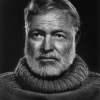
“The best way to find out if you can trust somebody is to trust them.” - Ernest Hemingway
Famous Cancer People
Discover famous Cancer people, from actors and musicians to writers, athletes, and historical figures. Explore their birthdays and biographies, and see who shares the Cancer zodiac sign.