Rockefeller grew up in a family shaped by two very different parents. His father, William Avery Rockefeller, was a traveling salesman and self-styled doctor whose long absences and questionable business dealings strained the household, while his mother, Eliza Davison Rockefeller, a devout Baptist, instilled discipline, thrift, and churchgoing habits. The family moved to Cleveland, Ohio, during his boyhood, and Rockefeller showed an early head for figures. He attended Central High School and took a course in bookkeeping at a commercial college before starting work at sixteen as an assistant bookkeeper for a commission merchant, where he learned the costs and margins of trade in close detail.
In 1859 he entered the produce commission business with a partner, Maurice B. Clark, and the firm prospered by supplying the Union Army during the Civil War. Rockefeller put his profits into a Cleveland oil refinery in 1863, judging that the young petroleum industry had more room to grow than produce trading. He bought out his partners in 1865 and, with associates including Henry M. Flagler and his brother William, incorporated the Standard Oil Company of Ohio in 1870. The company cut costs, built its own barrels and facilities, and negotiated secret rebates from railroads that gave it an edge over rivals.
Through the 1870s Standard Oil absorbed or drove out competitors in Cleveland, Pittsburgh, Philadelphia, and New York. In 1882 the partners organized the Standard Oil Trust to coordinate control of dozens of affiliated companies under a central board. By the early 1880s Standard Oil refined roughly ninety percent of the nation's crude oil. Its aggressive tactics drew growing criticism, most famously from journalist Ida Tarbell, whose 1904 history portrayed the trust as a ruthless monopoly. Ohio courts dissolved the original trust in 1892, and the enterprise was reorganized as a holding company, Standard Oil Company (New Jersey), in 1899.
Federal antitrust action eventually caught up. In 1911 the U.S. Supreme Court ruled that Standard Oil had illegally restrained trade under the Sherman Antitrust Act and ordered it broken into thirty-four separate companies. The descendants included firms that became Exxon, Mobil, Chevron, and Amoco. Far from ruining Rockefeller, the breakup multiplied the value of his shares as the new companies grew.
Rockefeller had already begun stepping back from daily management, retiring in 1897, and he devoted his later decades to giving away his fortune. He provided founding funds for the University of Chicago in 1890, helped establish the Rockefeller Institute for Medical Research in 1901 (now Rockefeller University), and created the Rockefeller Foundation in 1913. He also supported the education of Black women at Spelman College and backed large public-health campaigns, including work against hookworm disease in the American South. His philanthropic giving totaled in the hundreds of millions of dollars.
In 1864 Rockefeller married Laura Celestia Spelman, known as Cettie, a former schoolteacher; the couple had five children, including John D. Rockefeller Jr., who carried on the family's philanthropic work. A lifelong Baptist, Rockefeller remained notably frugal and abstemious in personal habits even amid immense wealth, and in retirement he took up golf and gardening. He died on May 23, 1937, at his winter home in Ormond Beach, Florida, at age ninety-seven. Estimates of his fortune at death vary, but by almost any measure he ranked among the richest Americans in history.
John D Rockefeller was born on July 8, 1839. In Cardology (Destiny Cards), July 8, 1839 corresponds to the Seven of Diamonds, making the Seven of Diamonds his Birth Card.
In numerology, the name adds another layer to the birth-date profile. The letters of a person’s name are used to explore inner motivation, personality, expression, and the qualities they bring into relationships and everyday life. Explore how his original name John Davison Rockefeller influences his life and personality.
John D Rockefeller Quotes
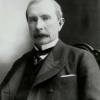
Famous Cancer People
Discover famous Cancer people, from actors and musicians to writers, athletes, and historical figures. Explore their birthdays and biographies, and see who shares the Cancer zodiac sign.




View All Famous Cancer People →
Famous People born on July 8




View All Famous People Born on July 8 →
Seven of Diamonds Famous People

View All Famous Seven of Diamonds People →