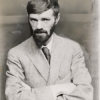
Roerich grew up in a prosperous, cultured family in imperial Russia. His father was a notary, and the household was well off. He studied at the Imperial Academy of Arts under Arkhip Kuindzhi while also taking a law degree at St. Petersburg University, and he took part in archaeological excavations that deepened his attachment to Russia's pre-Christian past. In the 1890s he joined the World of Art circle, which sought to bring Russian art into closer contact with European modernism.
His early paintings combined historical subjects with a symbolist palette, and his work as a stage designer brought him international recognition. For Sergei Diaghilev's Ballets Russes he designed the sets and costumes for the Polovtsian Dances from Alexander Borodin's Prince Igor in 1909 and for Igor Stravinsky's The Rite of Spring in 1913. These productions placed him at the center of the cosmopolitan avant-garde, even as he continued to paint Russian and later Himalayan landscapes.
After the 1917 revolution, Roerich found himself outside Soviet Russia. He lived briefly in Finland and London before moving to the United States in 1920. In New York he founded the Master Institute of United Arts and helped establish a museum devoted to his work. His interests were not confined to painting: with his wife Helena, whom he had married in 1901, he pursued Eastern philosophy, and together they became associated with the Agni Yoga teachings.
Between 1925 and 1928 Roerich led a large expedition through Central Asia, crossing India, Tibet, China, Mongolia, and the Altai region. The journey produced paintings, ethnographic observations, and plant and mineral specimens; it also reflected his mystical search for Shambhala. In 1928 he settled in the Kullu Valley of northern India, where he founded the Urusvati Himalayan Research Institute and continued to paint the mountains that became his signature subject.
Roerich's most enduring public achievement was the Roerich Pact, a treaty for the protection of artistic and scientific institutions and historic monuments during armed conflict. He campaigned for the idea in the United States and Europe, and representatives of 21 American republics signed the pact in Washington in 1935. After a further expedition to Manchuria in 1934 - 35, he remained in India, writing and painting until his death in 1947.
Nicholas Roerich was born on October 9, 1874 in Saint Petersburg, St.-Petersburg, Russia. In Cardology (Destiny Cards), October 9, 1874 corresponds to the King of Clubs, making the King of Clubs his Birth Card.
In numerology, the name adds another layer to the birth-date profile. The letters of a person’s name are used to explore inner motivation, personality, expression, and the qualities they bring into relationships and everyday life. Explore how his original name Nikolai Konstantinovich Rerikh (Николай Константинович Рерих) influences his life and personality.
Famous Libra People
Discover famous Libra people, from actors and musicians to writers, athletes, and historical figures. Explore their birthdays and biographies, and see who shares the Libra zodiac sign.