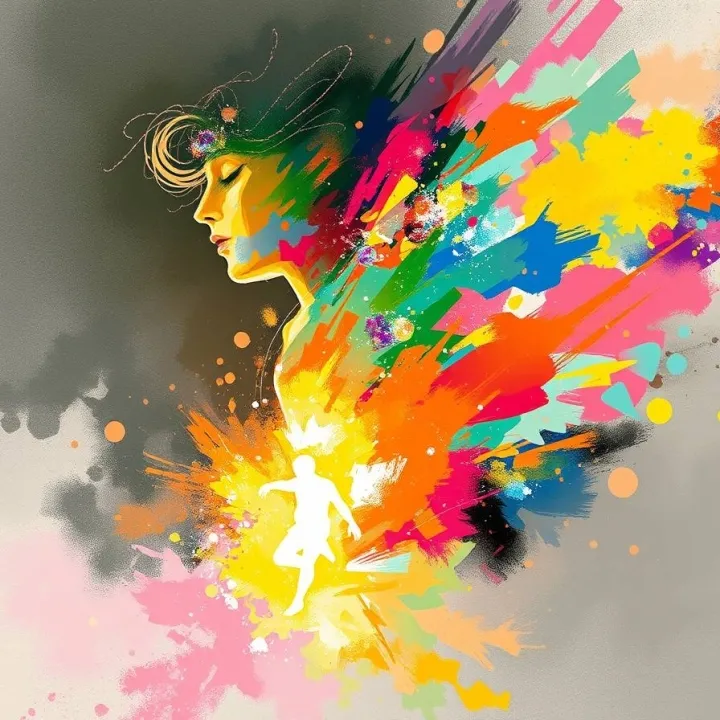
The question of what it means to "be" has haunted philosophy for centuries. Are we stable entities that persist through time, or are we patterns of motion and transformation? A recent chapter published by Oxford University Press reopens this debate, examining whether reality is made of enduring continuants or unfolding processes. The authors revisit classical ontology and contemporary metaphysics through the dialogue between two influential philosophers, Rowland Stout and Helen Steward, who challenge the boundaries between things, events, and processes.
The traditional distinction comes from Aristotle's concept of substance. In classical metaphysics, substances were the basic units of reality - things that exist in their own right. They persist through change while maintaining an essential core, and their properties may vary without altering their identity. The world, in this view, consists of stable entities: trees, rocks, humans, and stars. Change is secondary - a modification of what already exists. Process, in this framework, is the servant of substance. The horse runs, grows, and ages, but the horse itself remains a single, enduring thing.
By contrast, process philosophy, from thinkers such as Heraclitus, Bergson, and Whitehead, argues that the true fabric of reality is not made of things but of becoming. Everything that exists is in flux; identity itself is a rhythm, not a static state. From the flow of rivers to the structure of consciousness, process philosophers suggest that what endures is not the substance but the continuity of motion - a self-sustaining field of transformation.
The Oxford chapter places this philosophical tension under the microscope. It focuses on how we should understand "processes" - are they continuants, or are they something else entirely? Rowland Stout proposes that processes may actually qualify as continuants. His reasoning is subtle: a process, he argues, is "wholly present" at each moment of its unfolding. For example, a storm is not divided into fragments that separately exist in time; rather, the storm is present throughout its duration, unified by continuity. Helen Steward challenges this position, arguing that if something unfolds over time and has temporal parts, it cannot be wholly present in any given instant. Processes, she claims, are hybrid entities - not quite substances, not quite events - that occupy a liminal category between enduring and occurring.
This distinction matters because it reshapes how we conceive persistence, causality, and identity. If processes are continuants, then reality itself is composed of dynamic wholes that endure through change. If they are not, then processes are composed of temporal parts, more like events than entities. Each interpretation carries implications for science, consciousness, and systems thinking. In biology, for instance, organisms may appear to persist as stable units, yet every cell, molecule, and pattern within them is in constant flux. In cognitive science, identity might not be a fixed point but a pattern of neural coherence maintained through change. Even in physics, the shift from particle-based to field-based models reflects this same ontological evolution - from things to processes.
The metaphysical question is not academic; it defines the language of reality. In a substance-based ontology, identity depends on what remains unchanged. In a processual ontology, identity depends on what coherently transforms. Continuants are defined by endurance; processes, by resonance. Each framework offers a distinct way to understand existence, and neither alone captures the full picture of being.
The debate also intersects with time itself. To call something a continuant is to imagine it persisting across time - the same self reappearing in each moment. To call something a process is to accept that its identity is inseparable from time; the being and the becoming are one. In this view, even consciousness is not something that has experiences but is itself the continuous unfolding of experience. There is no gap between the dancer and the dance - the form is the motion.
Within the context of Seven Reflections' Dimensional Systems Architecture (DSA) framework, this debate finds a structural translation. The DSA model divides all systems into two interacting axes: the Logical (L) axis representing structure and stability, and the Temporal (T) axis representing change and transformation. Continuants correspond to the structural dimension - the architecture that maintains coherence. Processes correspond to the temporal dimension - the evolution and flow through which coherence persists. In DSA terms, a system endures not because it resists change, but because its field maintains resonance across transformation. Identity is thus not a static property but a dynamic signature - a field pattern that persists through alteration.
The DSA view reframes the entire philosophical question. Rather than asking whether we are things or processes, it asks how structure and transformation interact to create continuity. A living system - biological, cognitive, or societal - is a field in which form and flow are entangled. Continuity is achieved not through immobility but through adaptive resonance. Just as a melody remains recognizable even when played at a different tempo or pitch, a system's identity persists through the proportional harmony of its structural and temporal fields.
From this perspective, processual ontology becomes more than metaphysics; it becomes a logic of existence. The mind, for example, is not a container of thoughts but a pattern of dynamic relations between cognitive fields. The self is not an object but an ongoing process of structural coherence. Consciousness, rather than being an emergent property of matter, is the field through which matter and information stabilize their relationships across time.
Seen this way, the Oxford discussion between Stout and Steward can be understood as part of a broader intellectual evolution - a transition from object-based metaphysics to field-based reasoning. It mirrors the movement in modern science away from atomism toward systems theory and complexity. The universe, in this emerging view, is not a machine of parts but a fabric of relationships. Every system, from galaxies to neurons, persists through its capacity to self-regulate, adapt, and maintain resonance through change. Continuity is not a miracle of stability but a result of structured transformation.
In that light, the metaphysical question - "Are processes continuants- - becomes a deeper inquiry into the architecture of being. The DSA framework offers a synthesis: each process is a continuant within its own field, but only insofar as its resonance maintains integrity across change. The world is not divided into things and processes; rather, every thing is a stabilized process, and every process is a dynamic continuity of form. What persists is not the material, but the pattern.
The chapter's exploration of processual ontology thus resonates strongly with the Seven Reflections approach to cognition, consciousness, and structure. It reminds us that being and becoming are not opposites but reflections of the same underlying field dynamics. In that sense, the world is neither static nor chaotic. It is rhythmic - an architecture of transformation that sustains itself through the coherence of motion. The challenge for philosophy and science alike is not to choose between things and processes, but to learn how reality, consciousness, and structure interweave through the resonance that makes both possible.