Artificial intelligence is beginning to move from description to participation. A new paper in Briefings in Bioinformatics explores how large language model agents - autonomous systems capable of reasoning, planning, and taking action - are transforming bioinformatics and biomedicine. Unlike conventional models that only analyze data or generate text, these agents can interpret goals, execute workflows, and collaborate with other systems or human researchers. The result is a new generation of intelligent partners that can design drugs, interpret genomic data, and even assist in medical decision-making.
At the heart of this shift is the evolution from static models to dynamic agents. Traditional large language models such as GPT-4 or BioGPT are trained on vast datasets and can summarize research, generate code, or answer questions. Yet, they remain passive tools. LLM agents extend those capabilities by linking the model's reasoning to real-world action through APIs, databases, and laboratory systems. They are designed around four key components - perception, planning, action, and memory - allowing them to perceive data from many sources, plan multistep tasks, execute them through specialized software, and remember outcomes for future learning. In biomedical research, this means an AI system can automatically analyze RNA sequences, suggest experiments, write analysis scripts, and adjust its methods based on previous results.
This growing autonomy is already visible in laboratories and clinics. Agents such as DrugAgent and ChemCrow combine machine reasoning with chemistry databases to identify promising drug compounds and predict reaction conditions. ProtAgents and The Virtual Lab use collaborative frameworks to design and validate new proteins, while GeneAgent and BioMaster automate large-scale genomic and transcriptomic analyses. In clinical contexts, systems like MEDCO simulate interactions between virtual patients and trainees to improve diagnostic learning, and MDAgents supports physicians in decision-making by integrating text, images, and structured patient data. These are not isolated tools but entire ecosystems that can communicate, divide labor, and refine results through feedback loops.
The benefits are obvious, but so are the risks. The same creativity that allows an agent to discover a new molecule can also produce a plausible but false result - a phenomenon known as hallucination. When such errors occur in medical settings, they can have serious consequences. Privacy and security concerns are equally pressing, since biomedical agents often rely on sensitive genomic or clinical data. Ethical questions about responsibility remain unresolved: if an autonomous agent contributes to a misdiagnosis or flawed research, who is accountable - the developers, the institution, or the system itself? These issues highlight the need for transparency, auditability, and regulatory oversight before large-scale clinical deployment.
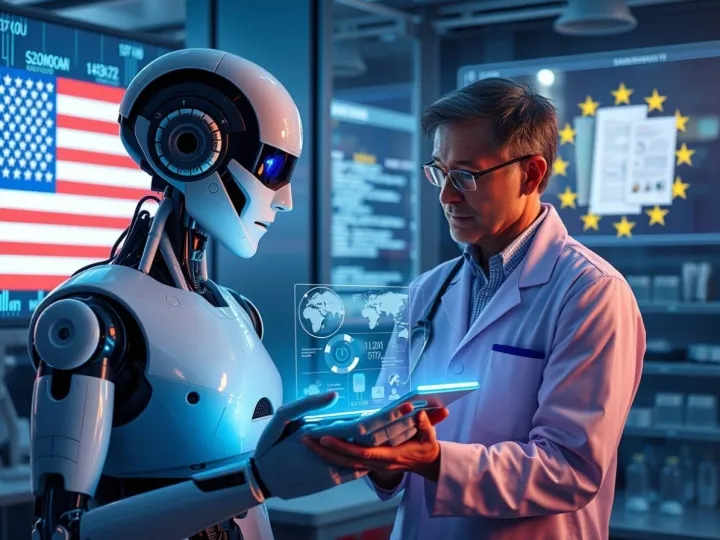
The authors of the study propose that collaboration, not replacement, should define the future of AI in medicine. In this model, human expertise and machine reasoning become complementary rather than competitive. The agent handles repetitive or data-heavy analysis, while human scientists and physicians provide intuition, context, and moral judgment. Together they create a feedback loop that accelerates discovery without losing accountability. Some systems already emulate this partnership through multi-agent collaboration, where specialized agents plan, verify, and correct each other's outputs under human supervision. This cooperative intelligence mirrors the distributed logic of human scientific teams and represents an early form of symbiosis between artificial and biological cognition.
The next horizon for these systems extends beyond digital environments. Embodied AI - the integration of reasoning agents into robotic or physical platforms - is beginning to connect machine thought with mechanical action. Robotic chemists, surgical assistants, and autonomous laboratory systems are early examples. These machines can reason about an experiment and then carry it out, adjusting parameters as they learn. At the same time, open-source projects are making such technologies accessible to smaller research institutions. Standardization and transparent benchmarks are becoming critical to ensure reliability and comparability across systems.
From the perspective of Seven Reflections' Dimensional Systems Architecture framework, LLM agents represent an expansion of the active cognitive field. They convert abstract intention into structured, executable form, bridging human creativity with machine precision. In biological terms, every cell and network functions as an autonomous agent guided by internal rules and feedback. Artificial agents in biomedicine are echoing that same principle at a higher level of complexity. Intelligence is shifting from isolated computation to systemic coherence - humans, algorithms, and environments interacting within a unified field of learning and adaptation.
The emergence of these agents signals more than technological progress; it reflects a deeper transformation in how knowledge itself is organized. The future of medicine may depend not on choosing between human and artificial intelligence but on discovering how they resonate together - how synthetic cognition and living systems can align toward the shared purpose of healing, understanding, and advancing life.
References
Please sign in to continue
Log in Create accountBy continuing you agree to our Terms & Privacy Policy.