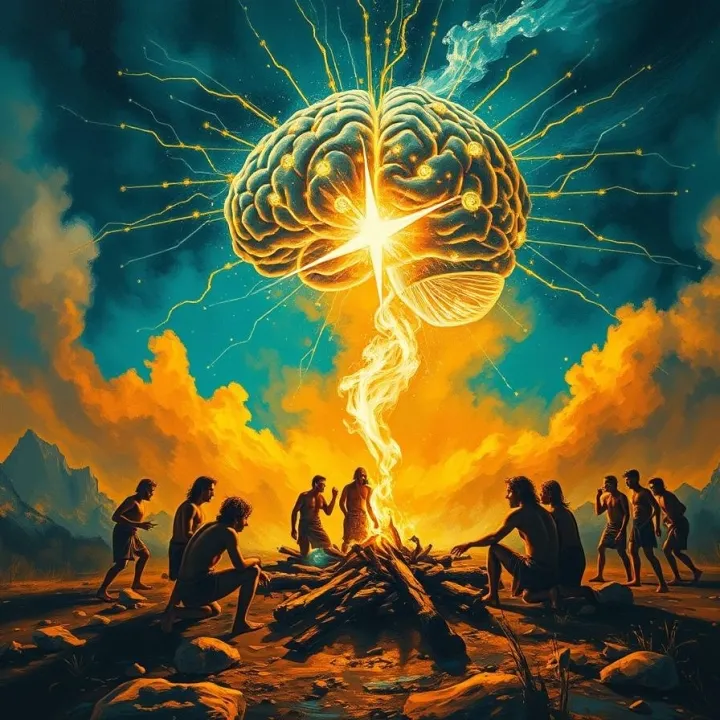
Ancient humans around a campfire morphing into a glowing neural network sky, smoke to data streams forming a brain.

How the Brain Learns: The Hidden Architecture of Reward and Connection

From food to friendship, the human brain is constantly learning what to seek and what to avoid. But new research suggests that reward - the driving force behind learning - is not just an external event or a burst of dopamine. It begins deep inside the body, where every meal, heartbeat, and breath shapes the way we learn, connect, and evolve. A trio of recent papers in Trends in Cognitive Sciences is reshaping how neuroscientists understand learning and motivation - revealing that reward signals arise from internal physiological states, extend through social dynamics, and may hold the key to more natural forms of artificial intelligence.

October 18, 2025 in Cognitive Science


The Inner Reward: Learning from Within

Traditionally, scientists believed rewards were simple: an animal receives food, dopamine spikes, and learning happens. But "The Interoceptive Origin of Reinforcement Learning" (Weber et al., 2025) turns that model inside out. The authors show that primary rewards don't come from taste or immediate pleasure - they emerge later, during digestion, when nutrients become usable energy. This means the brain's reward system listens to the body first: glucose oxidation, hydration, and fat metabolism create delayed but decisive reinforcement signals.

This redefines reward not as pleasure, but as evidence of survival. Every time the body's balance is restored - through nourishment, hydration, or homeostasis - it trains the brain to repeat the behavior. The research bridges neuroscience and physiology, suggesting that our sense of value is a mirror of our internal state.


From Gut to Group: How Reward Shapes Social Learning

If rewards are born in the body, how do they drive complex social behavior? A companion paper, "Reward Is Enough for Social Learning" (Schultner et al., 2025), argues that the same principles that guide animals toward food also guide humans toward each other. The researchers propose the Social Feature Learning (SFL) model, showing that strategies like "follow the majority" or "copy the successful" can emerge entirely from reward-based learning of social cues. In other words, people learn who to trust, emulate, or ignore not through fixed instincts but by associating social signals - approval, popularity, or prestige - with positive outcomes.

Over time, these learned social rewards scale into cultural evolution. Norms spread, trends amplify, and civilizations evolve as social learning loops reinforce behaviors that "feel rewarding." The same feedback mechanism that helps a mouse find sugar may, at a larger scale, explain how ideas spread through societies and social media.


Extending Reward to Machines and Minds

Both studies intersect with a broader trend: the effort to make artificial agents more like natural ones. Reinforcement learning (RL) in AI typically relies on external, static reward functions - points, scores, or success metrics. But biological systems generate their own goals dynamically, using internal feedback loops tied to physiology and context.

The implication is profound: to make AI more human, we must teach it to learn from internal states, not just external outcomes. Future systems could integrate self-monitoring mechanisms - "digital interoception" - to adjust their goals, motivation, and ethics in real time, much like the human brain maintains internal equilibrium while exploring the world.


The Hierarchy of Learning

Another study in the same journal, "A Hierarchical Model of Early Brain Functional Networks", suggests that even the brain's earliest structures follow layered principles of reward and adaptation. From sensory integration in infants to high-level cognition in adults, neural networks build themselves hierarchically - each layer refining signals from the one below. This aligns with the idea that both the body and brain learn by reducing uncertainty - a universal principle shared across evolution, psychology, and machine learning.


Toward a Unified Science of Reward and Consciousness

Taken together, these findings mark a shift from viewing reward as external and singular to seeing it as multi-layered, embodied, and social.

  • The body provides the primary reinforcement through interoceptive feedback.
  • The mind refines these signals through inference and prediction.
  • The social world amplifies them into shared meaning and culture.

In this new framework, reward is not simply what feels good - it is how life learns to preserve itself. From gut chemistry to global consciousness, the same logic unfolds: systems seek stability through feedback, adjusting their structure until balance feels like truth.
References

Christin Schulze, Ada Aka ,Daniel M. Bartels, Ryan Oprea, Nicholas Reinholtz (2025). A timeline of cognitive costs in decision-making. [Trends in Cognitive Sciences] https://www.cell.com/trends/cognitive-sc...

Leave a Comment


Why Our Brains Crave Risk When Reward Feels Near
Oct 8, 2025 Cognitive Science

Why Our Brains Crave Risk When Reward Feels Near

Every gamble begins in the same place - a pulse of anticipation that briefly suspends logic. Researchers in Japan have now traced that moment to a specific cluster of neurons: the orexin system, deep in the hypothalamus. When these neurons activate, the brain shifts its strategy - leaning toward risk, hunger, and reward. In new experiments published in PNAS Nexus, scientists found that stimulating orexin neurons in rats made them choose riskier options, while blocking orexin made them cautious. This discovery doesn't just explain gambling - it illuminates the biology of desire itself.

Science Finds Emotional Signals May Reshape How We Learn - in Ways Reward Alone Cannot
Dec 6, 2025 Creativity & Performance

Science Finds Emotional Signals May Reshape How We Learn - in Ways Reward Alone Cannot

A new article in Trends in Cognitive Sciences examines a striking development in reinforcement-learning research: emotion prediction errors appear to generate neural signals distinct from traditional reward-based prediction errors. Drawing on an EEG study by Heffner and colleagues, the commentary explores how emotional expectations and their violations may provide unique information that shapes social behavior. The findings suggest that incorporating emotion into computational models could refine our understanding of how humans learn, adapt, and respond to one another.

Sleep Restriction Increases Reward Sensitivity and Disrupts Goal-Directed Learning
Nov 6, 2025 Sleep & Dreaming

Sleep Restriction Increases Reward Sensitivity and Disrupts Goal-Directed Learning

A new open-access study in Sleep reveals that chronic sleep restriction - just five hours per night for a week - makes the human brain more reactive to rewards and less stable in decision making. Researchers from Monash University and the University of Sydney found that after limited sleep, participants updated their choices faster in response to rewards but lost consistency in strategy, suggesting heightened impulsivity. The results show how even mild, sustained sleep loss shifts our cognitive balance between exploration, control, and reward-seeking behavior.

When Distance Feels Closer: Reward System Atrophy and Emotional Sensitivity in Alzheimers
Nov 4, 2025 Cognitive Science

When Distance Feels Closer: Reward System Atrophy and Emotional Sensitivity in Alzheimer's

In a striking new study published in Social Cognitive and Affective Neuroscience, researchers found that people with Alzheimer's disease feel physically closer and emotionally warmer toward others - even when the actual distance remains unchanged. The phenomenon was linked to atrophy in brain regions associated with reward and emotional processing, including the right ventral striatum and orbitofrontal cortex. Far from merely diminishing social experience, Alzheimer's appears to reconfigure it - revealing how the loss of one system can amplify another, transforming the boundaries of human connection.

GLP-1 and the Biology of Desire: A New Frontier in Treating Addiction
Oct 10, 2025 Neuroscience & Health

GLP-1 and the Biology of Desire: A New Frontier in Treating Addiction

What if addiction isn't just psychological, but metabolic - a feedback loop between hunger, energy, and awareness? New research in the Journal of the Endocrine Society shows that GLP-1, the same hormone behind the global weight-loss revolution, may also reshape how the brain processes craving and reward. As scientists uncover the hormone's role in modulating dopamine and stress pathways, a new picture of addiction is emerging: one where biology, behavior, and consciousness share the same circuitry.

Beyond Uniformity: How Individual Sensitivities Shape the Brains Conflict Signals
Oct 31, 2025 Cognitive Science

Beyond Uniformity: How Individual Sensitivities Shape the Brain's Conflict Signals

Everyday choices often pit temptation against caution. Should we take the risk or stay safe? A new study from Osnabrück University shows that this internal tug-of-war looks very different for each of us. Using EEG to measure mid-frontal theta waves - neural rhythms linked to cognitive control - researchers found no single "universal" pattern of decision conflict. Instead, the brain's response depends on how strongly each person values reward or fears punishment, revealing the deeply individual nature of self-control and motivation.