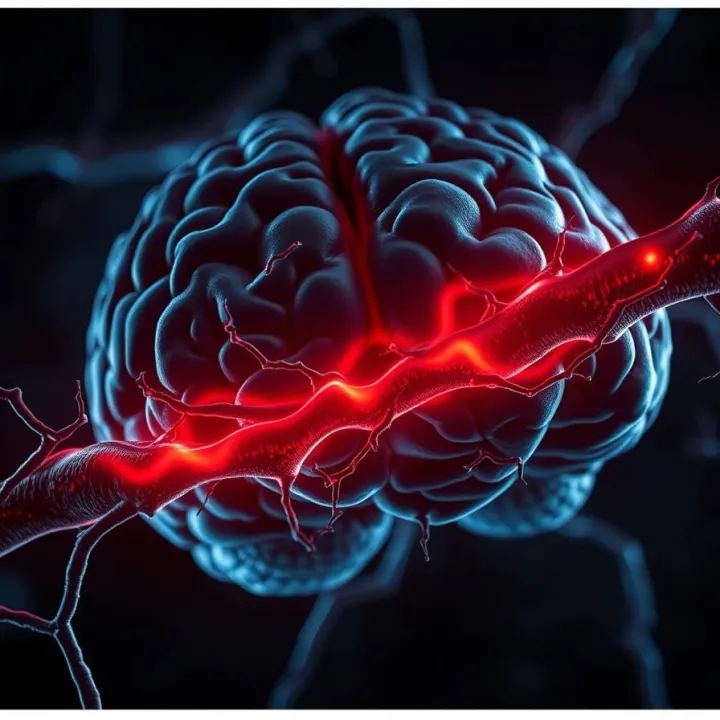
For decades, neuroscientists have known that ageing does not strike the brain evenly. Some regions lose neurons, shrink, or falter earlier than others. A new study in Brain Communications (September 2025) sheds light on one of the earliest cracks in the system: the blood - brain barrier (BBB) of the prefrontal cortex. Even at relatively early stages of ageing, this vital "gatekeeper" appears more fragile in the prefrontal cortex than in other regions, suggesting why executive functions often decline first.
The blood - brain barrier: gatekeeper of the brain
The BBB is a tightly regulated interface between the blood supply and the brain's delicate tissue. Made of specialized endothelial cells, basement membranes, and supporting astrocytes, it keeps toxins, pathogens, and excess molecules out while allowing nutrients and signals in. Its integrity is essential: small leaks or inefficiencies can set the stage for inflammation, protein buildup, and neurodegenerative changes.
Until now, most BBB ageing studies looked at individual regions or single features, making it unclear which regions are most vulnerable. The new research takes a multiregional approach, mapping structural, molecular, and functional changes across three areas in mice:
- Prefrontal cortex (PFC) - center of attention, planning, and decision-making.
- Hippocampus - key to learning and memory.
- Corpus callosum - white-matter bridge between hemispheres.
What the study found
Researchers compared young (2 - 4 months) and early-aged (18 - 20 months) mice using immunofluorescence, transmission electron microscopy, and permeability assays.
- Prefrontal cortex: showed the clearest BBB ageing. Endothelial cells increased caveolin-1 (a marker of abnormal transcytosis), basement membranes thickened, astrocyte endfeet enlarged, and barrier permeability rose.
- Hippocampus: only subtle, partly sex-dependent changes appeared.
- Corpus callosum: largely preserved at this stage.
In short: the prefrontal cortex ages first at the vascular level. Even before overt pathology, its BBB begins to loosen.
Why the prefrontal cortex is special
The prefrontal cortex is often described as the executive of the brain - coordinating attention, impulse control, working memory, planning, and flexible decision-making. It is what allows humans to weigh options, imagine futures, and regulate emotions.
It also happens to be one of the most energy-hungry and integrative brain regions. Constantly active, densely connected, and reliant on precise timing, the PFC depends heavily on vascular stability. Small disruptions in nutrient flow or barrier function may have outsized effects here. This may explain why:
- Attention and working memory are often the first cognitive skills to falter with ageing.
- Disorders like schizophrenia and depression, which involve PFC dysfunction, often show altered BBB markers as well.
- Neurodegenerative diseases such as Alzheimer's, though classically linked to the hippocampus, often show early vascular and metabolic stress in the frontal lobes.
A systems view of vulnerability
From a Seven Reflections perspective, the study reveals how vulnerability is not evenly distributed. Systems fail at their frontlines - where demand is highest, complexity is densest, and integration is most vital. The prefrontal cortex fits this description: it is both the conductor and the filter of cognition. When its protective gate (the BBB) begins to falter, the entire orchestra risks losing coherence.
This vulnerability also matches subjective experience. In everyday ageing, people often notice:
- Difficulty sustaining focus.
- Trouble juggling multiple tasks.
- More reliance on habits or automatic responses.
These are not just "mental lapses" but signs of the PFC's heightened sensitivity.
Insight: The Cracks in the Gate
The blood - brain barrier can be seen as a structural metaphor for attention itself. Both act as gates: one physical, one cognitive. When the physical gate of the PFC begins to weaken with age, the cognitive gate of focus may weaken too. The system no longer filters as efficiently - noise leaks in, clarity leaks out.
This is not simply degeneration; it is also redistribution. As the PFC falters, other brain systems (habit circuits, emotional reactivity, sensory bias) may take on more weight. That shift explains why ageing can bring both decline and, sometimes, new forms of insight: a reliance on pattern, intuition, or embodied memory rather than sheer executive control.
Why this matters
The study's authors emphasize that even subtle early BBB changes can set the stage for later disease. If the PFC is the first to show vascular ageing, it may also be the best target for early interventions:
- Lifestyle: Aerobic exercise, sleep hygiene, and vascular health directly support BBB integrity.
- Therapeutics: Drugs or nutraceuticals that protect endothelial cells and astrocyte function may extend PFC resilience.
- Cognitive training: Practices that sharpen attention and executive function may reinforce functional networks, helping the brain compensate for vascular micro-leaks.
The bigger frame
Seven Reflections often asks: where do cracks appear first in a system? Whether in ecosystems, economies, or the brain, the answer is usually the same: at the point of highest coordination pressure. The prefrontal cortex is precisely such a point. Its early vulnerability is not an accident - it is the cost of being the system's most integrative hub.
Rather than viewing this as weakness, it may be understood as a signal: ageing begins where demand is greatest. By noticing and supporting these early cracks - in brain, mind, or society - we can act before breakdown spreads.