Can stronger legs make your memory faster? According to new research from Umeå University and Sweden's Karolinska Institute, the answer might be yes. A twelve-week trial published in Cerebral Cortex (October 2025) found that older adults who performed supramaximal high-intensity interval training (HIT) showed not only gains in leg strength but also stronger activation in a key region of the brain responsible for working memory - the right dorsolateral prefrontal cortex (dlPFC).
The finding suggests that cognitive vitality in later life may depend less on how long we move and more on how powerfully our bodies engage the brain.
The Study: Turning Effort Into Activation
The research, known as the Umeå HIT Study, enrolled sixty-eight adults aged 66 to 79 who had not been exercising regularly. Participants were randomly assigned to one of two groups:
- Supramaximal HIT - brief, watt-controlled sprints above each individual's peak aerobic capacity, only 20 minutes per session.
- Moderate-intensity training (MIT) - forty minutes of steady cycling at a gentler pace.
Both groups trained twice a week for twelve weeks, with physiological and cognitive testing before and after. A subset of forty-three participants also underwent functional MRI while performing a working-memory task that required them to manipulate and recall letter sequences.
What They Found
While both exercise groups improved overall fitness, only the HIT group showed significant gains in leg strength and corresponding increases in prefrontal-cortex activation. Those changes predicted measurable improvements in working-memory performance inside the MRI scanner.
In statistical terms, changes in leg strength explained roughly 63 percent of the variance in prefrontal activation, which in turn predicted about 40 percent of the variance in working-memory gains. Cardiorespiratory fitness alone - how efficiently participants used oxygen - did not explain these neural or cognitive changes.
The chain of influence was strikingly specific:
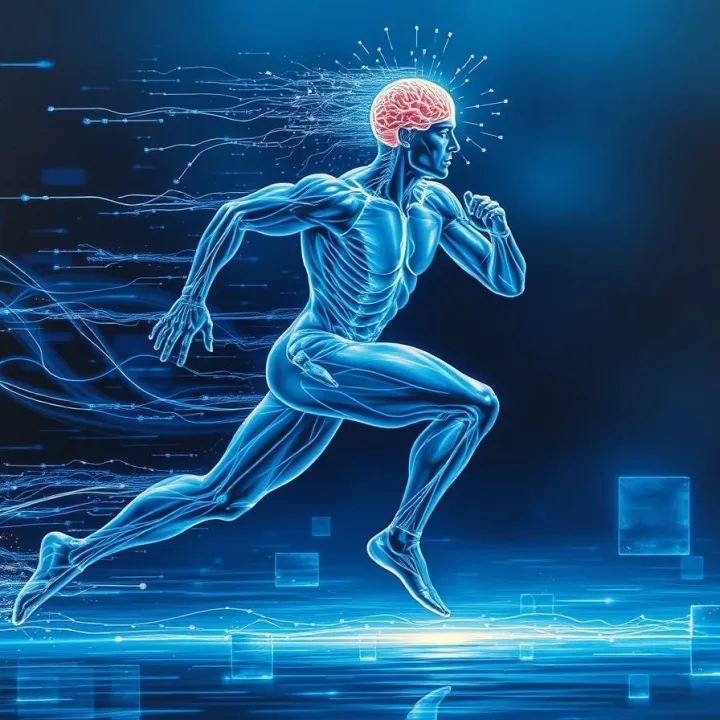
Stronger legs -> greater prefrontal activation -> sharper memory.
Why Leg Strength Matters
Leg muscles are more than mechanical engines; they are also biochemical messengers. When trained intensely, they release signaling molecules - myokines - that cross the blood - brain barrier and influence neural plasticity. One of these, brain-derived neurotrophic factor (BDNF), is known to promote neuron growth and synaptic strength.
The authors suggest that high-intensity muscle work may trigger a muscle - brain dialogue, encouraging the prefrontal cortex to "up-regulate" and sustain the kind of youthful activation pattern linked to better cognitive control.
In everyday terms, the very act of pushing your limits may send an instruction to the brain: adapt, coordinate, remember.
Rethinking the Aging Brain
Traditionally, exercise research on cognition has focused on aerobic endurance - how heart and lungs feed the brain with oxygen. This study adds a new layer: muscular strength may be an equally vital ingredient for neural health.
The prefrontal cortex, which orchestrates planning and focus, is one of the regions most vulnerable to age-related decline. Yet participants who gained the most strength showed increased activation in this area, essentially reversing a common aging pattern.
While the study's MRI sample was small and its results exploratory, the trend aligns with a growing body of evidence that short, intense effort produces disproportionately large neurological benefits.
From the Gym to Daily Life
Working memory underpins everyday independence - remembering medications, managing finances, navigating new technology. Declines in this function predict loss of autonomy even in adults without dementia. The possibility that a twelve-week intervention can measurably strengthen both muscles and memory offers a hopeful message: cognitive maintenance may begin in the body.
And it isn't about quantity. The HIT participants trained for half the time of the moderate group yet achieved superior gains. Precision and intensity, not duration, seemed to awaken the neural response.
A System Running in Harmony
From a broader systems view, the result illustrates a principle echoed across neuroscience and consciousness studies alike: coherence between energy and control. The brain is not an isolated organ - it's a field that integrates movement, intention, and physiological rhythm. When physical effort rises to a threshold that challenges both body and awareness, new synchronization appears.
In this case, the synchronization occurred between the legs and the prefrontal cortex - the foundations of action and the center of strategy - linking motion and thought into one adaptive circuit.
Cautions and Future Directions
The authors note that their findings, though compelling, are preliminary. The small sample and lack of whole-brain correction mean results should be replicated in larger trials. Still, the mechanistic insight - that leg strength predicts brain activation and cognitive performance - offers a clear target for future research and clinical application.
Next steps include testing whether similar neural effects occur in populations with chronic conditions or reduced mobility, and whether combining strength training with cognitive tasks can amplify the gains.
The Takeaway
For older adults - and perhaps for all of us - the path to mental sharpness may run through the legs. A stronger stride may mean a quicker thought, a clearer focus, a steadier sense of self.
Movement is memory in motion.