Neurodegenerative diseases often begin with invisible changes - molecules folding the wrong way, barriers leaking before they break, structures bending under hidden pressures. A new study in Nucleic Acids Research (September 2025) shows that even our DNA is subject to this principle. At the heart of the most common genetic cause of amyotrophic lateral sclerosis (ALS) and frontotemporal dementia (FTD), the same DNA sequence can fold into radically different shapes.
These shapes, called G-quadruplexes, may decide how vulnerable neurons become, and whether the genetic script leads to stability or decline.
The ALS - FTD connection: C9orf72
ALS is best known as the disease that attacks motor neurons, gradually paralyzing the body while leaving cognition painfully intact. FTD, by contrast, devastates the frontal and temporal lobes, altering personality, language, and judgment. Together, they form a neurodegenerative continuum, often overlapping in families.
In 2011, researchers discovered that both diseases can be driven by the same genetic culprit: abnormal expansion of a six-letter sequence - GGGGCC (G4C2) - in the first intron of the gene C9orf72. Healthy people may carry a few dozen repeats; in ALS and FTD, the number can soar into the hundreds or thousands.
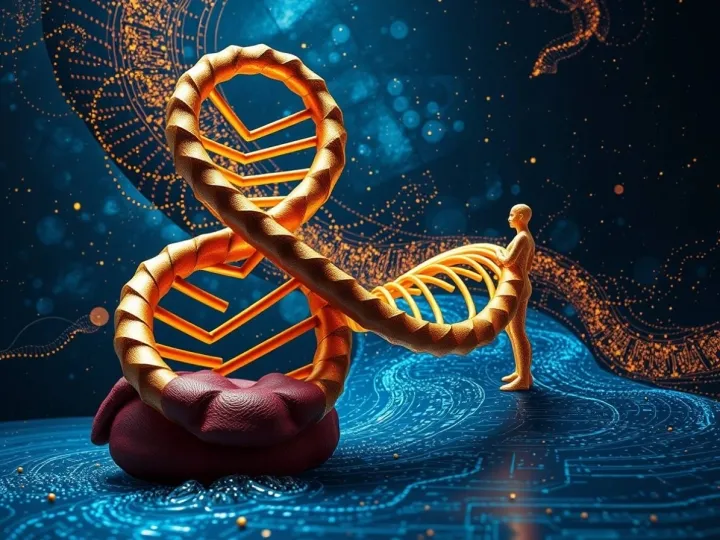
These repeats don't just sit in the genome. They fold into unusual DNA and RNA shapes called G-quadruplexes (G4s) - four-stranded knots stabilized by guanine bases and potassium ions. Their structural quirks can stall RNA polymerase, generate toxic byproducts, and disrupt cell function.
The new study: two hidden shapes
Until now, scientists knew G4C2 repeats could fold into multiple conformations, but the precise structures remained elusive. Using high-resolution crystallography, researchers in China resolved two distinct forms built from just four repeats:
- Parallel G-quadruplex
- Formed by two monomeric units stacking together.
- Eight layers of guanine "squares" (G-tetrads), stabilized by ? - ? interactions and potassium ions.
- The ends twist into a rare C·C+·C·C+ quadruple base pair.
- Less stable, but prone to oligomerization - forming higher-order assemblies that may encourage toxic aggregation.
- Antiparallel G-quadruplex
- A single monomer, four layers thick, connected by edgewise loops.
- Cytosines stack with guanine layers via potassium bridging.
- More stable, but potentially more dynamic - able to slip, reconfigure, and influence repeat expansion.
In other words, the same DNA sequence can fold into two very different knots: one stable and solitary, one fragile but prone to clumping.
Why this matters
These hidden DNA knots may help explain why C9orf72 expansions are so toxic.
- The parallel form could foster higher-order aggregates, clogging transcription and generating abnormal RNA-protein complexes.
- The antiparallel form may destabilize local chromatin or promote strand mispairing, fueling further expansion.
Both contribute to the "molecular storm" seen in ALS and FTD: disrupted transcription, toxic RNA foci, and neurodegeneration.
For drug discovery, these structural blueprints are crucial. G-quadruplexes are attractive targets: small molecules might be designed to stabilize one form, destabilize another, or block pathological oligomerization. The new crystal structures provide a map for that effort.
Insight: Structural Polymorphism as Fate
The most striking message here is not only biological, but systemic: polymorphism. One genetic code, two distinct folds, two paths to dysfunction.
This echoes a deeper principle: systems are not defined only by what they contain, but by how they fold under pressure. In the same way that a field of consciousness can shift into multiple configurations, the same DNA sequence can occupy different structural states - each carrying its own consequences.
Think of it as a fork in the road written into matter itself. The G4C2 repeat doesn't have one destiny; it has multiple latent geometries. The disease outcome may depend less on the raw sequence than on which geometry predominates, and how external conditions (ions, stress, pH) bias the fold.
This is a profound metaphor for cognition and culture alike: the same base material can produce radically different outcomes, depending on structural constraints.
The prefrontal echo
Interestingly, FTD - one of the diseases linked to C9orf72 - begins in the prefrontal cortex, the same region highlighted by the recent blood - brain barrier ageing study. Two distinct lines of research converge on one theme: the structures of highest coordination and control are also the most vulnerable to hidden cracks. Whether through barrier leaks or DNA knots, the prefrontal system is first to feel the strain.
A path forward
For now, the findings are structural - crystal lattices on a lab bench. But they hint at practical horizons:
- Therapeutics: Drugs tuned to the parallel form might block toxic aggregation, while others could prevent destabilizing slippage in the antiparallel form.
- Diagnostics: Conformation-specific probes could allow scientists to visualize which form predominates in neurons, and link it to symptom patterns.
- Broader insight: Structural plasticity is not a flaw but a rule. DNA, proteins, cognition - all fold into multiple potential realities. Stability is always conditional.
From Structure to Insight
The story of C9orf72 repeats is not just about a toxic expansion; it is about structural choice. The same DNA can be parallel or antiparallel, solitary or clumped, stable or unstable. Disease emerges not from the letters alone, but from the way they knot.
At Seven Reflections, we see in this a mirror of human systems: identical inputs can lead to divergent outcomes, depending on structure and context. In biology and in life, what matters is not only the code, but the fold.