In aviation, fatigue isn't just a comfort issue; it's a safety variable. Pilots crossing multiple time zones operate under intense circadian pressure, where even a few hours of misaligned rest can distort perception, reaction, and judgment. Traditionally, fatigue risk management has relied on medical-grade actigraphy and manual sleep logs. But a new narrative review by Jaime K. Devine and Steven R. Hursh, published in SLEEP Advances (Oxford University Press, 2025), suggests that a new generation of consumer sleep technologies - the same wearables used by millions of travelers - could become vital tools for flight research and global aviation safety.
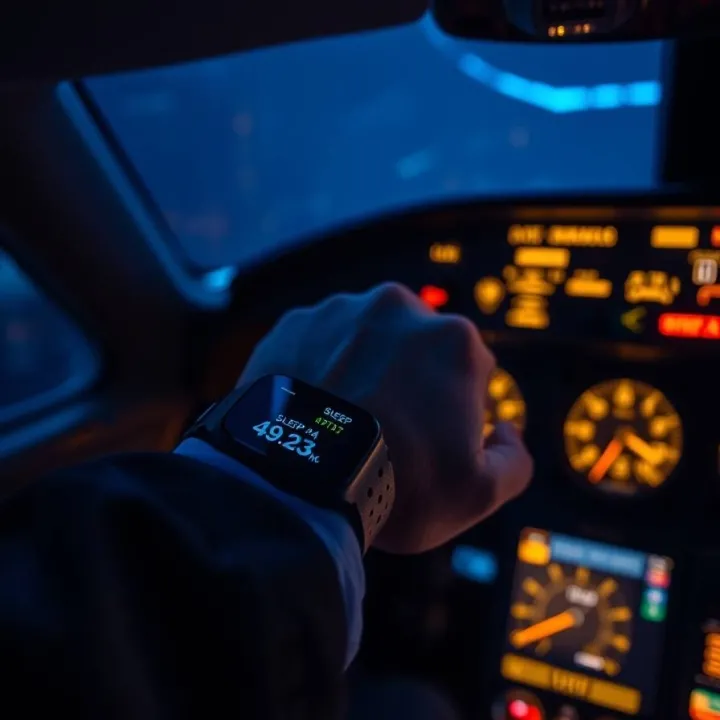
These consumer sleep technologies (CSTs), such as the Oura Ring, Fitbit, or WHOOP, collect continuous physiological data: heart rate, temperature, movement, and respiration. In theory, they could provide vast, real-time insights into sleep quality and fatigue without the logistical limits of laboratory studies. For an industry where pilots may rest in bunks, seats, or even short "controlled naps" on the flight deck, the ability to accurately measure sleep anywhere, at any time, would be revolutionary.
But the review warns: accuracy remains unproven. The aviation environment presents unique challenges - vibration, time zone shifts, electromagnetic restrictions on wireless devices, and short naps that most trackers fail to detect. "Technologies that cannot accurately capture in-flight sleep," the authors write, "are not a reliable method to use for aviation research." Before such devices can be integrated into regulatory fatigue risk management systems (FRMS), they must be scientifically evaluated under real flight conditions.
Fatigue management in aviation is a data-driven science. The International Civil Aviation Organization (ICAO) defines FRMS as "a means of continuously monitoring and managing fatigue-related safety risks based upon scientific principles." Airlines can even petition regulators for longer flight hours - but only if they can demonstrate, through verified sleep data, that crews remain safe and alert. That's where CSTs could fill a critical gap: continuous, ecological monitoring of how pilots actually sleep, not just how they report it.
Yet, the review makes clear that CSTs differ fundamentally from scientific actigraphy. Actigraphy requires trained scoring and controlled algorithms; CSTs use proprietary software that users and researchers can't fully access. Device manufacturers can update these algorithms without notice, making cross-study comparisons unreliable. From Seven Reflections' DSA framework perspective, this represents a feedback gap in the field loop: when data interpretation depends on a hidden algorithm, the observer loses structural coherence with the system being observed.
Interestingly, CSTs also let users edit their own sleep data - a feature that can both help and harm scientific integrity. On one hand, a pilot can correct missed naps or false readings. On the other, real-time access can bias behavior. If a pilot adjusts sleep patterns to "improve" their metrics during a safety study, the resulting dataset may show an idealized system that only exists under observation - a classic example of feedback interference. In DSA terms, the system becomes self-referential: the measurement alters the state being measured.
Another challenge involves circadian mapping. When a wearable crosses time zones, it may reset local time automatically, misaligning in-flight sleep episodes. For pilots who operate on Coordinated Universal Time (UTC) or home-base time to reduce biological strain, this automatic adjustment can fragment the data record. The review suggests that devices incorporating GPS data could eventually distinguish in-flight rest from ground rest, but no current CST offers such functionality. Here, DSA would interpret the issue as temporal frame instability - when measurement systems fail to maintain consistent temporal coordinates, system coherence breaks down.
Ethical and privacy issues further complicate integration. Traditional actigraphy data belongs to the researcher; CST data flows through commercial servers. This introduces a third party - the manufacturer - into a safety-critical chain. Who owns that sleep data? Can it be audited? The authors urge collaboration between regulators, scientists, and technology companies to establish clear protocols before CST data becomes admissible in regulatory submissions.
The review ultimately proposes a structured framework for evaluating CSTs in aviation: performance evaluations (not "validation studies") comparing CST data against gold-standard measures like polysomnography or actigraphy, under realistic flight conditions. These evaluations should test how devices perform during turbulence, short naps, and irregular circadian schedules - the very conditions that make aviation unique. Statistically, researchers should use equivalence testing rather than simple mean comparisons, to confirm that CSTs are not inferior to current approved methods.
From a DSA standpoint, this conversation about wearables goes beyond aviation. It touches on the larger evolution of human-technology integration - the merging of biological and digital fields into a shared feedback environment. The cockpit is a perfect metaphor for this: a closed, high-stakes system where human consciousness, technology, and temporal distortion meet. Measuring sleep in that context isn't just about fatigue; it's about how living systems maintain coherence within accelerating time loops.
If fatigue represents a local collapse in systemic synchronization - the mind's temporary desynchronization from its field rhythm - then technologies that monitor fatigue are not merely diagnostic tools. They are extensions of our collective attempt to stabilize attention, safety, and awareness under increasing temporal pressure. In that sense, aviation fatigue research becomes a mirror for modern consciousness: a study of how we stay awake inside systems that never sleep.