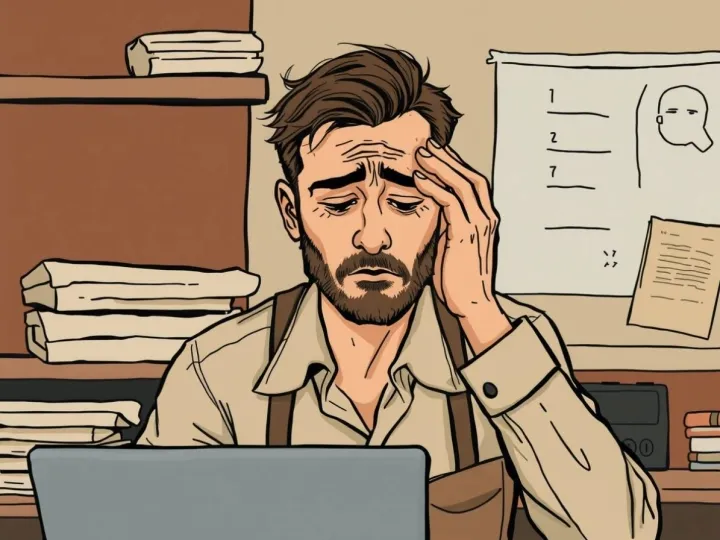
Tired truck driver sitting in the cabin with eyes closed and hand on his forehead, showing exhaustion while holding the steering wheel

When Sleep Problems Pile Up, Young Adults Face Dangerous Risks

For many young workers, late nights and early shifts don't just mean feeling tired - they may push sleep to a dangerous tipping point. A new study in Sleep Medicine finds that when common disruptors like insomnia, short sleep, and shift work overlap, young adults face sharply higher risks of near-miss driving incidents and falling asleep on the job.

August 27, 2025 in Business & Workplace


Sleep is often the first thing sacrificed when work, study, and social life collide - but new research suggests that the cost is higher than most realize. A team of Australian researchers studied more than 400 employed young adults in their early twenties, tracking their sleep disorders, work schedules, and accident history.

They found that sleepiness while driving was reported by 16 percent of participants, and workplace sleepiness by 11 percent. Even short sleep alone (less than seven hours a night) doubled the odds of dozing off behind the wheel. But the real risk came when problems overlapped. Those juggling multiple sleep disruptors - such as shift work on top of sleep apnea or insomnia - showed the highest rates of near-miss car accidents and nodding off at work.

"Sleep problems don't just add up - they interact," the researchers noted. The overlap of shift work and sleep disorders was particularly dangerous, with young adults in this group nearly five times more likely to report falling asleep at work compared to their peers.

The findings highlight a blind spot in both road safety and workplace wellbeing. Sleepiness is often dismissed as a personal issue, but the study suggests it can become a systemic risk when common factors combine. For young workers, especially those in healthcare, retail, or transport industries where shift work is routine, the dangers are clear.

The researchers argue that greater awareness and intervention are needed - not just for individuals, but for employers and policymakers. As they conclude: the combined burden of multiple sleep-disrupting factors is more than just feeling tired - it can put lives at risk.


References

Kelly Sansom, Murthy N. Mittinty, Claire Dunbar, Andrew Vakulin (2025). Additive interactions of sleep disorders, insufficient sleep, and shift work on road and workplace safety incidents: A sufficient cause approach with overlap weights. [Sleep Medicine Volume 134, October 2025, 106699] https://www.sciencedirect.com/science/ar...

The Future of Sleep Medicine: Data Analytics Uncovers Hidden Links Between Sleep and Health
Sep 24, 2025 Sleep & Dreaming

The Future of Sleep Medicine: Data Analytics Uncovers Hidden Links Between Sleep and Health

Sleep has always been central to human health, but until recently, medicine relied on simple categories to understand it. A new article in Sleep highlights how artificial intelligence and modern data analytics are transforming the field. By moving beyond traditional sleep staging, researchers are uncovering richer insights into how sleep relates to conditions ranging from heart disease to depression. The future of sleep medicine, the authors argue, is already here.

When One Bad Night Slows the Mind: How Daily Sleep Fluctuations Impair Cognitive Speed
Oct 14, 2025 Sleep & Dreaming

When One Bad Night Slows the Mind: How Daily Sleep Fluctuations Impair Cognitive Speed

Your brain remembers every lost hour. A groundbreaking 21-day study from Stockholm University and the Karolinska Institute reveals that even subtle, everyday fluctuations in how long or how well you sleep can slow cognitive performance the next day. The effect was found across all ages - proving that it's not just sleep quantity that matters, but the stability of your inner rhythm. This research highlights a deeper truth about the human system: when coherence fades, clarity follows.

Measuring the Cost of Ill-Health at Work: How the WPAI Questionnaire Redefines Productivity
Sep 15, 2025 Business & Workplace

Measuring the Cost of Ill-Health at Work: How the WPAI Questionnaire Redefines Productivity

The Work Productivity and Activity Impairment (WPAI) questionnaire has become one of the most widely used tools for understanding how health affects our ability to work and live fully. Developed for clinical trials, it has since been adapted to study everything from chronic diseases to everyday symptoms, across industries and countries. By transforming experiences of absenteeism, presenteeism, and daily activity loss into measurable percentages, the WPAI offers a structured way to capture the hidden costs of illness on productivity and life.

Is Glymphatic Clearance the Secret Behind Truly Restorative Sleep?
Dec 1, 2025 Sleep & Dreaming

Is Glymphatic Clearance the Secret Behind Truly Restorative Sleep?

Why does some sleep leave us refreshed while other nights feel strangely empty, even when we sleep for the same number of hours? A growing body of research points to a surprising candidate: the brain's glymphatic system, a clearance pathway that flushes out metabolic waste during sleep. New evidence suggests that variations in this system - not just brainwaves or sleep stages - may shape how restored we feel. As scientists explore this hidden physiological rhythm, they are uncovering clues that could redefine how we understand "good sleep."