
Everyone talks about ego, but few can define it. Some treat ego as pride, others as insecurity, others as a mask to be destroyed. But what if ego were not good or bad at all - just measurable? Ego Content Ratio (ECR) is the proportion of your inner field occupied by self-reference. When ECR is high, consciousness feels defensive, heavy, and distorted. When ECR is low, consciousness feels open, aligned, and free. Within a broader structural framework, ECR explains why ordinary states feel cluttered, why altered states feel liberating, and why real growth means lowering ego saturation - not building a "better self."
By Lorans I. Hedgecock - August 27, 2025 in The Inner Logic
Every experience unfolds within a field - a patterned space where thought, perception, and emotion interact. ECR measures how much of that field is filled with self-reference.
ECR is not the same as self-esteem. Arrogance ("I am the best") and self-loathing ("I am worthless") both indicate high ECR. What changes is only the polarity - the self still occupies the bandwidth.
Within this framework, there is a baseline configuration of consciousness: the Walking State.
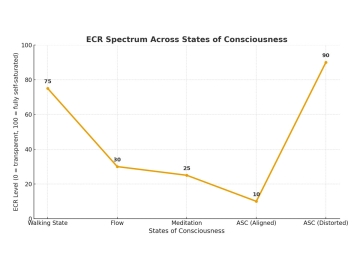
Walking State is not literal walking. It describes the ordinary default of human life - a high- to mid-ECR condition where identity dominates perception. Thoughts loop, attention fragments, and the field is cluttered with worry, desire, and defensive comparison.
Most people live here most of the time. From this state, moments of flow or altered states appear as rare relief.
Contrast Walking State with Flow. In flow, ECR drops. The self grows transparent as attention merges with activity. Time stretches or vanishes, effort feels effortless, and reactions sharpen.
Flow is not mystical - it is a different field configuration. The bandwidth once occupied by ego becomes available for systemic alignment. Athletes call it "the zone." Artists describe losing themselves in creation. Children show it naturally before identity hardens.
| High ECR (Walking State) | Low ECR (Flow / Aligned State) |
|---|---|
| Defensive, self-centered, or self-loathing | Transparent, open, compassionate |
| Narrative loops: "I'm better," "I'm worse," "What do they think of me" | Systemic perception: "How does this connect" |
| Reactive and fragile | Adaptive and resilient |
| In ASC: distortion, delusion, ego fantasy | In ASC: clarity, alignment, insight |
This distinction clarifies why ego has felt so confusing: it isn't one trait, but a ratio of saturation.
Ancient traditions often framed the same polarity as "ego vs. spirit," "demonic vs. divine," or "hell vs. heaven." In framework terms:
The binary of "good vs. evil" was an early attempt to capture what can now be described structurally: ECR defines the polarity of human experience.
When consciousness shifts into an altered state, ECR changes. But not always in the same way.
From a framework perspective, ASC has three outcomes:
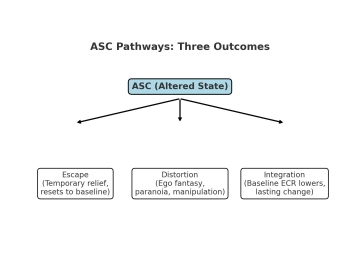
Awareness alone does not reduce ECR. People can "see their ego," or even touch profound insight in meditation, yet return unchanged to Walking State.
Why? Because integration is missing.
Integration is not a mystical gift - it is a structural necessity. Without it, ECR always rebounds.
Walking State explains why everyday human presence often feels unpleasant to perceive: most fields are mid-to-high ECR, filled with loops of worry, greed, and ambition.
But when ECR lowers, life looks different. A child at play, an artist absorbed in creation, or a mystic radiating stillness - all feel luminous. It is not that they added "spirituality," but that ego saturation dropped.
Growth is not becoming "more." It is becoming less occupied by self.
ECR is a structural ratio, but it can be estimated. Research already points to markers:
One day ECR may be a true bio-psycho-metric index, bridging subjective states with objective measurement.
You cannot "become more spiritual." Spirituality is not an achievement. It is what emerges when ego saturation lowers.
Self-growth is lowering ECR until systemic clarity shows through.
Not destruction of self, not ego death - simply the release of bandwidth so the larger field can resonate.
How is ECR different from "ego" in psychology?
In psychology, ego usually means the part of the mind that mediates between instinct (id) and morality (superego). Freud saw ego as necessary, not good or bad. In modern psychology, ego often refers to self-concept or self-identity. ECR is not a thing, but a ratio. It measures how much of your mental field is filled with self-reference. It doesn't judge the content - it quantifies saturation.
How is ECR different from ego in philosophy or spirituality?
Philosophy often treats ego as self-consciousness or personal identity. Spiritual traditions sometimes treat ego as the "illusion of self" that must be transcended. ECR reframes both: it explains why ego sometimes feels necessary and sometimes destructive. At low levels it helps navigation; at high levels it clogs the system.
Can you give an everyday example of high ECR?
Yes. Imagine being in a meeting where you're more worried about how you look or what others think of you than about the actual project. Your mental bandwidth is consumed by "me." That's high ECR in action.
Example of low ECR?
Playing with a child, painting, or running a race where you forget yourself and are absorbed in the activity. You're still present, but the self is transparent. That's low ECR.
Does lowering ECR mean I lose my identity?
No. ECR isn't about erasing self, but about reducing saturation. A lower ECR makes the self transparent, not absent. You can still function, but with more openness, clarity, and connection.
Can ECR change over time?
Yes. In altered states (meditation, dreams, flow), ECR often drops. In stress or conflict, it rises. With practice and integration, baseline ECR can lower permanently - what people often describe as "personal growth" or "spiritual maturity."
Why not just use "ego" instead of inventing ECR?
Because the word "ego" is overloaded. To some it means arrogance, to others it means self-worth, to Freud it meant mediator. ECR cuts through the confusion: it is a measurable ratio, not a moral judgment.
Does treating trauma in psychology help lower ECR?
Yes. Trauma creates anchored loops in the mind - intrusive memories, defensive reactions, and chronic fear - that fill the field with self-reference. This keeps ECR elevated and makes the Walking State feel heavy. Good trauma therapy helps dissolve these loops, which frees mental bandwidth and lowers ECR to a more functional level. The limitation is that therapy usually returns a person to a lighter version of Walking State, not beyond it. Many describe feeling healthier and less burdened, yet still sensing something missing. Healing reduces suffering, but without integration, it does not open the deeper systemic alignment that people often call spiritual growth. Trauma work helps you function; integration helps you transform.
