
Most of life is lived in what we call the Walking State - the ordinary baseline of consciousness where identity dominates attention. It doesn't mean physical walking. It means the default mode where Ego Content Ratio (ECR) runs high, thoughts loop, and perception is cluttered by "me": my fears, my desires, my ambitions. The Walking State feels normal, but compared to flow or altered states it is heavy, reactive, and often unpleasant. Understanding this state is the first step toward seeing why growth requires more than awareness - it requires lowering ego saturation.
By Lorans I. Hedgecock - August 27, 2025 in The Inner Logic
In this framework, every human experience unfolds inside a field - a structured space where thoughts, emotions, and perceptions cluster into patterns. One of the most important of these configurations is the Walking State.
Walking State is the baseline mode of consciousness, the ordinary condition most people live in most of the time. Here, ECR (Ego Content Ratio) runs mid-to-high. That means much of the field's bandwidth is filled with self-reference: "How do I look? What will happen to me? What do they think of me? "
This is why it is called Walking. Not because of physical steps, but because it reflects the trudging rhythm of ordinary time - ego-heavy, habitual, full of repetitive thought.
The Walking State is so common it feels natural, but once you learn to recognize it, its qualities are distinct:
It is the state of "being awake" that psychology often treats as neutral. But in truth, it is not neutral - it is already a distorted baseline.
Mainstream psychology calls this waking consciousness, implying it is simply awareness without distortion. But viewed structurally, the Walking State is not clean - it is saturated.
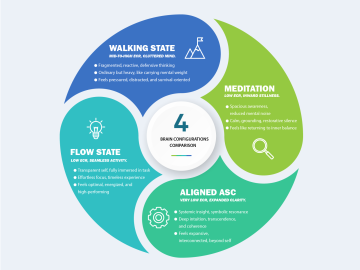
| Walking State | Flow | Meditation | Aligned ASC |
|---|---|---|---|
| Mid-to-high ECR, cluttered | Low ECR, transparent self in activity | Low ECR, inward stillness | Very low ECR, systemic clarity |
| Fragmented, reactive, defensive | Effortless focus, timelessness | Spacious, calm, reduced thought | Deep insight, symbolic resonance |
| Feels ordinary but heavy | Feels optimal, high performance | Feels silent, grounding | Feels transcendent, expansive |
This table shows why the Walking State, though ordinary, is not optimal - it is simply habitual.
If the Walking State sounds abstract, it is easy to spot in daily life:
These are not random "bad habits" - they are structural features of the Walking State itself.
Understanding the Walking State is crucial because:
Without this clarity, people mistake Walking State for "normal life," and measure progress only in degrees of comfort within it. But the real shift is not comfort - it is structural transformation.
The Walking State cannot be permanently escaped. It is part of human life, just as waking and sleeping are. But its saturation can be reduced.
The point is not to destroy the Walking State, but to lighten it. With integration, baseline life can be lived with less saturation, more clarity, and more resonance.
Walking State is not evil - it is ordinary. But ordinary is not neutral. It is ego-heavy, cluttered, and reactive. Recognizing it is the first step toward growth.
From here, every practice - meditation, creativity, therapy, altered states - makes sense. They are not escapes from life. They are ways of lowering saturation so that life itself can be lived more openly.
Is Walking State the same as "waking consciousness" in psychology?
No. Psychology usually calls waking consciousness the normal, neutral state of being awake. Walking State is not neutral - it is already distorted by high ego saturation. It is a baseline filled with self-reference, not a clean slate.
Why does Walking State often feel unpleasant?
Because the field is saturated with ego loops - worry, comparison, self-criticism, ambition. Even when nothing is wrong externally, the internal bandwidth is clogged, making life feel heavy and reactive.
Is Walking State bad?
No. It is ordinary. The problem is mistaking it for the whole of human experience. Walking State is simply the default configuration. Growth means lightening it, not demonizing it.
Can we ever fully escape the Walking State?
No. Just as we always return to waking from sleep, we always return to Walking State as a baseline. But its saturation can be reduced. Through flow, meditation, and integration, it becomes lighter, clearer, and less reactive.
How can I notice when I'm in Walking State?
Signs include repetitive self-talk, feeling stuck in comparison, or being preoccupied with how things affect "me." The moment life feels heavy, cluttered, or reactive, you are likely in Walking State.
What is the first step out of Walking State?
Recognition. Once you see Walking State as a structural condition - not just your personality - you stop identifying with it. From there, practices like breath awareness, creative flow, or reflective pauses can lower ECR and give you a glimpse of lighter configurations.
Does treating trauma in psychology help lower ECR?
Yes. Trauma creates anchored loops in the mind - intrusive memories, defensive reactions, and chronic fear - that fill the field with self-reference. This keeps ECR elevated and makes the Walking State feel heavy. Good trauma therapy helps dissolve these loops, which frees mental bandwidth and lowers ECR to a more functional level. The limitation is that therapy usually returns a person to a lighter version of Walking State, not beyond it. Many describe feeling healthier and less burdened, yet still sensing something missing. Healing reduces suffering, but without integration, it does not open the deeper systemic alignment that people often call spiritual growth. Trauma work helps you function; integration helps you transform.
