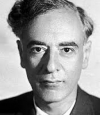
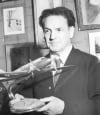
"My first infatuation proved to be my first true-love. But this true-love was not all bliss; it was not only tempestuous, it was tragic."

Born on January 22, 1898, under the sign of Aquarius - the Law of Innovation - Sergei Eisenstein arrived as a shockwave before the age could define what he was. His birth card, the Five of Diamonds, marks the restless innovator, forever transforming the material into the symbolic, the visible into the electric. With a Life Path of 49/13/4, he stood at the meeting point of revolution and order: a system builder trapped inside the chaos of his own genius. His Attitude 23/5 gave him the air of freedom even when the air itself was rationed.
Eisenstein's life was an equation the state could never solve. The son of an engineer, he began with blueprints and structure, but his imagination ignited where calculation failed. When the Revolution came, he didn't pick up a weapon - he picked up a frame. The camera became his instrument of rebellion, and montage his method of liberation. In every splice of film he revealed a secret law: that consciousness could be shaped by rhythm, that emotion could be engineered.
But the same system that needed his brilliance feared its reflection. The Soviet machine wanted stories of obedience; Eisenstein gave it the mechanics of awakening. His films - Strike, Battleship Potemkin, October, and later Ivan the Terrible - were cathedrals of movement built on tension: the state's demand for order against the artist's hunger for transformation. He stood at that threshold where form and freedom wrestle endlessly, where genius is both celebrated and punished.
The authorities called him "formalist," a dangerous word in an empire that worshipped content. They demanded simplicity; he offered structure. They wanted faith; he offered perception. Eisenstein's montage was more than editing - it was the collision of truths that could not coexist within ideology. He saw that conflict was the only honest form of unity.
By the 1940s, his heart began to mirror his art: fractured, rhythmic, unpredictable. Even under surveillance, even when Ivan the Terrible was condemned for reflecting too clearly the face of power, Eisenstein kept filming within. His last years were a slow fade between body and brilliance, a man dying of structure itself - heart blocked by what could not be expressed.
Sergei Eisenstein lived and died in the paradox of every true creator: sustained by the system he had to defy. His genius was not rebellion for its own sake, but revelation by necessity. In the fixed frame of ideology, he found motion; in the silence of control, he heard the pulse of thought. He proved that even under total constraint, art remains the last free organ of the human design.
Eisenstein did not simply make films. He turned cinema into consciousness - a living architecture of rhythm and reason, forever reminding us that every system eventually meets its own reflection.
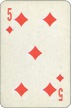
Sergei Eisenstein was born on January 22, 1898 in Riga, Riga, Latvia. In Cardology (Destiny Cards), January 22, 1898 corresponds to the Five of Diamonds, making the Five of Diamonds his Birth Card.
In numerology, the name adds another layer to the birth-date profile. The letters of a person’s name are used to explore inner motivation, personality, expression, and the qualities they bring into relationships and everyday life. Explore how the name Sergei Eisenstein influences her personality.