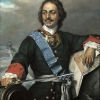
Peter was the son of Tsar Alexis and his second wife, Natalya Naryshkina, and he grew up in a court divided by rival families and palace guards. When Alexis died in 1676, his eldest surviving son, Feodor III, took the throne. Feodor's death in 1682 made Peter co-tsar with his half-brother Ivan V, but real power passed to their sister Sophia, who ruled as regent. Peter spent much of his youth outside the Kremlin, in villages near Moscow, where he drilled a "toy army" that later became the core of Russia's professional guard regiments. He also developed a lasting fascination with ships, navigation, and Western technology.
In 1689 Peter pushed Sophia from power and took effective control, though Ivan V remained co-tsar until his death in 1696. Peter's early military campaigns against the Ottoman Empire at Azov failed at first; after building a fleet, he captured Azov in 1696. A grand tour of Western Europe in 1697 - 1698 exposed him to Dutch and English shipyards, factories, and scientific instruments. He recruited foreign officers and craftsmen and returned determined to remake Russia's army, navy, and administration.
His main war was against Sweden. Russia was crushed at Narva in 1700, but Peter rebuilt his army, introduced conscription and modern artillery, and founded St. Petersburg in 1703 on the Baltic coast. The decisive victory at Poltava in 1709 broke Swedish power, and the Treaty of Nystad in 1721 gave Russia access to the Baltic Sea. In 1721 he took the title Emperor of All Russia and replaced the patriarchate with the Holy Synod, bringing the Orthodox Church under state control.
Peter's domestic reforms touched nearly every institution. He created a Senate, reorganized government into colleges, and issued the Table of Ranks, which tied noble status to service. He promoted mining and manufacturing, founded schools, simplified the alphabet, and ordered nobles to adopt Western dress and manners. He moved the capital from Moscow to St. Petersburg in 1712. These changes strengthened the state but also relied on forced labor, heavy taxation, and the expansion of serfdom.
Peter's family life was turbulent. He forced his first wife, Eudoxia Lopukhina, into a convent and had his son Alexei condemned after he fled abroad; Alexei died in 1718. His second wife, Catherine, was crowned empress in 1724. Peter died in 1725 without naming a successor, leaving a succession crisis that helped produce decades of palace instability. His founding of St. Petersburg and his drive to make Russia a European power shaped the country long after his death, although his methods were often brutal and his reforms deepened autocracy and serfdom.
Peter The Great was born on June 9, 1672 in Moscow, Moscow, Russia. In Cardology (Destiny Cards), June 9, 1672 corresponds to the Eight of Diamonds, making the Eight of Diamonds his Birth Card.
In numerology, the name adds another layer to the birth-date profile. The letters of a person’s name are used to explore inner motivation, personality, expression, and the qualities they bring into relationships and everyday life. Explore how his original name Пётр Алексеевич Романов (Pyotr Alekseyevich Romanov) influences his life and personality.
Famous Gemini People
Discover famous Gemini people, from actors and musicians to writers, athletes, and historical figures. Explore their birthdays and biographies, and see who shares the Gemini zodiac sign.



View All Famous Gemini People →
Famous People born on June 9




View All Famous People Born on June 9 →
Eight of Diamonds Famous People


View All Famous Eight of Diamonds People →