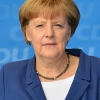
Merkel was born Angela Dorothea Kasner in Hamburg, the daughter of Horst Kasner, a Lutheran pastor, and Herlind Kasner, a teacher of English and Latin. When she was an infant, her father accepted a church post in East Germany, and the family settled in the town of Templin north of Berlin. She grew up in a Protestant household in the communist state, showing early strength in mathematics, physics, and languages. She studied physics at Karl Marx University in Leipzig, graduating in 1978, and earned a doctorate in physical chemistry in 1986 from the Central Institute for Physical Chemistry in Berlin. She then worked as a research scientist at the East German Academy of Sciences.
The fall of the Berlin Wall in 1989 drew her into politics. She joined the reform-minded Democratic Awakening movement and briefly served as a deputy spokesperson for East Germany's final government. After German reunification she joined the Christian Democratic Union (CDU) and won a seat in the Bundestag in 1990. Chancellor Helmut Kohl brought her into his cabinet as Minister for Women and Youth from 1991 to 1994 and then as Minister for the Environment, Nature Conservation and Nuclear Safety from 1994 to 1998. After the CDU lost power in 1998, she became the party's general secretary and, in 2000, its leader, taking charge as the party weathered a funding scandal.
In 2005 she became chancellor at the head of a grand coalition between the CDU/CSU and the Social Democrats, the first woman and the first leader raised in the former East Germany to hold the post. Her tenure was defined by crisis management. She coordinated Germany's response to the 2008 global financial crisis, pressed for austerity and integration during the eurozone debt crisis, and in 2015 allowed roughly a million migrants and refugees into Germany, a decision summed up in her phrase "Wir schaffen das" ("We can do it"). She later led the country through the COVID-19 pandemic. Governing for four terms, she was known for a pragmatic, low-key, and consensus-seeking approach that often made her a bridge between competing powers.
Merkel declined to seek a fifth term and left office in 2021 after 16 years. She was named Time magazine's Person of the Year in 2015 and received the UN refugee agency's Nansen Refugee Award in 2022. In retirement she largely withdrew from public life and published a memoir, Freedom, in 2024. She has been married since 1998 to the quantum chemist Joachim Sauer; an earlier marriage to Ulrich Merkel ended in 1982, and she kept his surname. She has no children.
Angela Merkel was born on July 17, 1954 in Hamburg, Free and Hanseatic City of Hamburg, Germany. In Cardology (Destiny Cards), July 17, 1954 corresponds to the Jack of Clubs, making the Jack of Clubs her Birth Card.
In numerology, the name adds another layer to the birth-date profile. The letters of a person’s name are used to explore inner motivation, personality, expression, and the qualities they bring into relationships and everyday life. Explore how her original name Angela Dorothea Kasner influences her life and personality.
Famous Cancer People
Discover famous Cancer people, from actors and musicians to writers, athletes, and historical figures. Explore their birthdays and biographies, and see who shares the Cancer zodiac sign.



View All Famous Cancer People →

Jack of Clubs Famous People
View All Famous Jack of Clubs People →