Robocop in motion, depicted amidst intense, dramatic weather with a blurred bokeh effect, featuring sharp subject focus against a soft background, stormy skies, and high tension

Can AI Transform Policing Without Losing Public Trust?

Generative AI can already write reports, analyze data, and answer calls - tasks once reserved for police officers. But should it? A new framework, the Transformer Led Policing model, argues that the future of AI in law enforcement will not be decided by technology alone. It will depend on whether the public believes it is being used fairly, transparently, and with accountability at every step.

September 20, 2025 in Ethics & Governance


Artificial intelligence has been edging its way into police work for nearly two decades, from predicting crime hotspots to scanning hours of body-cam footage. But the arrival of powerful generative AI tools such as ChatGPT has supercharged the conversation - and raised urgent questions. How can police forces use these tools responsibly? How do they avoid bias, maintain transparency, and keep the public on their side?

A new article in Policing: A Journal of Policy and Practice introduces the Transformer Led Policing (TLP) model, the first structured framework designed specifically to help law enforcement integrate generative AI into their daily work.


A model built for policing

The TLP framework, developed by researcher Eric Halford, breaks AI adoption into three cyclical phases: Devise, Discuss, and Deploy. Each phase contains four elements, ranging from defining real-world use cases and designing prompts to testing, evaluating, and openly discussing issues of legality, ethics, and security. Unlike ad hoc approaches that might bolt AI onto existing systems, the TLP model is meant to ensure that every stage of adoption is deliberate, transparent, and auditable.

This structure matters because police organizations have historically been cautious about external technologies. Officers are more likely to adopt tools that feel tailored to their work rather than imported wholesale from other industries. By creating a framework explicitly designed for law enforcement, the TLP model increases the chances of cultural acceptance while also ensuring compliance with regulations such as the EU's AI Act and the UK's Covenant for Using Artificial Intelligence in Policing.


Why policing needs its own AI framework

Until now, most AI governance models have focused on general ethics or technical standards. These are valuable but often too broad to address the unique challenges of law enforcement. Policing decisions directly affect people's freedoms, rights, and even life-and-death situations. A flawed risk assessment or biased investigative tool could undermine public trust and lead to serious legal consequences.

Halford argues that the integration of generative AI cannot simply mirror how it is adopted in healthcare, finance, or education. In policing, public legitimacy is just as important as technical performance. The TLP model therefore emphasizes stakeholder engagement, legal scrutiny, and ethical review alongside technical testing. It is designed as much to build confidence as to improve efficiency.


The promise and the limits of generative AI

The article outlines the broad spectrum of tasks where generative AI might be applied. In theory, it could support officers by answering emergency calls, drafting witness statements, analyzing vast sets of intelligence, planning interviews, or even generating training materials. At the administrative level, it could summarize documents, manage schedules, or automate routine reporting, freeing officers for frontline duties.

Yet these possibilities come with risk. When generative AI was tested on UK police risk assessments, it produced results that were only about 62 percent accurate - far too low for operational deployment. The technology has also shown a tendency to "hallucinate," producing outputs that look convincing but are factually wrong. These issues underline why the TLP model insists on rigorous testing, clear performance thresholds, and ongoing human oversight before any system is put into use.


Balancing potential and public trust

The deeper challenge is not only technical but cultural and ethical. Generative AI can analyze data and automate processes at a scale no human team could match, but without careful safeguards it risks amplifying existing biases or eroding trust between police and the communities they serve. For this reason, the TLP framework builds legitimacy into its core. It requires public consultation, fairness testing, and open disclosure of how the technology is being used.

If policing is to benefit from the efficiencies of AI, it cannot ignore the lessons of past controversies over surveillance and predictive algorithms. The future of AI in law enforcement depends on ensuring that every innovation complements officers rather than replaces them, and that transparency and accountability are never sacrificed for speed.


A turning point for AI in policing

The introduction of the Transformer Led Policing model marks a turning point in the debate. The question is no longer whether AI can be used in policing, but how it should be used and under what rules. If adopted carefully, AI could reduce paperwork, sharpen investigations, and improve safeguarding. If deployed recklessly, it risks repeating old mistakes and damaging public confidence.

Halford's framework offers a way forward: a methodical, police-specific roadmap that balances technological opportunity with ethical obligation. In the end, the success of AI in policing may not hinge on what the technology can do, but on whether the public believes it is being used fairly, responsibly, and in the service of justice.


References

Eric Halford (2025). The Transformer Led Policing model: a framework for applying generative artificial intelligence in policing. [Policing: A Journal of Policy and Practice, Volume 19, 2025] https://doi.org/10.1093/police/paaf027...

How the FDA and EMA Differ on Regulating AI in Drug Development
Nov 9, 2025 Ethics & Governance

How the FDA and EMA Differ on Regulating AI in Drug Development

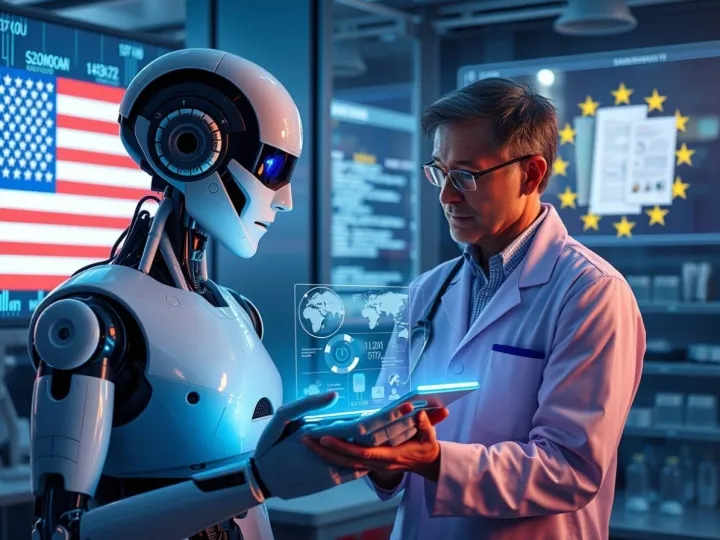
A new open-access article in The Journal of Law and the Biosciences examines how the US Food and Drug Administration (FDA) and the European Medicines Agency (EMA) are regulating artificial intelligence in drug development. Written by Gabriela Lenarczyk, Timo Minssen, Nicholson Price, and Arti Rai, the study compares the FDA's flexible, dialogue-based oversight with the EMA's structured, risk-tiered model under the EU's new AI Act. The analysis highlights growing divergence across the Atlantic and its implications for innovation, safety, and global harmonization.

Can You Trust AI With Your Health Questions? Heres What the Research Shows
Nov 14, 2025 Cognitive Science

Can You Trust AI With Your Health Questions? Here's What the Research Shows

A comprehensive Open Access narrative review published in The European Journal of Public Health examined how citizens and patients perceive the use of large language models in healthcare. The study analyzed 120 scientific papers on ChatGPT and similar systems, identifying perceived benefits in health information access but also substantial concerns regarding accuracy, bias, safety, and the future of the doctor - patient relationship. The findings provide one of the broadest portraits to date of how the public understands AI-driven health information and what safeguards people expect.

How Social Control Shapes Organizational Culture and Performance
Nov 9, 2025 Business & Workplace

How Social Control Shapes Organizational Culture and Performance

A new open-access study in The Journal of Law, Economics, and Organization offers a formal model of how organizational culture emerges and evolves through social control. Economist Mark Gradstein examines how management influences employees' values and norms - through rewards, penalties, and shared commitment - to achieve coordination and cohesion. The analysis shows that loyalty and social pressure can substitute for financial incentives in shaping behavior and that tighter alignment of cultural norms correlates with improved firm performance.

From Algorithms to AI Scientists: The Rise of Intelligent Agents in Medicine
Nov 11, 2025 Theory & Systems

From Algorithms to AI Scientists: The Rise of Intelligent Agents in Medicine

Artificial intelligence is no longer just analyzing data - it's beginning to reason about it. A new open-access paper in Briefings in Bioinformatics explores how Large Language Model (LLM) agents - AI systems capable of planning, reasoning, and taking action - are reshaping bioinformatics and biomedicine. These autonomous "AI scientists" are now being used to design drugs, interpret genetic data, and even collaborate with doctors in clinical decision-making. But as their power grows, so do the challenges: bias, hallucination, privacy, and the ethics of machines that can think.

Belief, Confidence, and the Minds Firewall: How Students Resist Phishing Attacks
Nov 4, 2025 Business & Workplace

Belief, Confidence, and the Mind's Firewall: How Students Resist Phishing Attacks

A study in Journal of Cybersecurity applies the Health Belief Model to understand how university students protect themselves from email phishing. While technical defenses improve, phishing attacks persist - driven not by code but by cognition. Researchers found that self-efficacy, perceived severity, and cues to action were the strongest predictors of protective behavior. Students who believed in their ability to act, and who recognized the seriousness of threats, showed greater cyber-resilience - suggesting that awareness and belief are as crucial as technology.

Culture Travelers: How Fandom and AI Reimagine the Boundaries of Culture
Oct 31, 2025 Creativity & Performance

Culture Travelers: How Fandom and AI Reimagine the Boundaries of Culture

A new study from the University of Oxford introduces "transculturing" - a concept redefining how culture evolves through creativity, language, and human connection. Published in Applied Linguistics (Open Access), Alfred W. T. Lo explores how global fandoms, from Squid Game to K-pop, reveal a deeper process of cultural movement. In the GenAI age, where human imagination intersects with algorithmic production, transculturing offers a hopeful vision of creativity as a shared human - machine dialogue rather than a competition.