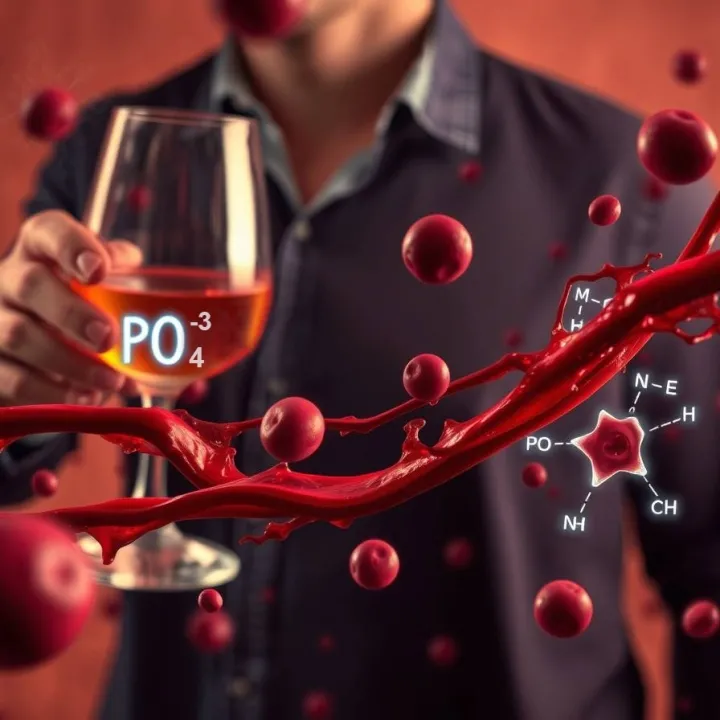
The ability to "hold one's liquor" has long been seen as a social trait, but new research suggests it may also be a biochemical one. A team from the Norwegian Institute of Public Health and collaborating clinics has shown that phosphate levels in the blood may partly determine how strongly a person feels the effects of alcohol. Their results link higher serum phosphate (se-P) with a lower subjective response to alcohol, as measured by a well-validated self-report tool - the Self-Rated Effects of Alcohol (SRE) questionnaire.
The study builds on decades of work showing that people who require more drinks to feel intoxicated are at greater risk for heavy consumption and alcohol use disorder (AUD). This "low response" phenotype has been identified as an early warning sign for problematic drinking. However, most research has relied on self-reported or behavioral data, leaving its biological underpinnings largely unexplored.
To investigate the physiology behind alcohol response, Bramness and colleagues combined data from three separate cohorts: an experimental group of healthy young men, a sample of volunteer blood donors, and a clinical group of patients in residential AUD treatment. Participants completed the SRE questionnaire, which estimates the number of drinks needed to feel alcohol's effects. Blood samples were analyzed for multiple biochemical markers, including se-P, liver enzymes, prolactin, and vitamins.
In both the experimental and blood donor groups, higher phosphate levels correlated strongly with higher SRE scores - meaning those participants needed more alcohol to feel an effect. The correlations (r = 0.507 and 0.389, respectively) were statistically significant and consistent across sensitivity analyses. No such relationship appeared in the AUD group, where phosphate levels were elevated but variable, likely due to nutritional supplementation during treatment. The researchers concluded that the se-P/SRE link may operate primarily in individuals with intact metabolic balance, offering a measurable window into presystemic alcohol metabolism.
Presystemic metabolism refers to the processing of alcohol before it enters systemic circulation - primarily in the stomach and liver. Earlier work by the same team suggested that differences in this early metabolism could explain why some individuals experience weaker intoxication despite consuming similar amounts. In a 2021 study, phosphate levels predicted variations of up to 40 percent in peak blood alcohol concentration between individuals. The new data extend that finding by connecting phosphate not only to measurable metabolism but also to subjective experience.
The mechanism remains uncertain. Phosphate plays multiple roles in cellular energy transfer, enzymatic activity, and acid-base regulation. Its involvement in alcohol metabolism may relate to enzymatic pathways or transport processes in gastric tissues. While presystemic metabolism is difficult to measure outside controlled experiments, se-P could serve as an accessible proxy for these internal processes.
Beyond phosphate, the study revealed another intriguing signal: prolactin levels correlated positively with SRE scores in both healthy and clinical groups. Because dopamine inhibits prolactin release, higher prolactin may reflect lower dopaminergic tone. This could imply that dopamine regulation contributes to subjective alcohol effects even in moderate drinkers - though the precise relationship remains speculative.
The research also confirmed well-known patterns: patients with AUD had higher SRE scores overall, indicating that they needed larger quantities of alcohol to feel intoxicated, consistent with tolerance and the low-response risk profile described in previous literature. However, their phosphate correlation disappeared, likely confounded by supplementation, abstinence recovery, and metabolic variability. Many AUD patients in treatment receive fortified diets rich in phosphate, magnesium, and vitamins, which may obscure natural physiological relationships.
The authors emphasize that their findings are preliminary but potentially important. Identifying biochemical correlates of alcohol sensitivity could lead to new risk markers for early detection of problematic drinking tendencies. Measuring serum phosphate is inexpensive and routine, making it a promising candidate for future screening research. Still, replication in larger, diverse samples is necessary to establish causality and clarify mechanisms.
The work also contributes to a broader re-evaluation of how metabolic individuality shapes cognition and behavior. If subtle differences in phosphate metabolism influence alcohol response, similar biochemical parameters may modulate other subjective experiences - from fatigue and reward to sensory processing. These results underscore how internal chemical balance interacts with perception and self-control, bridging metabolism with psychology.
From the perspective of Seven Reflections' Dimensional Systems Architecture (DSA), this study illustrates how a physiological variable can act as a "field regulator" between first-order processes (biochemical transformation) and higher-order states (subjective awareness). In DSA terms, serum phosphate functions as a stabilizing element within the body's dynamic system - a structural factor that modulates the timing and intensity of perceptual feedback loops. A lower phosphate state corresponds to faster saturation and stronger signal feedback (early intoxication), while a higher state supports greater absorption latency, delaying subjective recognition. This pattern reflects the DSA principle that consciousness and matter share similar field-timing relationships: when the structural field (here, metabolic buffering) expands, subjective experience becomes less reactive and more tolerant.
The implication extends beyond alcohol metabolism. It suggests that what we experience as "sensitivity" or "tolerance" may represent the system's calibration of processing speed and energetic buffering - principles that DSA formalizes as interactions along the temporal-structural (L/T) axes. Under this framework, biochemical balance is not separate from cognition but a direct expression of systemic organization. The body's chemistry defines the bandwidth through which consciousness perceives internal change.
Bramness and colleagues frame their work conservatively, calling for replication and mechanistic research, yet its conceptual reach is significant. By identifying phosphate as a measurable correlate of subjective intoxication, they bridge the gap between psychological reporting and physiological data. Future research may determine whether manipulating phosphate levels can alter alcohol sensitivity or whether this relationship is purely correlative. Either way, the study reinforces an emerging view in neuroscience: consciousness - even in its altered forms - is not only a function of neural activity but of the entire systemic field in which metabolism, regulation, and awareness co-evolve.