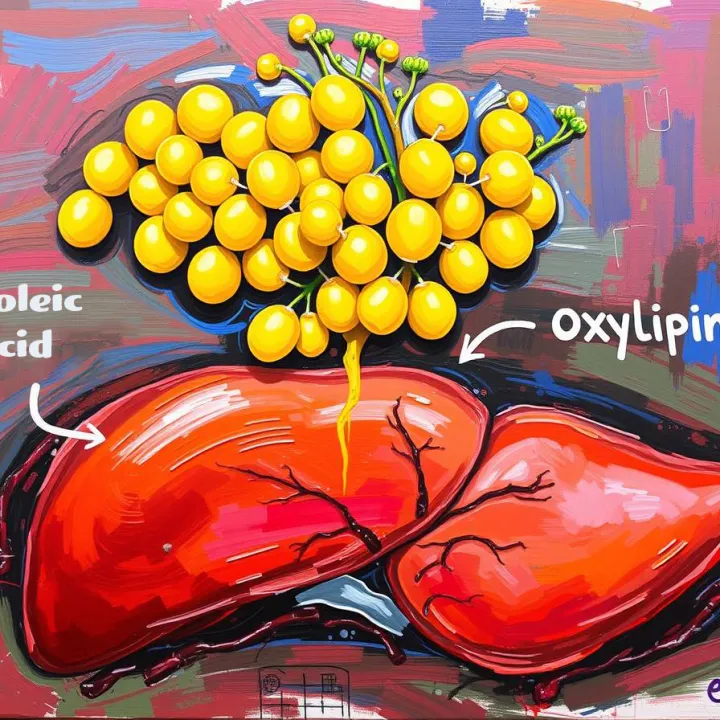
Soybean oil is one of the most widely used cooking oils in the United States and a major component of processed foods. Its high linoleic acid content has long raised questions about how modern diets may influence metabolism and weight gain. A new study published in the Journal of Lipid Research provides a detailed look inside the liver to uncover why soybean oil-rich diets cause significant weight gain in mice, while other fats do not. The findings point to a group of oxidized fat-derived molecules, called oxylipins, as the key drivers of this effect.
The researchers began by comparing two high-fat diets that were identical in calories but differed in fat composition. One diet contained soybean oil, rich in linoleic acid, while the other relied primarily on coconut oil, which contains far less linoleic acid. Normal mice fed the soybean oil diet became obese, accumulated substantial white adipose tissue, developed fatty liver, and showed impaired glucose tolerance. The same mice gained less weight on the coconut oil diet, reinforcing earlier observations that linoleic acid-rich oils tend to be more obesogenic than saturated fats.
A second group of mice received the exact same diets but carried a genetic modification that caused their liver cells to rely on an alternative promoter of the HNF4A gene. This alternate configuration reduces the abundance of several enzymes involved in polyunsaturated fat metabolism. Remarkably, these mice gained far less weight on the soybean oil diet and did not develop fatty liver or glucose intolerance. Their bodies handled the same fats differently, producing fewer oxylipins from linoleic acid and alpha-linolenic acid. This contrast allowed the researchers to isolate which internal metabolic steps make soybean oil problematic.
Oxylipins are produced when polyunsaturated fats undergo enzymatic oxidation inside tissues. They are biologically active molecules involved in inflammation, vascular signaling, and immune function. In this study, several oxylipins created from linoleic acid and alpha-linolenic acid showed strong positive correlations with body weight, liver fat, and glucose dysregulation in normal mice. These included 9,10-DiHOME, 12,13-DiHOME, 9,10-DiHODE, and 12,13-DiHODE. All four were dramatically lower in the protected mice, suggesting they play a role in the development of diet-induced obesity.
Surprisingly, the study showed that the protected mice actually accumulated more linoleic acid itself in the liver than normal mice, despite having better metabolic outcomes. This indicates that linoleic acid is not the direct cause of obesity. Instead, the harmful effects appear to emerge only once linoleic acid is converted into specific oxylipins. The researchers emphasize that the ratio of parent fatty acid to oxylipins may be more meaningful than the absolute amount of dietary fat consumed.
To identify why the protected mice produced fewer oxylipins, the team conducted a proteomic analysis of liver samples. They found significantly lower levels of several key enzymes involved in polyunsaturated fat metabolism, including members of the CYP2C cytochrome P450 family, fatty-acid desaturases, and epoxide hydrolases. These enzymes normally convert linoleic acid into epoxides and then into oxylipins. Reduced enzyme abundance disrupts this pathway and limits the buildup of oxylipins associated with obesity.
To test whether blocking oxylipin formation could protect normal mice from obesity, the researchers treated soybean-oil-fed mice with a soluble epoxide hydrolase inhibitor. Although the treatment raised epoxide levels and lowered many oxylipins, it had almost no effect on body weight. Crucially, the specific oxylipins most strongly associated with weight gain in the normal mice did not decrease under inhibition. This further narrows the list of oxylipins most likely involved in driving the metabolic response to soybean oil.
The study also examined inflammation, another process often linked to obesity. Surprisingly, most inflammatory cytokines in the liver did not increase in response to the soybean oil diet, and both mouse groups showed similar inflammatory profiles. Only a small number of cytokines differed between normal mice and the protected group, and none were consistently elevated by the diet. This shows that the soybean-oil effect on weight gain is not primarily driven by inflammation within the liver.
A broader view of metabolism revealed more clues. The protected mice had elevated levels of TCA-cycle intermediates and ketone bodies, indicating stronger mitochondrial activity and more efficient energy processing. In contrast, the normal mice showed reduced mitochondrial metabolites on the soybean oil diet, aligning with poorer metabolic stability. The liver's ability to process energy may therefore amplify or mitigate the effects of oxylipins created from dietary fats.
Given that soybean oil consumption has increased dramatically over the past century, rising from about 2 percent of daily calories to nearly 10 percent, these findings highlight how modern dietary patterns interact with internal metabolic architecture. While soybean oil itself is not inherently harmful, the way certain bodies convert its linoleic acid into oxylipins may predispose individuals to obesity or metabolic dysfunction. Other high-linoleic oils - including corn, safflower, and sunflower oils - may follow similar pathways.
From the perspective of Seven Reflections' Dimensional Systems Architecture, this research illustrates how biological outcomes emerge from structural interactions rather than isolated variables. The genetic modification in the second group of mice did not change diet, appetite, or calorie intake. Instead, it altered the internal signaling architecture through which metabolic information flows. A single change in regulatory configuration reshaped the entire lipid-processing field, reducing signal amplification in the oxylipin pathway and preserving systemic stability. In DSA terms, the normal pathway represents a high-activation state with escalating metabolic load, while the modified pathway reflects a lower-activation configuration that maintains coherence under dietary stress.
This framework emphasizes that metabolic behavior is not solely determined by nutrients entering the system. It is governed by the structural logic through which those nutrients are parsed, transformed, and integrated. The study highlights a broader principle within DSA: when a critical interface shifts, downstream dynamics reorganize, producing entirely different outcomes from the same external input. In this case, two identical diets produced opposing metabolic trajectories because the system's internal architecture either amplified or dampened oxylipin signals.
The findings underscore the importance of understanding metabolism not as a linear chain of cause and effect but as an interacting field in which enzymes, lipids, signaling molecules, and mitochondrial activity form a coherent system. Diets rich in linoleic acid may stress this system in some individuals, not because the fat itself is harmful, but because the processing architecture converts it into signals that the body is not optimally designed to handle.