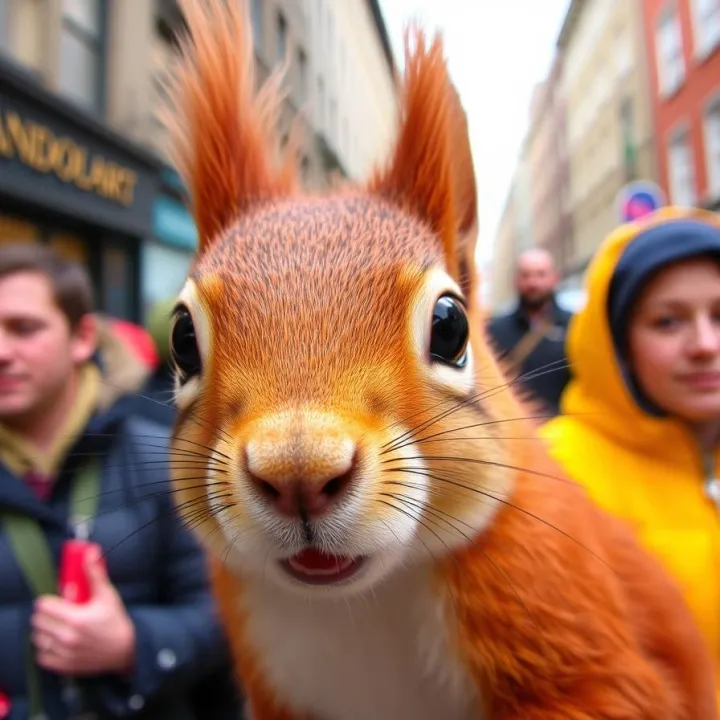
The city is not just a habitat for people; it is a stage where wild creatures must constantly adapt. A new study published in Behavioral Ecology reveals that human presence and everyday activities - walking, dog walking, cycling, and playground play - significantly diminish the problem-solving abilities of Eurasian red squirrels living in Finland's urban parks.
Researchers from the University of Oulu and Southern Medical University examined 64 squirrels across 15 green spaces in Oulu, Finland, testing their ability to solve puzzle boxes filled with hazelnuts. These tasks measure innovation, a key cognitive skill that helps wildlife adapt to changing environments. While squirrels are famously nimble and resourceful, their success plummeted in areas with heavier human traffic.
The findings are striking. Higher human presence consistently reduced the proportion of squirrels who solved the puzzles. Playground activity was particularly disruptive, exerting the strongest negative effect on both first-time and repeat solving attempts. Even seemingly harmless activities, such as walking, sharply lowered success rates, while dog walking emerged as a unique factor - it both reduced success and sped up the problem-solving of those squirrels who did succeed, suggesting heightened vigilance and pressure to act quickly.
The study shows that urban noise and movement are not neutral backdrops but active forces shaping animal cognition. For squirrels, the presence of unleashed dogs, unpredictable cyclists, and the noise of playgrounds represent a constant stream of potential threats. Rather than fostering adaptability, these disturbances appear to narrow the animals' ability to experiment and innovate.
Yet the results also reveal a paradox: when squirrels did manage to succeed under high human presence, they solved the task faster. Researchers interpret this as an adaptive strategy - complete the task quickly, then retreat to safety. This dual response - less overall success but swifter solutions among survivors - suggests that city living may be exerting selective pressure, favoring individuals with faster risk assessment and rapid execution.
The implications stretch beyond squirrels. As cities expand, human leisure patterns increasingly overlap with the spaces where wildlife forages, nests, and learns. Simple, everyday activities - strolling, playing ball, or walking the dog - carry hidden cognitive costs for animals. If innovative problem-solving is essential for survival in unpredictable urban habitats, then the very fabric of our recreation could be shaping the evolutionary future of species we rarely notice.
Rethinking Coexistence
The researchers suggest that urban planning and policy could help buffer these impacts - enforcing leash laws more rigorously, creating pet-free zones near foraging sites, or designing green spaces that account for both human play and animal refuge. Such measures may sound small, but they acknowledge an important truth: human presence is not neutral. Our activities ripple into the minds and survival strategies of the creatures around us.
The squirrels of Oulu remind us that city life is an experiment in shared cognition. Our footsteps, laughter, and unleashed companions are rewriting the rules of survival for wildlife in real time.