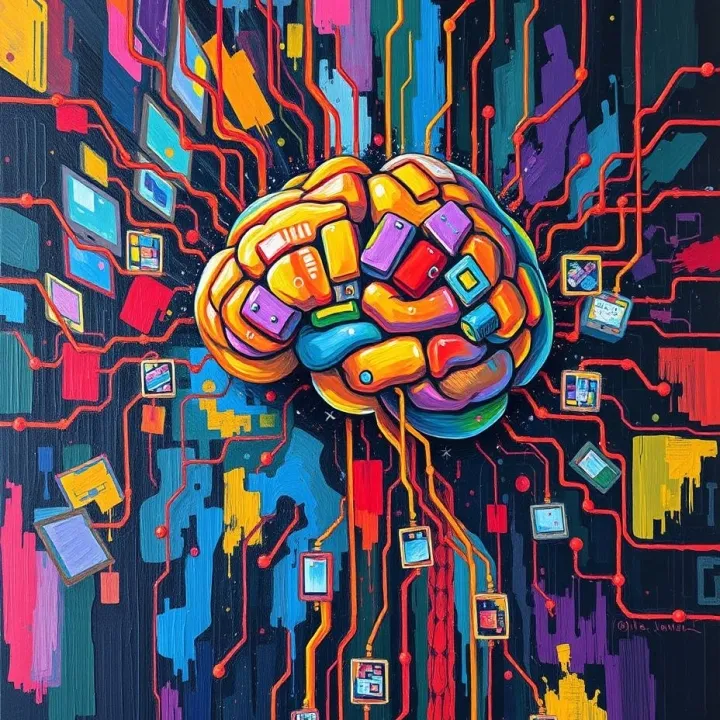
A new open-access study in Neuroscience of Consciousness presents a provocative and rigorously argued position: computers cannot be conscious, and if the brain were nothing more than a neural computer, human consciousness would be impossible as well. The central reasoning rests on a deceptively simple insight. All information inside a computer - whether voltages, bit sequences, or stored states - is encoded. For that encoded state to gain meaning, an external entity must decode it. Without decoding, the internal information could represent anything or nothing at all. Computers therefore possess no intrinsic content, no inherent aboutness, and no awareness of external things.
To illustrate this, the author compares computers to books. The shapes of ink on a page contain no inherent meaning. Only a reader's knowledge of language transforms marks into words, words into sentences, and sentences into a meaningful narrative. A computer's voltages and bits function similarly: without an interpreter, they fail to be "about" any specific event, object, or concept. Computation, the paper argues, is not a physical property but an interpretation assigned by humans. A machine running its electronic cycles could be performing arithmetic, simulating weather, or generating a chess move, but only because an external interpreter maps its physical states onto abstractions.
Extending this logic to artificial intelligence, the study notes that even advanced neural networks do not escape the encoding barrier. Without human interpretation, the internal activations of an AI model carry no defined meaning. A floor-cleaning robot navigating a room is not internally "aware" of obstacles. Its memory states could be interpreted as locations A, B, and C, but the robot itself lacks knowledge of what those internal states correspond to in the real world. The decoding information exists only in the designers' documentation or in the motor systems that translate outputs into behavior. As a result, AI cannot possess consciousness of external things, nor can it become "superintelligent" in a way independent of human interpretation.
The argument becomes more controversial when applied to the human brain. Standard neuroscientific theories treat the brain as a computational system. Sensory information is said to be encoded into neural spikes, processed through interconnected networks, and decoded into motor commands or perceptual states. But the study argues that this computational framework fails to explain phenomenal consciousness - the subjective experience of being aware of something. If brain information is encoded in neural firing, and if decoding information is not physically present inside the brain, then nothing inside the brain by itself can specify what any neural pattern is "about." Without a decoding mechanism intrinsic to the system, the brain cannot generate meaningful conscious content.
This creates a direct contradiction with our lived experience. Consciousness evidently is about external things: a cup, a sound, a person, a spatial environment. The paper argues that this empirical fact shows the brain must contain something beyond neural computation. Our awareness of objects cannot arise purely from encoded spike trains, because encoded signals alone cannot specify their own meaning. Any theory claiming that computational processes - such as predictive coding, global workspace broadcasting, recurrent feedback loops, or integrated information - cause consciousness must therefore grapple with this decoding problem. Computation, the study insists, cannot generate meaning on its own.
The paper also assesses philosophical attempts to defend computational functionalism. Some approaches claim that syntax or causal topology inside the system is sufficient to specify computation. Others argue that all physical systems compute in some sense, or that meta-computation inside the brain might help decode neural states. The study systematically dismantles these responses, noting that any internal decoding process would itself be encoded and therefore require its own decoding - leading to an infinite regress. Without a workable mechanism to break this chain, computational models fail to explain consciousness.
As an alternative possibility, the author discusses analogue models. Analogical representations - such as maps, optical images, or holograms - preserve structural relationships directly, requiring little or no decoding. If the brain maintained an analogue model of three-dimensional space, this structure might provide consciousness with direct spatial binding, allowing experience to mirror external geometry without heavy encoding. Although speculative, this proposal aims to identify a physical substrate that could hold unencoded or lightly encoded information, offering a potential bridge between neural processes and conscious experience.
The study emphasizes that this analogue hypothesis is exploratory, not definitive. The central contribution of the paper is the negative result: computational processes alone cannot account for consciousness. This conclusion challenges dominant theories in neuroscience and AI and suggests that understanding awareness requires investigating physical processes that preserve meaning intrinsically rather than through symbolic encoding.
From the perspective of Seven Reflections' Dimensional Systems Architecture (DSA) framework, the study's core argument resonates strongly with the idea that consciousness depends not merely on operations, but on the structure of information fields. In DSA terms, encoded information belongs to a high-entropy, interpretation-dependent layer - one that cannot generate intrinsic meaning. Conscious experience, by contrast, requires a stable, low-entropy field where structure and meaning coexist without external decoding. The paper's focus on analogue models parallels DSA's distinction between symbolic computation and structural resonance: only the latter provides a foundation for awareness because it embeds meaning directly into the system's spatial-temporal organization.
Seen through this structural lens, the study offers not a refutation of computational approaches, but an invitation to expand the scientific model of the brain beyond discrete operations and into continuous fields, mappings, and dynamically coherent structures. It suggests that consciousness may emerge not from algorithmic processing, but from the deep architecture of how information is organized in space and time - a perspective that aligns closely with the DSA emphasis on intrinsic field logic.