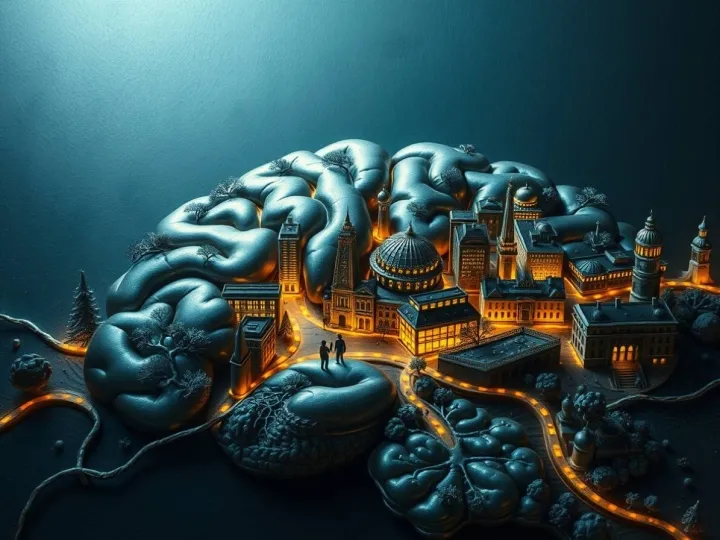
The idea that the adult brain can grow and change was once controversial. For centuries, scientists believed that neurons were finite and that learning merely reshuffled existing circuits. Yet over the last few decades, discoveries in neuroscience have turned this belief upside down. The human brain, it turns out, is a living architecture - continuously reshaping itself through every thought, movement, and emotion.
In their new review, researchers Iqra Mukhtar and Kanwal Iftikhar explore how neuroplasticity forms the foundation for cognitive enhancement - the practice of improving normal, healthy mental functions. Their work bridges decades of research into brain stimulation, cognitive training, and adaptive learning, revealing how deliberate engagement with challenging tasks, focused attention, and emotional resilience can physically remodel the brain's architecture.
From Structure to Potential
Neuroplasticity operates through microscopic changes in the brain's structure - forming new synaptic connections, strengthening existing pathways, or even generating entirely new neurons. These processes occur across all ages, but they can be consciously cultivated. "Plasticity," as Mukhtar and Iftikhar note, is not just a biological phenomenon; it's the medium through which growth and learning occur.
In youth, plasticity is abundant, driving the rapid learning that characterizes early development. As we age, the process slows - but it never stops. Modern neuroscience shows that exposure to novelty, emotional engagement, and purposeful learning can reignite plastic growth even in later decades of life. This opens the door not only to healthy aging but to a new model of lifelong mental evolution.
Beyond Pills: Training the Brain to Evolve
Cognitive enhancement has often been associated with pharmaceuticals - stimulants like modafinil or methylphenidate, which temporarily boost focus or alertness. But the new wave of research emphasizes non-drug approaches that harness the brain's inherent adaptability. Meditation, language learning, music training, physical exercise, and even strategic gaming can reshape the brain's circuitry in measurable ways.
The paper highlights a range of techniques - from neuromodulatory stimulation (like transcranial direct current stimulation) to behavioral training (like working-memory exercises). When used together, these interventions show synergistic effects, amplifying cognitive capacity more effectively than isolated methods. This "integrated model" of enhancement aims not only to improve performance but also to build what researchers call cognitive reserve - the brain's capacity to withstand stress, disease, and aging.
Plasticity as the Architecture of Resilience
One of the most compelling aspects of neuroplasticity is its relationship with resilience. The same adaptive processes that help us learn new skills also govern how we recover from emotional hardship. Studies show that people who maintain flexible thinking patterns - those who can reframe challenges and shift attention constructively - exhibit stronger neural integration between the prefrontal cortex and the limbic system. This balance enhances emotional regulation and prevents burnout.
Mukhtar and Iftikhar point out that these adaptive mechanisms mirror the principles of psychotherapy and mindfulness: training the brain to see differently changes not only perception but physiology. In a sense, resilience is not just a mindset - it's a structural property of the nervous system.
Culture and Context: The Invisible Sculptors of the Brain
The review also highlights how culture shapes neuroplasticity. Practices such as yoga, meditation, martial arts, and even daily crafts alter brain patterns by embedding attention, rhythm, and meaning into action. Studies on musicians, chess players, and abacus practitioners show structural changes in brain regions responsible for spatial reasoning and memory. Culture, in this sense, is not merely learned behavior - it is a collective sculptor of cognition.
This insight has profound implications. It suggests that our environment and routines - the languages we speak, the technologies we use, and even the emotional tone of our communities - continuously reshape the biological substrate of consciousness. Our collective habits literally wire the future of our minds.
Toward Conscious Neuroarchitecture
The emerging vision of cognitive enhancement, the authors suggest, is not about creating superhumans - it's about cultivating conscious neuroarchitecture. By understanding how thought and experience alter the brain, we can design lifestyles that align with how the nervous system naturally thrives: through novelty, social connection, purpose, and emotional balance.
This perspective dissolves the boundary between science and self-development. Every time we choose to read, practice gratitude, or learn a skill, we are acting as architects of our own neural worlds. The promise of neuroplasticity lies not in external technology but in internal discipline - the capacity to sustain curiosity and coherence over time.
The Future of Cognitive Enhancement
Mukhtar and Iftikhar conclude that while pharmacological tools may continue to play a role, the future of cognitive enhancement depends on integrated and measurable approaches. They call for more rigorous methods to assess long-term outcomes, ensuring that interventions remain ethical, practical, and safe.
Their vision aligns with a broader movement in neuroscience - one that sees the human mind not as a machine to be optimized, but as a living system to be cultivated. The ultimate goal is not to boost productivity, but to deepen adaptability - to extend the mind's capacity for learning, empathy, and creative intelligence throughout life.
In Summary
The new science of neuroplasticity offers a radical redefinition of what it means to grow. Aging no longer implies decline but transformation. Our thoughts and habits are not just reflections of who we are - they are construction materials of who we can become.
Every new skill, conversation, or challenge sends a subtle signal through the brain's latticework, forming new patterns that expand the boundaries of awareness. Whether through meditation, art, technology, or social connection, we are all participating in a continuous experiment of consciousness - one that proves, time and again, that the brain is designed not merely to survive, but to evolve.