Kipling grew up in a family immersed in the arts and in colonial India. His father, John Lockwood Kipling, was an artist and teacher at an art school in Bombay, and his mother, Alice, came from a family with literary connections. As a small child, Kipling was sent to England to live with a foster family in Southsea, a lonely and unhappy period he later drew on in fiction such as Baa Baa, Black Sheep. He attended the United Services College in Devon, a school that supplied material for his later collection Stalky & Co.
In 1882 Kipling returned to India and began working as a journalist, first at the Civil and Military Gazette in Lahore and later for the Pioneer in Allahabad. Writing to tight deadlines, he produced a stream of poems and short stories about soldiers, officials, and ordinary residents of the subcontinent. These appeared in volumes including Departmental Ditties and Plain Tales from the Hills, and their unsentimental, closely observed detail quickly made his name. He traveled to London in 1889 and found himself celebrated as a fresh literary voice.
The 1890s and early 1900s were his most productive years. Barrack-Room Ballads brought him wide attention with poems written in the voices of common soldiers, and The Jungle Book and its sequel became lasting favorites. He married Carrie Balestier in 1892, and the couple spent several years in Vermont, where he wrote Captains Courageous and much of Kim. The family also endured the death of their young daughter Josephine from pneumonia in 1899. Settling in Sussex, Kipling published Kim and the Just So Stories, and wrote poems such as Recessional and, later, If - .
Kipling's writing often reflected and defended British imperial rule, most pointedly in the poem The White Man's Burden. In 1907 he received the Nobel Prize in Literature. During World War I his son John died in action at the Battle of Loos in 1915, an event that shadowed his later years. He worked for the Imperial War Graves Commission, helping choose inscriptions for military cemeteries, and wrote a history of his son's regiment. Kipling died in London in 1936, and his ashes were placed in Poets' Corner at Westminster Abbey. Later generations have debated his legacy, praising the craft of his fiction while criticizing the imperial assumptions built into much of his work.
Rudyard Kipling was born on December 30, 1865 in Mumbai, Maharashtra, India. In Cardology (Destiny Cards), December 30, 1865 corresponds to the Ace of Hearts, making the Ace of Hearts his Birth Card.
In numerology, the name adds another layer to the birth-date profile. The letters of a person’s name are used to explore inner motivation, personality, expression, and the qualities they bring into relationships and everyday life. Explore how his original name Joseph Rudyard Kipling influences his life and personality.
Rudyard Kipling Quotes
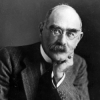
Famous Capricorn People
Discover famous Capricorn people, from actors and musicians to writers, athletes, and historical figures. Explore their birthdays and biographies, and see who shares the Capricorn zodiac sign.




View All Famous Capricorn People →