Albert Einstein was born on March 14, 1879, in Ulm, Germany, and went on to become one of the most influential thinkers in modern history. His name has become a synonym for "genius," but Einstein's legacy extends far beyond formulas and blackboards. He was a physicist, yes?"but also a philosopher, a humanist, and an unrelenting seeker of deeper truths.
Einstein is best known for his theory of relativity, especially the equation E=mc2, which revealed the interchangeable nature of mass and energy. This insight transformed modern physics and reshaped humanity's understanding of the universe, time, and gravity. His General Theory of Relativity, published in 1915, described how massive objects cause a curvature in space-time - an elegant explanation for what we experience as gravity.
But Einstein's mind didn't stop at the edge of science. He questioned everything, including the limits of logic. He once said, "Imagination is more important than knowledge," and he lived by it. Einstein often relied on thought experiments - creative mental journeys that led him to insights even before they could be proven in the lab. It was not just numbers and data that guided him, but wonder, curiosity, and a childlike openness to the unknown.
In his personal philosophy, Einstein was deeply concerned with ethics, peace, and the future of humanity. He spoke out against war, supported civil rights, and questioned nationalism. Though often seen as a recluse, he used his voice to advocate for global responsibility and scientific humility.
What made Einstein's genius unique was not just his intellect, but his perspective. He was willing to hold contradictions, to let uncertainty sit beside clarity, and to ask the kinds of questions that didn't have answers yet. He didn't just solve problems - he redefined what it meant to see a problem.
Albert Einstein died on April 18, 1955, in Princeton, New Jersey, but his influence endures. From quantum theory to GPS technology, from philosophical debates to pop culture icons, his presence still bends our sense of time.
Albert Einstein was born on March 14, 1879 in Ulm, Baden-Wuerttemberg Region, Germany. In Cardology (Destiny Cards), March 14, 1879 corresponds to the Nine of Diamonds, making the Nine of Diamonds his Birth Card.
In numerology, the name adds another layer to the birth-date profile. The letters of a person’s name are used to explore inner motivation, personality, expression, and the qualities they bring into relationships and everyday life. Explore how the name Albert Einstein influences his life and personality.
Albert Einstein Quotes
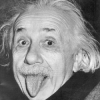
“Men marry women with the hope they will never change. Women marry men with the hope they will change. Invariably they are both disappointed.” - Albert Einstein