Earth as a Mode of Experience
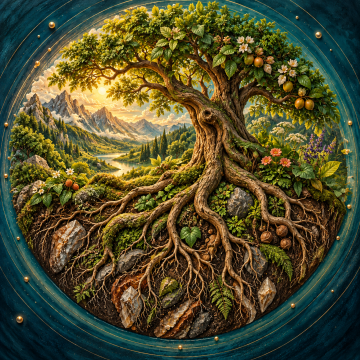
In Seven Reflections, Earth is understood as a mode of experience within the elemental system, not a material substance or personality category. It describes how energy behaves once initiation has occurred and requires containment. Earth consolidates activity into form, making experience tangible, reliable, and repeatable over time.
Earth governs persistence rather than momentum. Where Fire introduces direction, Earth provides durability. It answers the question: What can be held? Without Earth, initiation remains fleeting and unstable, unable to support continuity or growth within the elemental cycle.
Earth is present whenever experience takes shape - in structure, habit, routine, material systems, and embodied presence. It allows energy to settle into something usable, anchoring movement so it can endure and participate meaningfully in the broader elemental flow.
Earth and the Sense of Smell
Earth aligns with smell, the sense most directly tied to physical presence and material reality. Smell detects substance at its most immediate level. It registers what is real, what is present, and what occupies space.
Unlike sight, which reveals at a distance, smell requires proximity. In the same way, Earth demands contact with reality. It brings experience into the body, into form, into direct engagement with what exists rather than what is imagined.
Through smell, Earth anchors perception. Through stabilization, Earth anchors experience.
Earth in the Elemental System
Earth follows Fire in the life-promoting cycle. Its role is not to initiate, but to hold. Where Fire brings activity into motion, Earth gives that activity weight, form, and continuity.
Within the experiential cycle, Earth allows momentum to slow enough to become usable. It prevents energy from dissipating and provides the conditions necessary for connection and integration to follow.
Earth does not oppose change. It simply ensures that change has something to stand on.
Balanced Earth
When Earth is balanced within the system, stability arises without rigidity. Structure supports growth rather than constraining it. Effort is steady, reliable, and sustainable. What is built can be maintained without constant reinforcement.
Balanced Earth allows experience to settle into rhythm. Action becomes repeatable. Progress is measured rather than forced. There is a sense of grounded presence - not immobility, but endurance.
In practical terms, balanced Earth enables continuity. What begins is carried forward, supported, and allowed to mature over time.
Excess Earth
Excess Earth occurs when stabilization becomes fixation. Energy remains locked in structure long after movement is required. The system prioritizes holding over adaptation, causing experience to stagnate.
At the system level, excess Earth produces rigidity, over-attachment to form, resistance to change, and accumulation without circulation. Structure becomes an end rather than a support.
In lived expression, excess Earth may appear as heaviness, slowed metabolism, inertia, or over-reliance on routine and control. Effort may persist long after relevance has faded. Security is sought through holding rather than through adaptability.
Excess Earth is not strength. It is stability without circulation.
Deficient Earth
Deficient Earth occurs when stabilization fails to occur. Initiation may arise, but nothing is held long enough to take form. Energy dissipates before structure can develop.
At the system level, deficient Earth produces instability, inconsistency, and difficulty sustaining effort. Activity may be frequent, but results remain fragile or short-lived.
In lived expression, deficient Earth may appear as difficulty with routine, weak embodiment, lack of follow-through, or discomfort with structure. Momentum exists, but continuity does not.
Restoring Earth means restoring containment - not forcing discipline, but allowing form to develop naturally around what has already begun.
Earth and Desire
Earth plays a critical role in the desire - resolution loop. Where Fire activates response, Earth determines whether satisfaction can be sustained. Desire resolves not only through action, but through holding the result.
Without Earth, fulfillment is temporary. With Earth, resolution becomes stable enough to support peace before the next cycle begins.
Earth does not suppress desire. It allows desire to complete.
Earth and Consciousness
Within the broader consciousness cycle, Earth corresponds to embodiment and continuity. Awareness moves from differentiation into form. Experience becomes grounded, measurable, and real.
Earth is not ego or materialism. It is coherence over time. Without it, consciousness remains abstract. With it, experience becomes lived.
Earth in Astrology
In astrology, Earth is expressed through the zodiac signs Taurus, Virgo, and Capricorn, each stabilizing experience in a different way. Taurus sustains through continuity and value, Virgo stabilizes through precision and refinement, and Capricorn stabilizes through structure and responsibility. Though their expressions differ, all three signs give form and durability to experience.
The element itself, however, remains constant in function. Earth always stabilizes. How that stabilization appears depends on timing, balance, and interaction with other elements within the birth chart.
This is why Earth must be understood structurally before it is interpreted personally.
Earth as Part of a Living System
Earth cannot operate in isolation. Stabilization without movement leads to stagnation. Earth must eventually give way to Air, allowing what has been built to connect, circulate, and adapt.
In Seven Reflections, Earth represents the Law of Continuity at the elemental level - the principle that allows experience to endure long enough to matter.
Closing: Earth's Role in Continuity
Earth reminds us that beginnings are only meaningful when they can be sustained. Stability is not resistance to change, but the condition that allows change to become real. What is held can be connected. What is formed can be refined.
From Earth, the cycle moves naturally into Air - the element of connection, where structure gains relevance through interaction and exchange.