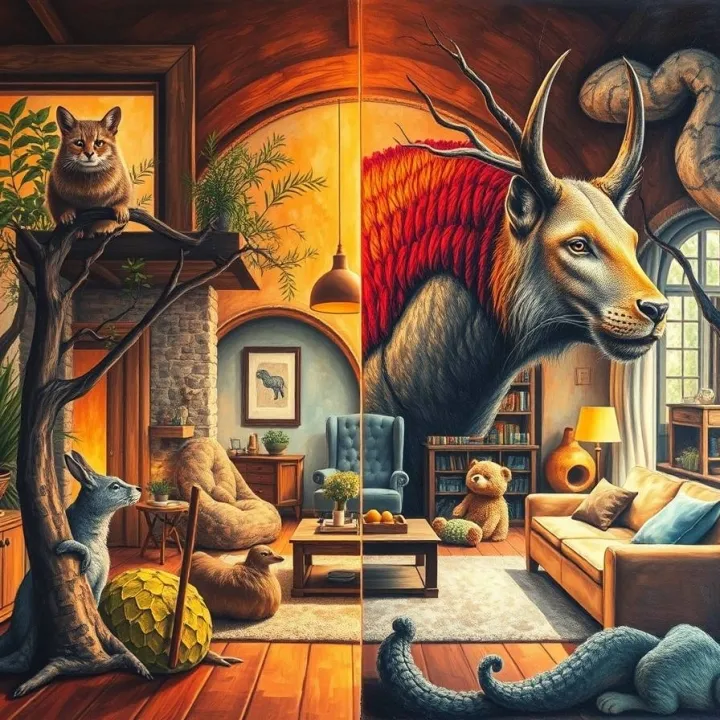
Across cultures and species, home is often described as a physical refuge, yet research shows that its meaning extends far beyond architecture or nesting behavior. The BioScience article examines home as a multidimensional concept that integrates functional use of space, territorial behavior, emotional attachment, symbolic expression, and temporal rhythms. This broad approach reveals that many species construct and inhabit home-like environments through behavioral patterns that mirror those observed in humans. Rather than being an exclusively cultural creation, home becomes a cognitive and ecological phenomenon shaped by universal needs for safety, identity, predictability, and orientation.
The authors first highlight the functional logic underlying domestic spaces. Human dwellings include differentiated zones for sleeping, eating, hygiene, and social activity, but similar partitioning appears in animal structures. Rodents create distinct chambers for nesting, food storage, rearing young, and waste, while polar bears maintain bifurcated dens that separate caregiving from resting areas. These examples illustrate that home organization is guided by recurring functional pressures such as cleanliness, survival, and the protection of offspring. Although materials and complexity differ widely, the underlying behavioral logic remains comparable: species shape space to match biological rhythms and social needs.
Beyond function, home serves as an extension of personal space. In humans, this includes rooms aligned with levels of privacy, cultural expectations of hospitality, and spatial boundaries that regulate access and comfort. Similar patterns appear in animals that regulate interpersonal distance, defend territories, or create buffer zones around nesting areas. The parallels are especially clear in species where proximity triggers graded behavioral responses; birds, mammals, and fish often maintain defined zones around themselves or their dens, echoing human distinctions between intimate, personal, social, and public space. This spatial regulation underscores a shared psychological mechanism: home is partly defined by the boundaries it establishes around the self.
The symbolic and identity-bearing dimensions of home also find analogues in the animal world. Adolescents decorate bedrooms to express individuality, while cultural groups imprint shared identity onto neighborhoods and architectural styles. Animals likewise personalize or mark their environments. Bowerbirds decorate bowers with curated objects, rodents deposit scent markers to claim territory, and many mammals use visual or auditory signals to personalize space. These behaviors reveal that home functions as a medium for expressing identity, communicating status, and supporting continuity of self across contexts.
Another central dimension is the use of home as a cognitive and spatial anchor. Humans organize daily movement patterns around home, conducting round trips to workplaces, schools, and resource sites. Animals display comparable home-base behavior: rodents establish preferred locations from which they explore, returning along direct paths, while other species navigate living ranges using predictable routes and landmarks. Whether in human cities or animal territories, movement is structured by stable anchor points that support memory, orientation, and routine. This anchoring effect is strengthened by environmental cues, spatial familiarity, and the comfort associated with known locations.
The concept of home also expands across scales. Individuals identify with dwellings, neighborhoods, hometowns, and homelands, each layer providing a sense of belonging and symbolic meaning. Animals likewise maintain living ranges, seasonal territories, and migratory pathways that operate as spatial frameworks for behavior. Even in the absence of fixed structures, social groups can serve as mobile homes, as seen in herding mammals, flocking birds, and migratory insects whose cohesion provides safety and orientation. These examples demonstrate that home is not constrained to physical walls; it can be a social or ecological structure that shapes collective behavior.
Conditions of displacement highlight the psychological importance of home. Homeless individuals construct improvised forms of order and identity through personal belongings, while nomadic groups maintain cultural continuity through portable dwellings and social bonds. Animals separated from fixed locations rely on group cohesion or repetitive marking behaviors to recreate stability. Across contexts, the creation of home-like structures - symbolic, spatial, or social - serves to regulate stress, maintain identity, and preserve routines.
The BioScience article ultimately argues that home is best understood as an integrative construct composed of functional requirements, spatial habits, emotional states, cultural meanings, and temporal patterns. No single species exhibits all dimensions simultaneously, yet each dimension appears across biological and cultural contexts. The continuity of these patterns suggests that homeliness emerges not from human uniqueness but from shared cognitive and ecological principles. It arises wherever organisms create protected, structured, and meaningful spaces for living, resting, raising young, and returning.
Through the lens of Seven Reflections' Dimensional Systems Architecture, the concept of home can be interpreted as a stabilizing field that organizes behavior across multiple layers of a system. Home functions as an internal reference structure, grounding movement, identity, memory, and social interaction. It reduces cognitive entropy by providing predictable spatial and emotional boundaries, enabling efficient navigation through complex environments. Across species, home thus represents a systemic node where function, meaning, and orientation converge - a point of coherence within an otherwise dynamic behavioral landscape.
Understanding home as a multidimensional system highlights the deep connections between biological instincts, cultural practices, and cognitive structures. It reframes home not as an artifact but as a universal behavioral architecture that evolves with both individuals and societies. Whether constructed from soil, wood, fabric, or memory, home remains one of the fundamental ways living beings shape the world and shape themselves through it.