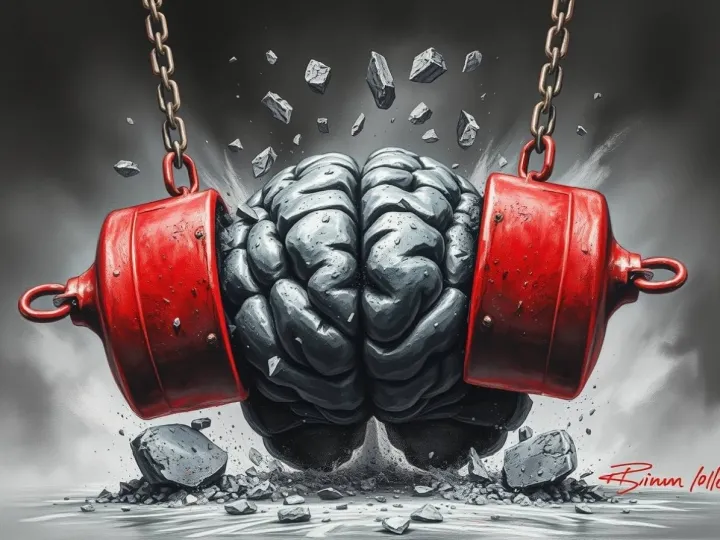
What if depression could be understood not only as mood disturbance but as a breakdown in learning itself? A new commentary in Brain by Oxford psychiatrist Erdem Pulcu reflects on fresh evidence that both unipolar and bipolar depression involve measurable impairments in associative learning - how the brain links actions, rewards, and losses. These deficits may help explain why some patients fail to respond to conventional treatments, and they offer a promising bridge toward precision psychiatry.
Unipolar vs. Bipolar Depression: What's the Difference?
Both unipolar and bipolar depression involve periods of low mood, loss of energy, and difficulty experiencing pleasure. But they belong to different families of mental illness, and that distinction matters both clinically and biologically.
Unipolar depression, also known as major depressive disorder (MDD), is characterized by recurrent episodes of depression without the presence of mania or hypomania. People experience persistent sadness, hopelessness, loss of motivation, changes in sleep and appetite, and cognitive slowing. These episodes can last weeks to months and may recur across a lifetime, but mood elevation is not part of the picture.
Bipolar depression, by contrast, occurs within bipolar disorder, a condition defined by alternating mood states. Alongside depressive episodes, patients experience periods of mania or hypomania - marked by elevated mood, increased energy, reduced need for sleep, rapid thoughts, and sometimes impulsive or risky behavior. The depressive phases in bipolar disorder can look nearly identical to unipolar depression, but the presence of manic states differentiates the two.
This overlap poses a serious diagnostic challenge: many individuals first seek help during a depressive episode, before any manic symptoms have emerged. As a result, bipolar depression is often misdiagnosed as unipolar depression. This matters because treatment responses differ - some antidepressants that help in unipolar depression can worsen manic symptoms or trigger rapid mood cycling in bipolar disorder.
In short, both conditions involve depression, but unipolar is depression-only, while bipolar is depression plus mania/hypomania. Clinicians must distinguish between them to tailor treatment safely, and researchers are increasingly looking to cognitive and neural markers - like the associative learning impairments studied here - as tools to improve that distinction.
The study under discussion, led by Suveges and colleagues, used reinforcement learning combined with drift diffusion models (RLDDMs) and neuroimaging to probe how patients with treatment-resistant depression learn in a task mixing positive and negative outcomes. Compared with healthy controls, both unipolar and bipolar groups were slower to accumulate evidence before making decisions. This pattern, consistent with psychomotor retardation, suggests that depression is not only about low mood but also about fundamental disruptions in the speed and efficiency of cognitive processing.
More intriguingly, the modeling revealed that certain parameters - non-decision time and drift rate - correlated with depression severity. Patients took longer to initiate responses, yet once engaged, sometimes accumulated evidence faster than expected. This unusual balance raises questions about whether standard models capture distinct cognitive domains or blur them, highlighting the complexity of computational psychiatry's evolving toolkit.
Neuroimaging data added another layer. Both depression groups showed blunted reward signals in the lateral orbitofrontal cortex and reduced amygdala responses to loss prediction errors. But their neural signatures diverged as well: unipolar depression was marked by reduced activity in the nucleus accumbens, a region tied to motivation, while bipolar patients showed exaggerated reward-related signals in the anterior cingulate and orbitofrontal cortex. A machine learning classifier trained on these brain differences was able to distinguish unipolar from bipolar depression with over 74% accuracy - a striking result in a field often plagued by diagnostic ambiguity.
Still, Pulcu cautions against over-reliance on costly neuroimaging. The real promise may lie in the behavioral data itself - reaction times, error patterns, decision-making styles - that are easy and inexpensive to collect. These digital fingerprints, if refined through replication, could form the backbone of scalable clinical tools.
The broader message is both sobering and hopeful. Sobering, because decades of neuroimaging advances have yet to yield reliable biomarkers in psychiatry. Hopeful, because computational approaches that merge cognitive modeling with neuroscience are beginning to unravel hidden layers of depression, revealing differences between subtypes that traditional diagnostic categories often blur.
In the long run, characterizing depression through its learning impairments may shift psychiatry closer to personalized medicine. Instead of treating "depression" as a single entity, clinicians may one day tailor interventions based on whether a patient shows slowed evidence accumulation, blunted reward sensitivity, or heightened loss reactivity.
The code of depression, it seems, is written not only in mood but in the mathematics of learning itself.