Pushkin came from an old Moscow noble family that prized French manners and literature more than its modest income. Through his mother he descended from Abram Gannibal, an African-born page of Peter the Great who rose to become a military engineer and general; Pushkin treasured the story of this ancestor and later gave it a fictional treatment in The Moor of Peter the Great. He was educated at the Imperial Lyceum at Tsarskoye Selo, near St. Petersburg, entering in 1811 as a member of its first class. The lyceum's liberal atmosphere and celebrated teachers encouraged his early verse, and a public reading of his poem on the imperial residence won him notice before he graduated.
After finishing school in 1817, Pushkin took a post in the foreign ministry in St. Petersburg and threw himself into the capital's theater, salons, and literary circles. His first long poem, Ruslan and Ludmila (1820), blended folk tale and mock epic and established his reputation. But his epigrams and political poems, including the ode Liberty, drew the attention of the authorities, and in 1820 he was sent away from the capital, ostensibly on official business, to southern Russia. Under this exile he traveled through the Caucasus and the Crimea and wrote the romantic narrative poems The Prisoner of the Caucasus and The Fountain of Bakhchisarai.
In 1824 a dispute with his superiors led to his dismissal and confinement at Mikhailovskoye, his family's country estate, where he spent two years in enforced solitude. This period proved decisive: he read deeply, finished Boris Godunov, a historical tragedy about the Time of Troubles, and worked on the early chapters of what became Eugene Onegin. After the Decembrist revolt of 1825, its leaders were found to have held copies of his banned poems, and Tsar Nicholas I summoned Pushkin to Moscow, granted him a personal pardon, and made himself the poet's censor - a favor that also kept him under close watch.
Settling between Moscow and St. Petersburg, Pushkin brought out some of his most accomplished writing: the published drama Boris Godunov (1831), the Tales of Belkin, the historical novel The Captain's Daughter, the narrative poem The Bronze Horseman, and the completed Eugene Onegin (1833), a novel in verse whose idle hero and spirited heroine Tatyana became fixtures of Russian culture. In 1831 he married Natalia Goncharova, a celebrated beauty, and the couple struggled with the costs of fashionable court life and with the tsar's demands on the poet's time.
Anonymously circulated letters insulting his wife's honor provoked Pushkin into challenging a French officer, Georges-Charles d'Anthès, to a duel. The fight took place in January 1837 on the outskirts of St. Petersburg, and Pushkin was shot in the abdomen. He died two days later, at thirty-seven. His death became a national event, and his work, above all Eugene Onegin and the verse and prose he wrote in his last decade, set the standard for modern Russian literature and the language in which it is written.
Alexander Pushkin was born on May 26, 1799 in Moscow, Moscow, Russia. In Cardology (Destiny Cards), May 26, 1799 corresponds to the Six of Clubs, making the Six of Clubs his Birth Card.
In numerology, the name adds another layer to the birth-date profile. The letters of a person’s name are used to explore inner motivation, personality, expression, and the qualities they bring into relationships and everyday life. Explore how his original name Александр Сергеевич Пушкин influences his life and personality.
Alexander Pushkin Personal Life
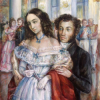
Natalia Goncharova & Alexander Pushkin
Compatibility: Three of Diamonds & Six of Clubs
Famous Gemini People
Discover famous Gemini people, from actors and musicians to writers, athletes, and historical figures. Explore their birthdays and biographies, and see who shares the Gemini zodiac sign.