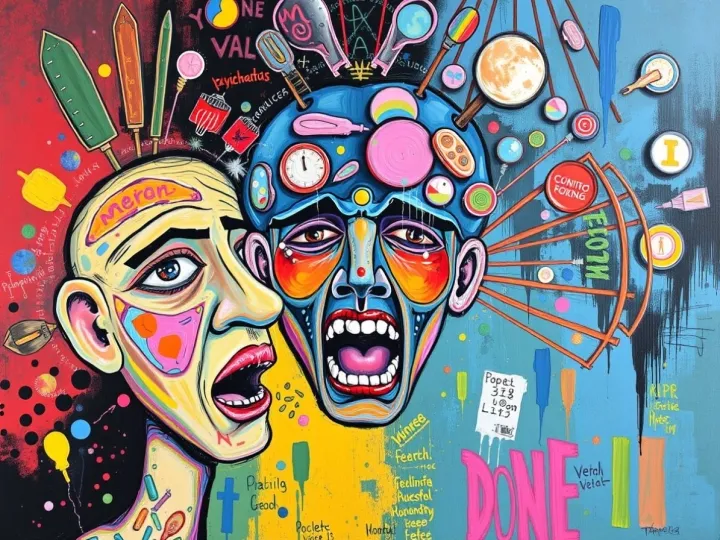
Paranoid thoughts - suspicions that others are hostile, watching, or conspiring - are not limited to clinical psychosis. They exist on a spectrum, appearing in the general population as fleeting worries or suspicions. Most fade. But for some, they solidify into distressing, persistent patterns.
Researchers Paulina Bagrowska and ?ukasz Gaw?da at the Polish Academy of Sciences investigated how paranoia grows by looking at its moment-to-moment dynamics. Instead of relying on questionnaires alone, they used the Experience Sampling Method (ESM): 175 adults carried smartphones for seven days, reporting multiple times per day on paranoia, feelings of rejection, negative affect, body image, social stress, and misophonia symptoms.
Mapping the Networks of the Mind
Using temporal network analysis, the team mapped how these variables influenced one another across time. Results revealed a self-reinforcing cycle:
- Paranoid thoughts predicted increases in negative affect, feelings of rejection, and negative body image.
- Paranoia itself was predicted by feelings of rejection and reduced social safety.
- The most striking finding was a bidirectional loop: social rejection fed paranoia, which in turn heightened perceptions of rejection.
Contemporaneous and between-subject networks confirmed this pattern, showing that paranoia consistently clustered with rejection, negative emotions, and lack of safety.
High vs. Low Paranoia
The sample included a low-paranoia (LP) group and a high-paranoia (HP) group. While both showed links between rejection and paranoia, the HP group displayed stronger and more numerous connections. Their network was denser, with paranoia linked not only to rejection but also to negative affect and social stress.
This suggests that paranoia may not arise from a sudden structural change in the psyche. Instead, it develops through gradual reinforcement of connections between symptoms - a tightening web where every rejection fuels suspicion, every suspicion fuels rejection.
Vulnerability Factors
The study also examined newer vulnerability factors. Negative body image and misophonia (extreme sensitivity to certain sounds) were tied to paranoia, particularly in high-paranoia individuals. Misophonia, for instance, may make ordinary social interactions feel hostile, feeding into the perception of danger.
Together, these findings show that paranoia emerges not from a single cause but from interconnected vulnerabilities: fear of rejection, fragile self-esteem, emotional reactivity, and heightened sensory sensitivity.
The Cost of Rejection
The discovery of a rejection - paranoia feedback loop has direct clinical implications. Early interventions - whether through therapy targeting rejection sensitivity, building social safety, or reducing negative affect - could disrupt the cycle before paranoia becomes entrenched. As the authors note, paranoia is not just a belief but a dynamic system. Changing one part of the system may unlock cascading improvements across others.
Reflection
This research reminds us that paranoia is not born in isolation - it is born in relationship. When rejection is felt, even small, it can echo through the psyche, altering how the world is perceived. The suspicious mind is not simply irrational; it is often the mind of someone who has felt unsafe for too long. Recognizing this opens a path to compassion. By addressing the pain of rejection early, we may prevent suspicion from hardening into a worldview.